By Esther Onyegbula
Sylvester Asoya’s Waiting for Tomorrow is a compelling and thought-provoking narrative that critically examines Nigeria’s sociopolitical landscape. The 283-page book is a mix of personal reflection, political analysis, and historical commentary that explores Nigeria’s long-standing issues of leadership failure, systemic dysfunction, and the urgent need for reform.
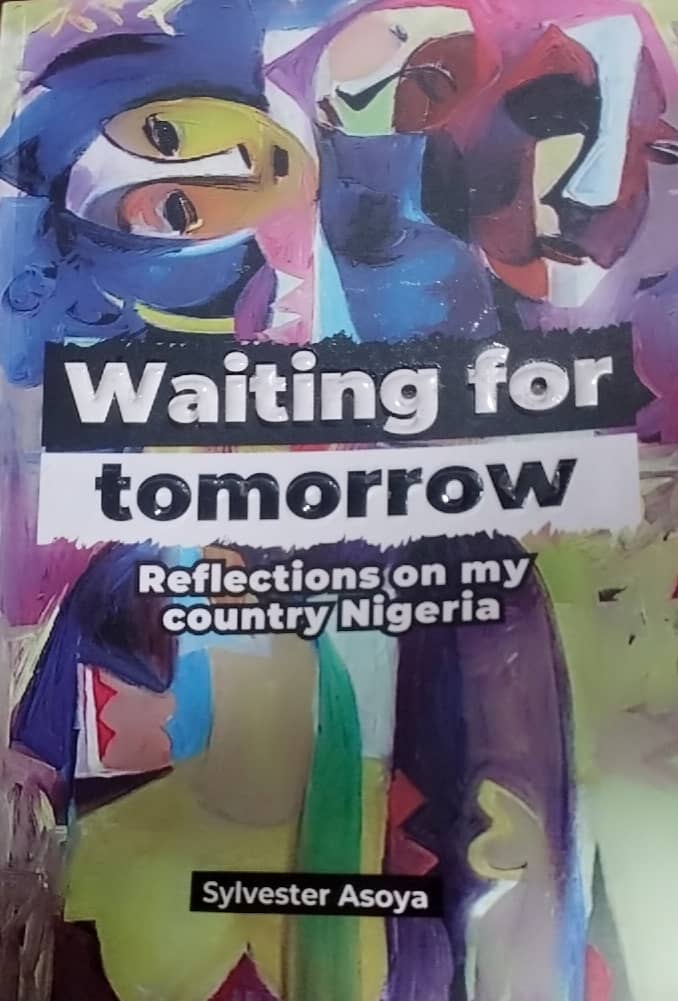
At its core, the book argues that Nigeria is a nation in perpetual flux, stuck in a cycle of poor governance, corruption, and societal stagnation. Asoya does not shy away from confronting the uncomfortable truth: Nigeria’s problems are rooted in a self-serving political elite that prioritizes personal gain over national development. He laments that despite the country’s vast potential, leadership vision remains absent, leaving the people disillusioned and the country on the brink of collapse.
One of the book’s most striking chapters, Our Tragic Parallel Fate with the Arabs, highlights how Nigerian politicians exploit ethnic and religious divisions to maintain their grip on power. Asoya sees this as a deliberate strategy to prevent national unity, keeping the masses distracted while the ruling class enriches itself. He also addresses the consequences of this leadership failure, including mass emigration (brain drain), the collapse of public institutions like hospitals and universities, and a general decline in living standards.
Asoya writes with a journalist’s precision and an activist’s urgency. His words reflect both frustration and deep concern for Nigeria’s future. The book reads as an emotional plea, particularly in sections that discuss how many Nigerians, himself included, once held high hopes for change but have since been disillusioned by the continuous decline in governance. The post-2015 political era, in which many believed things would improve, is particularly scrutinized for its continuation of Nigeria’s downward trajectory.
His reflections are deeply personal, and his critique is as much a lamentation as it is a call to action. He credits his courage and fearless writing to his late mother, Bridget Obiageli Asoya, whom he describes as a woman who lived life on her own terms. This influence is evident in the book’s unfiltered honesty and sharp analysis.
One of the most compelling chapters, Nigeria: A Land of Strange Heroes, takes a hard look at how Nigerian society often celebrates the wrong people, politicians, fraudsters, and opportunists, while sidelining genuine change-makers. Asoya argues that true heroes are not those who manipulate the system for personal gain but rather everyday Nigerians who survive despite the odds stacked against them.
That said, Waiting for Tomorrow is not entirely a book of complaints. Asoya also pays tribute to Nigeria’s true visionaries, including nationalist leaders like Dr. Nnamdi Azikiwe, Chief Obafemi Awolowo, and Alhaji Ahmadu Bello. He acknowledges their selfless contributions to Nigeria’s independence and development. Similarly, he celebrates literary figures like Chinua Achebe, Wole Soyinka, and Zulu Sofola, whose works have shaped Nigerian and African intellectual history. The recognition of Sofola as a pioneer in African theatre adds a refreshing gender perspective to the book’s historical narrative.
Another fascinating section, The Scramble for Nigeria, presents a paradox: while Nigerians excel in various fields abroad, their home country remains stifled by incompetence and misplaced priorities. Asoya attributes this to nepotism and the politicization of public offices, where appointments are based on connections rather than merit. He calls for a new political culture that prioritizes competence, national unity, and social harmony over tribalism and corruption.
A particularly strong argument in the book is Asoya’s rejection of the idea that Nigeria belongs to a privileged few. He challenges the “born to rule” mentality that some political figures perpetuate, urging Nigerians to rise up against godfatherism and political entitlement. He asserts, “We cannot leave our politics in the hands of demented people for the reason that politics is superior to every other human activity.” This is perhaps one of the book’s most powerful statements, underscoring the urgency of civic engagement.
Asoya’s writing is fluid, engaging, and persuasive. He blends journalism, political commentary, and personal storytelling to create a book that is both informative and emotionally stirring. The prose is accessible, making complex issues easy to grasp without oversimplifying them. The minimal use of the first-person pronoun “I” in personal narratives is a subtle stylistic choice that allows readers to form their own conclusions rather than being swayed by the author’s direct experiences.
One potential drawback is the book’s structural organization. A thematic arrangement of topics might have made for a smoother reading experience. Since the essays were written at different times, the transitions between topics can feel abrupt. However, this does not detract from the book’s overall impact, as each chapter offers valuable insights.
Waiting for Tomorrow is more than just a political critique, it is a challenge to journalists, media practitioners, and ordinary Nigerians to document their experiences, engage in informed discussions, and take responsibility for shaping the country’s future. Asoya’s work sets a high bar for political journalism in Nigeria, showing that media professionals have a duty to hold power accountable.
This book is a must-read for anyone interested in Nigerian politics, history, and society. It is particularly recommended for students of History, Political Science, Mass Communication, Journalism, and Theatre Arts, but its relevance extends to all Nigerians who seek to understand their country’s struggles and future prospects.
Sylvester Asoya’s Waiting for Tomorrow is not just a book, it is a wake-up call. It exposes the harsh realities of Nigeria’s current state while offering a vision for a better future. By blending sharp analysis with emotional depth, Asoya delivers a powerful message: change is possible, but only if Nigerians take ownership of their destiny.
Disclaimer
Comments expressed here do not reflect the opinions of Vanguard newspapers or any employee thereof.