By Taye Obateru
When rumours and text messages purportedly from the Boko Haram Sect to attack Plateau State started making the rounds towards the end of last year, many residents found them unsettling. What with the antecedents of the sect in different parts of the North.
Many who had no initial plans to travel for the Christmas festivities changed their minds and decided to be out of town should the threat become reality. The list was long and had targets like churches, educational institutions, security formations, markets and other public places marked for attack. That the threats were taken seriously was evident in the measures introduced by security agencies, churches and others concerned.
Following the bombing of the United Nations Building in Abuja during which a suicide bomber crashed into the building in a car, the idea of mounting barricades or bumps were introduced in many areas to forestall such an attack. In fact, many churches bought vehicle scanners and metal detectors to discover any attempt to smuggle explosives into their premises.
Some of them also stopped worshippers from taking their bags into the churches. They advised members especially ladies to leave their bags at home and if they decide to carry bags, they are made to deposit them at designated points.
With two suicide bomb attacks, first, at the COCIN Headquarters Compound Church on February 26 and the subsequent one at St. Finbarr’s Catholic Church both in Jos on March 11, more security measures have been introduced in many areas.
The modus operandi of the attackers on the two occasions have forced measures geared towards preventing or allowing unauthorized vehicles from gaining easy access or getting close enough to cause any harm.
Probably taking a cue from the guidelines prescribed by the State Security Council to check any further attack, many institutions have erected concrete dividers used on dual carriage ways to block potential targets of attack.
For example, the turnings into the police headquarters on Joseph Gomwalk Road, the Governor’s Lodge Jishe and some other places have been blocked with the concrete bulwarks. The Main Campus of the University of Jos on Bauchi Road also had some of the bulwarks positioned on some drive-ins around the Administrative Block.
Just last weekend, the road leading to the Jos High Court premises was blocked to traffic from the National Museum end. Metal barricades were also mounted on the one-way road leading to the premises where vehicles are thoroughly checked. Vehicles are also now made to park a little distance away from the court buildings.
In several churches, apart from the mounting of additional or new metal barricades, concrete bumps have been erected along the roads leading to their premises. Drawing an apparent lesson from the attack on St. Finbarr’s Church where the suicide bomber detonated his explosive at the gate of the church when he was not allowed entry, churches now conduct initial security checks away from their gates.
Many of them also no longer allow vehicles into their premises during church services. Last Sunday, many church goers had to park several meters away and trekked into their church premises. Traffic is also now diverted in some churches during their services.

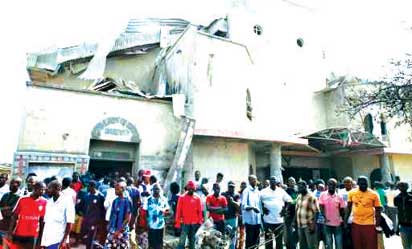
St. Finbarr’s Church, Jos where the suicide bomber detonated his explosive at the gate of the church.
Only church members are allowed to pass through the blocked portion after proper checking. All these measures are in addition to the routine checks by members of the Special Task Force (STF) maintaining security in the state. Many residents describe the diversion or closure of roads, erection of barricades and the stringent security checks in many places as inconveniencing but welcoming in view of the need to forestall further terrorist attacks.
A civil servant, Mr. James Ikara told Sunday Vanguard that it was better to suffer the inconveniences than get killed. “It is a fact that one is facing a lot of inconveniences as a result of these security measures. You are made to stop at many places to open the boot of your car, you are no longer allowed to drive into many places and even some of the roads have been blocked. But these are necessary measures to check these Boko Haram people”.
On his part, a businessman, Ishaya Nanven, lamented that the measures were creating a “siege atmosphere” and increasing the fear of citizens which he said is bad for business. He nonetheless agreed that they were necessary in the prevailing circumstance.
According to him, “we are all living in fear of Boko Haram and nowhere is safe any longer.” However, some other residents argue that beyond the measures, steps should be taken by government and security agencies to rout the sect and debilitate it from carrying out further terrorist attacks.
“One had expected that government and security agencies would have by now got to the root of this matter and solved it once and for all. Since they have arrested some of these people, information got from them should help in routing the sect”, a lecturer who did not want to be named said.
Notwithstanding one’s position of the matter, it remains unequivocal that fear of possible Boko Haram attack is giving many residents of the Tin City sleepless nights. This is also having effects on businesses and recreational activities as people try to avoid crowded places which they fear might be targeted by attackers. To many, a quick solution to the debacle is a daily prayer.
Disclaimer
Comments expressed here do not reflect the opinions of Vanguard newspapers or any employee thereof.