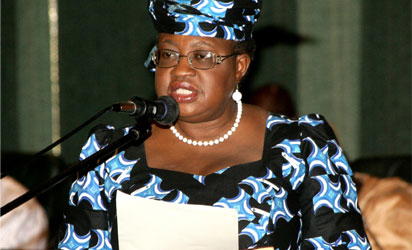
*Finance Minister, Okonjo Iweala
By Adisa Adeleye
As it is being generally said, many factors among which are insecurity and deepening poverty are pointing to the fact that Nigeria is becoming a failing state, but fortunately not a ‘failed state‘ which many enemies of Nigeria prophesied.
The prophets of doom take pleasure in a polity, which is deficiently structured and whose political system is awkwardly operated. The political panorama exhibits one big political party dominating the entire federation and in many of the states and two or three weaker opposition parties scattered among the remaining ethnic units.
In a country still groaning under the incessant atrocities of the dangerous Boko Haram insurgency and still plagued by nefarious activities of kidnappers, armed robbers and ritual killers, the hottest news of the week is the elections of principal officers of a political party, howbeit, the ruling party in Nigeria, and the ‘biggest party‘ in Africa.
The election (or selection) of the delegates to the party‘s convention has not been proved to be free of jeopardy associated with what is regarded in political parlance as rigging or in political philosophy as absolutism of the leaders.
It is a pity that ‘zoning principle‘ which was first introduced into political calculation by the National Party of Nigeria (NPN), and which was adopted by the Peoples Democratic Party (PDP) in recent times has again dominated the political horizon.
The tragedy of our past political history and the current one is the inability of the people to learn, plan and show initiative. It looks as if we have all become slaves of history and political nuisance to ourselves and other nations, who perceive Nigeria as a Giant of Africa.
On one hand, there is a party whose sole aim is to perpetuate itself in power by all means, even if some of these means turn the face of morality upside down. It takes its advantage in the unfortunate lack of unity of purpose and actions of a badly divided and opportunistic opposition parties.

*Finance Minister, Okonjo Iweala
The weak opposition parties have failed to promote a common platform, which is strong enough to offer an alternative rule to the present ruling caste. Thus, the country is faced with the absolute rule of a Big party without responsibility. The present electoral process recognizes among the runners, the first to breast the tape even with only a small majority.
The winner forms the government, nominates its cabinet and set up the machinery of running the government. It does not matter if the cabinet is made up of the mediocre, though conscientious. The satisfaction is that every sector of the party is rewarded.
In a civilized democratic environment where efficiency is the norm and sound administration is recognized, such practice would work until the next election when the people would decide. However, in our environment, the sitting ruling caste would concentrate on measures to retain power rather than be judged by developmental efforts that make for happiness and prosperity of the people.
Many commentators on politics of the developing nations have harped on the danger of one party rule and have advocated a form of government that would take care of a greater number of people, who have voted but have not seen any achievement in the exercise of their civic responsibilities.
They have advocated for the introduction of proportional representative government, which would make the government to represent the interest of all the parties in proportion to their strength. Thus, if a party scores about 25 million votes and the opposition scores about 15 million votes, the government will be formed based on the proportion of votes received. This seems an answer to the ‘winner -take -all‘ attitude of many governments in failing state.
In an attempt to understand and remedy the political instability of Nigeria, the Uwais Commission on Electoral Reform in his report suggested a form of representational voting and also the introduction of an independent candidate in elections.
The ruling party in 2010 because of its selfish motive rejected representational voting and independent candidacy because it thought such might affect its political fortunes. A statesmanship approach would have been to test Uwais suggestion in a referendum of all eligible Nigerians. However, the selfish leadership of the ruling party refused to adopt a sane political approach.
Today, the political atmosphere is polluted by nuances of disunity, ethnic rivalries and individual ambition. Different political parties do exist, but there are no clear cut ideological and economic divide lines. All parties preached democratic principles and the sharing of democratic dividends.
But all portray traits of money mongering and lack of internal democratic tendencies. The pursuits of personnel wealth and individual political hegemony have all helped to affect systematic political development which could transform the polity into a state of peaceful and prosperous co existence.
The lack of political system that recognizes stability and economic prosperity has led to the culture of financial instability borne on the wings of fiscal irresponsibility. Here is a case of a federal structure being run on a unitary machine. The federal government with its appendages – 36 States and Abuja – depend solely on revenue from crude oil.
The emperor sits in his glory in Abuja, and distributes stipends (according to a monstrous formular) to his serfdoms. Strangely, some of the satellite states are now attributing their poverty to the inequitable distribution of the national cake, OIL, being produced in the Niger Delta area.
First, the allocation formular is iniquitous, not because it discriminates against some states, but because it portrays no economic sense. Each state under a federation, should be expected to cater for itself and to contribute to the federation according to its means and to receive from the federation if need be.
A formular that distributes oil revenue to every state without such state contributing anything to its production looks not only silly but senseless. Any distribution of oil revenue should be in proportion to the contribution to its development.
That is why I have suggested in my past writings that the oil industry should be owned by federal government 30%, oil producing states 40% and all other states 30%. The revenue and production cost of oil should be shared accordingly.
Thus, it stands to reason that oil revenue should be devoted to the development of real economic infrastructures and not made the subject of conspicuous consumption (of luxuries) and administrative wastages. Imagine a budget which had 80% of its revenue based on oil and 80% of its spendings allocated to recurrent expenditure. What if there is a disturbance in the oil world market the next day?
Disclaimer
Comments expressed here do not reflect the opinions of Vanguard newspapers or any employee thereof.