By James Agberebi
On the morning of October 20, 2020, Ayobami Salaudeen set out to work in Ikoyi, an affluent part of the bustling Lagos Island. He had just resumed at Arise Television a couple of weeks before.
As a journalist, he was well aware of the #EndSARS protests that had been gaining momentum across the country. Still, he had no idea that the events of that day would become one of the most defining moments of his career.
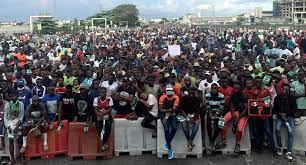
Earlier in the month, thousands of Nigerian youths had taken to the streets in a historic movement against police brutality, demanding the dismantling of the infamous Special Anti-Robbery Squad (SARS). The unit had long been accused of various crimes, including extortion, illegal arrests, and extrajudicial killings.
What began as a call for police reform quickly evolved into a broader struggle against bad governance, resonating with millions who felt frustrated by systemic failures.
On the night of October 20, everything took a dark turn. Nigerian troops opened fire on unarmed protesters at the Lekki tollgate, less than five kilometres from Salaudeen’s office. What had been a peaceful demonstration turned into a bloodbath, sending shockwaves across the country and beyond.
The shooting marked a turning point not just for the protesters but also for the media professionals committed to documenting the truth. The responsibility of covering such a historic yet tragic event fell on the shoulders of professionals like Salaudeen, who found himself deeply affected by what happened.
“It was a traumatic experience for me,” Salaudeen told Vanguard. “Watching the videos of soldiers opening fire on the protesters was bad enough. But having to supervise the coverage of such an experience was as daunting as it was traumatic.”
Despite the emotional toll, his professional instincts took over.
“The professional training kicked in despite the repulsion I felt,” he said. “What was important at the moment was to follow the story, not just because it was our job but because it was important for the story to be told of what truly transpired.”
With millions of Nigerians relying on social media for real-time updates, Salaudeen’s immediate priority was ensuring that Arise TV’s coverage was disseminated swiftly on all the broadcaster’s digital properties.
The broadcaster’s video footage became one of the most widely circulated evidence of the tragedy, solidifying its reputation as a media house committed to speaking truth to power.
“What we were concerned about at that point was to provide a true representation of what was going on at each point in time,” he said. “Ratings were the last thing on our mind, at least mine.”
What is more important for Salaudeen was that timely distribution of content helped disprove disinformation. For instance, the Nigerian Army initially denied that its troops shot at any protesters at the tollgate. But the timely publication of pictorial and video content by the likes of Arise TV proved fundamental.
The army later said only blank rounds were fired to disperse a crowd at Lekki that was breaking a night-time curfew earlier imposed by the Lagos state government.
It was not only governmental institutions that disproved the Lekki events, government supporters also pushed false narratives to counter the evidential videos in circulation.
More than a year after, a commission set up by the Lagos State government to probe the deaths of the Lekki shootings found the army shot and “killed unarmed” demonstrators in a crackdown that could be considered a “massacre”.
For Salaudeen, the #EndSARS coverage was more than just a professional duty; it was a defining moment that underscored the critical role of the media in curbing disinformation while documenting events.
“One of the most important takeaways from the event of that day for me was the fact that timely distribution of content on our media platforms helped curtail the spread of false narratives,” he said.
Disclaimer
Comments expressed here do not reflect the opinions of Vanguard newspapers or any employee thereof.