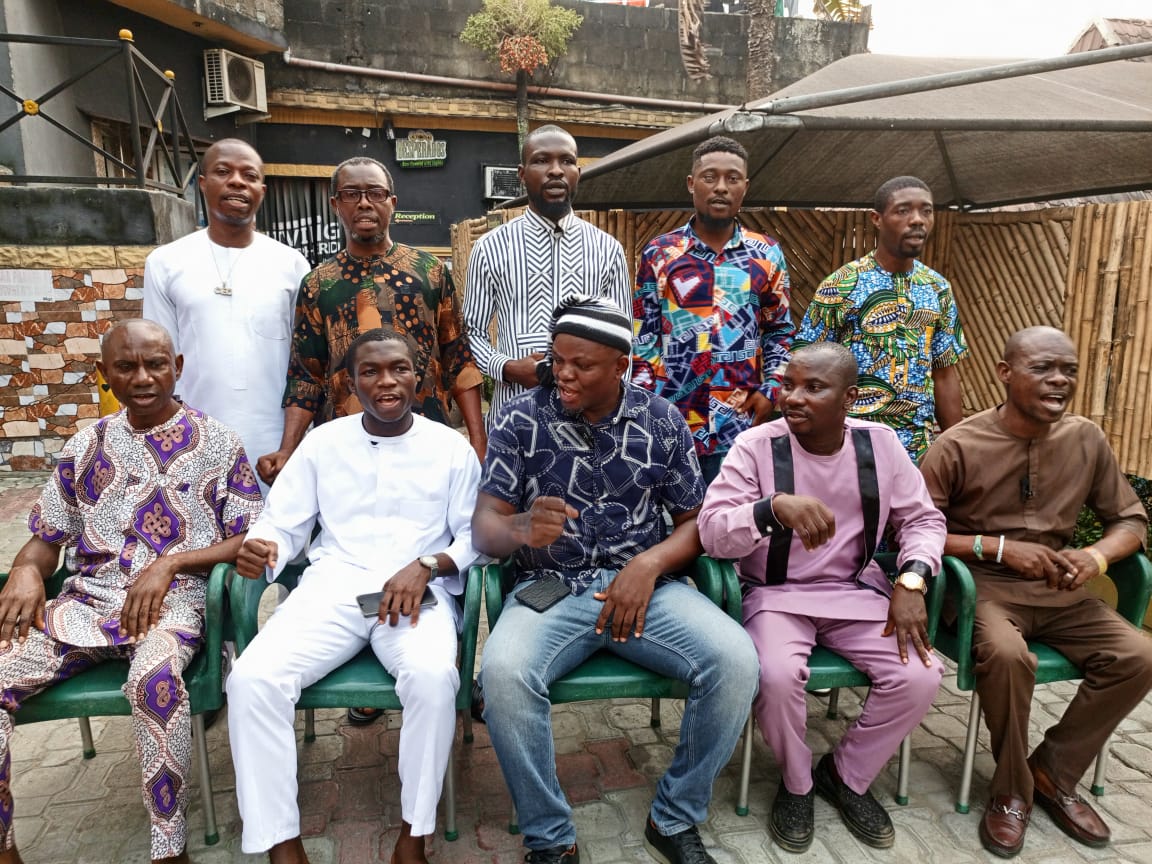
Exco and Members of Indigenous Igbo Council, Rivers State Shortly after an Emergency Meeting Weekend in Port Harcourt. Photo. Nwankpa Chijioke
An Indigenous Igbo Council in Rivers State has faulted claims by Rivers Ijaw People’s Congress that none of the ethnic groups in Rivers is part of the Ndigbo ethnic nationality.
The council in a statement issued by its President, Chimenum Amadi shortly after an emergency meeting weekend in Port Harcourt said it is essential to confront the assertions head on with facts grounded in historical and anthropological evidence.
He said “The Rivers Ijaw Peoples Congress claims that the Igbo are not indigenous to Rivers State, despite evidence showing that the Igbo groups together constitute the largest single majority indigenous ethnic bloc in the State. These claims made by stakeholders of the Rivers Ijaw People’s Congress regarding the ethnic composition of Rivers State are not only misleading but also reveal a dangerous agenda aimed at perpetuating ethnic disunity. It is essential to confront these assertions head-on with clear, factual rebuttals grounded in historical and anthropological evidence.
“It is misleading for the Rivers Ijaw Congress to define the people of Ikwerre, Etchie, and Ogba—who communicate in a single language and share a unified culture—as different ethnic groups while concurrently categorizing the Ijaw groups of Okrika, Ogbia, and Obolo, who speak entirely different unintelligible languages and have distinct anthropological backgrounds, as a single ethnic unit.
“The irony is palpable; it is not only disheartening but also inaccurate to classify the Engenni and Abua people, whose languages relate more closely to those of Isoko of Delta State and Efut of Cross-River State, respectively, as Ijaw meanwhile, the Egbema, Etchie, and Ndoni, who are linguistically homogeneous, are unjustly portrayed as separate.
“This inconsistency and selective interpretation of ethnicity exposes the ulterior motives behind such categorization. The attempts to diminish the Igbo identity within Rivers State and portray its people as fragmented serves a specific agenda. The notion implies that these groups should be viewed as separate entities, thus undermining their collective heritage.
“The reality, as evidenced through historical documents and reports, particularly the Willinks Commission of Inquiry, illustrates the Indigenous Igbo majority within Rivers State. Attempts at balkanization must be recognized for what they are—strategies designed to fracture solidarity and create divisions where none should exist.”
“The entirety of the Igbo nation recognizes Ikwere, Etche, Omuma, Ndoki, Asa, Ogba, Ndoni, Opobo, Ekpeye as part and parcel of the greater Igbo nation. It does not matter which geopolitical space any Igbo group is situated. Igbo is Igbo anywhere State balkanization settles the group. We have noted the calculated efforts to balkanize and sow seeds of disaffection among the Igbo-speaking regions of Rivers State. These actions seem designed to foster animosity toward the South-East and undermine the unity that has historically characterized these communities”.
The President further declared, and read resolution reached by members and Supporters of the Indigenous Igbo Council, Rivers state.
“The renewed quest to align and identify with our Igbo ancestry is purely borne by natives of Ikwerre, Ogba, Ndoki, Ndoni, Etche, Omuma, Opobo, Ekpeye, Asa. Individuals and people from these territories stemming from historical, anthropological and empirical evidence identify themselves as Igbos. If 11 LGAs who are not mutually intelligible in language can come together to claim Ijaws under Rivers Ijaw Congress, the Igboid ethnic groups who are mutually intelligible in language (Igbo) have come to establish The Indigenous Igbo Council of Rivers State.
“Rivers Igbos are the ones agitating and working towards their unity with the greater Igbo nation and not Igbos of the South East. We will continually align with our kits and kins in SE as we owe no one explanation as much as you do not owe us an explanation for identifying with Ijaw.
“We will not hesitate to seek for legal redress if the Ijaws continually malign our right to identify with our Igbo ancestry. Ohanézè Ndígbo is a socio-cultural organisation comprising only Igbo-speaking areas, and so its influence transcends the State borders to areas including Rivers State, where the Igbo are Indigenous. The Igbo people of Rivers State, such as Isaac Wonwu, Chibudom Wuche, Ihunwo Obi Wali, Francis Ellah, Joel Kroham, and Emmanuel Aguma, have been instrumental to Ohanézè Ndígbo.
“Are the RIPC insinuating that an Egbema man in Imo State is an Igbo man but the Egbema man in Rivers State is a distinct ethnic tribe? This is laughable! The Rivers Ijaw enjoy their affiliation and relationships with their brothers in Bayelsa, Delta and Ondo States. They should also allow the Ikwerre, Etchie, Asa, Ndoni, Ndoki, Egbema, Ogba, Opobo and Ekpeye to enjoy their filial relationship with their brothers in the South East.” He said.
Disclaimer
Comments expressed here do not reflect the opinions of Vanguard newspapers or any employee thereof.