By Ike Obiaya
Why do people write autobiographies? Some do it out of a sense of triumphalism. Others do it to leave behind a defence for their own actions. Still others do it because they think their stories are worth telling.
In the case of Maggie, it is a celebration – a celebration of a place – Abule-Oja,Yaba – and of those who, in the words of the author, “grew up around the Seventies, Eighties, and early Nineties in Lagos, irrespective of ethnic affiliation.”
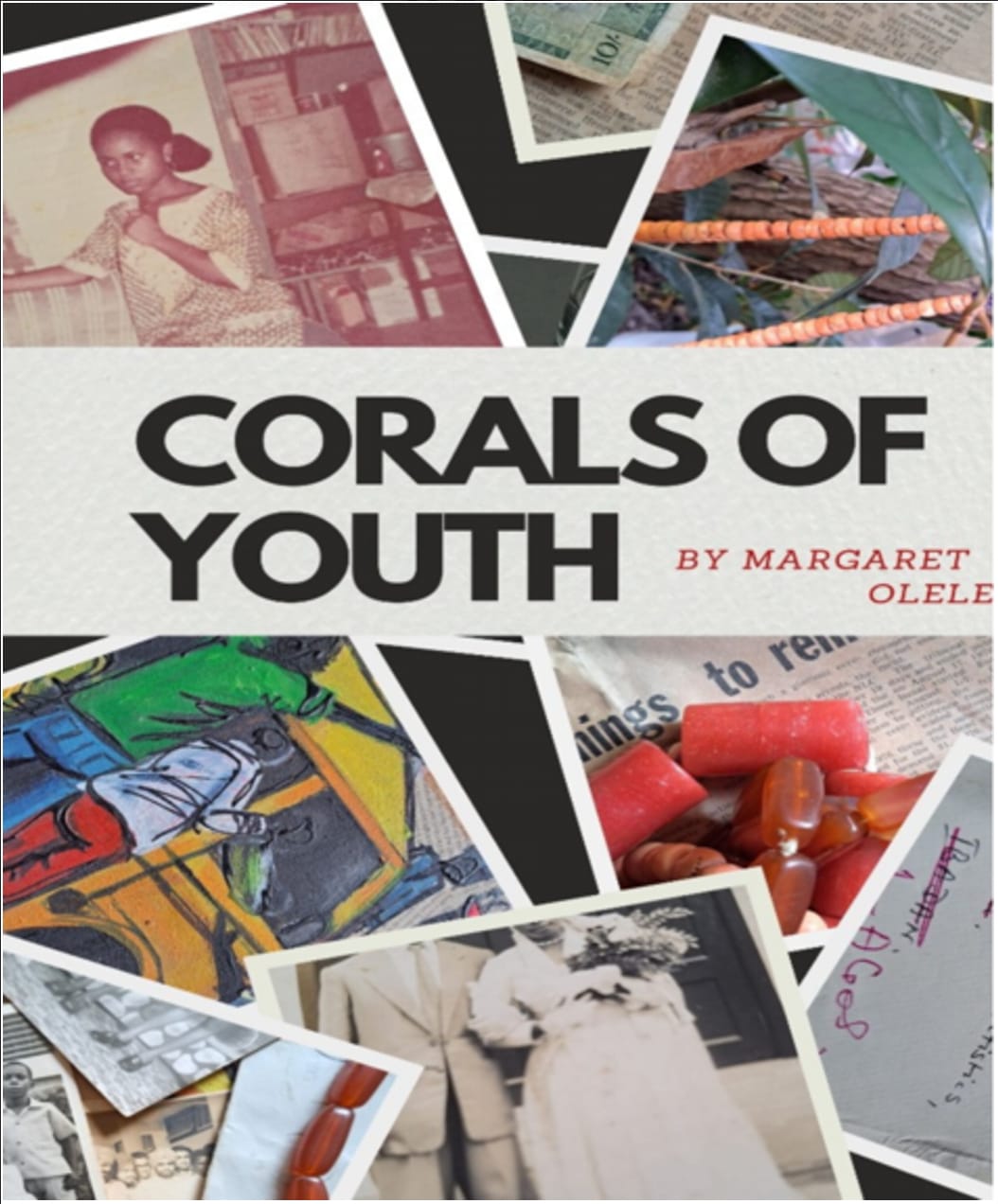
Corals of Youth is a book of ten chapters that cover the first fifteen years, more or less, of the author’s life. The chapters are not of equal length. The shortest is Chapter 7 while the longest is Chapter 10, the last one. (One gets the impression that the author realised that there was still so much more to say and tried to cram as much as possible into the last chapter. Perhaps this is an indication that there will be a part two).
The style is unassuming and familiar; you get the impression that the author is face to face with you just “gisting” as we say. If you know Maggie well enough, you can almost hear her giggle at various points of the text.
I must confess that I marvel at the author’s ability to remember in fine details the various events of her childhood. Some of us can barely remember the things that happened to us last month talkless about the occurrences of forty -fifty years ago.
In Corals of Youth, Maggie has opened and shared with us a treasure chest full of memories. The word “portmanteau” will be very familiar to those of us of a certain age. Back then, rather than suitcases, one was more likely to hear and use the word portmanteau.
And the portmanteau was where the special outfits were stored, one’s bottom-box that only saw the light of day on special occasions. Then, on such occasions, in opening the portmanteau and carefully unwrapping the treasured garments, there would waft forth a rich musty smell enhanced by the odour of camphor with which the garments had been stored to protect them from moths.
Corals of Youth evokes a sense of nostalgia as Maggie carefully unwraps these nuggets of memory and one can almost smell again that rich musty smell of well-preserved treasures, which are achingly familiar for those that lived through those years in Nigeria.
We are all very familiar, I daresay, with the adage that “it takes a village to raise a child. “Corals of Youth demonstrates that a child is moulded not only by its immediate family but by the very society in which it finds itself.
Thus, Maggie weaves into her narrative the different societal events of her years growing up and the impact that they had on her and her family. From the fact of being, as she calls herself, “the child of the Nigerian civil war, born in the year when the war began, “to when she talks about a “forced holiday, thanks to another student demonstration against the government in 1986.”
She reminds us of “the project Operation feed the Nation during the days of Obasanjo as a military ruler in Nigeria,” “the idiagbon/Buhari strike which came as a result of the removal of food subsidy”; the various students’ riots of the military years that led to the author experiencing “The deadly odor of the tear gas from the anti-riot policemen who chased rioting students right into Abule Oja…”, and so on.
The narrative has its highpoints of humour. Take for instance how the author, in chapter three, details the plotting and execution of the “revenge plan” against the girl that had beaten her up:
“We noticed that the adults at the African Church stayed behind after the service for meetings, while the youth and children of the church left for their various homes and so we knew how to get our target. We positioned ourselves in two locations: frontline (advance troop) and back-up almost like warfare.
“At the beginning of the lane – Callistus, Sylva and Anene positioned themselves with sticks – their weapons of war for battle, while Baby, Lizzy and me by Mosuro street awaited our victim. She passed the first team unsuspectingly. As she and her younger siblings navigated the Mosuro curve (we had apparently studied her usual path), I looked boldly at the young lady who was with only three of her siblings. My impish smile spread across my face. I nodded in the affirmative, vigorously too. “Give her a hot slap now!” my cousin ordered.
“As if I needed any prodding, I jumped as high as I could and slapped her, the lure of revenge like the heady warm feel of wine on a cold day. The young lady and her siblings tried to fight back, thinking at this point that it was only my cousin, Lizzy and I. Calli, as we often called him and the rest of the boys moved to the frontline to reinforce the advanced troops (perhaps we can share our success story with the Nigerian Army). The boys, our own second battalion, charged at them with sticks beating off any resistance of our target and her team.
We will not dwell on the violent tendencies of the author; suffice it to say that we are well warned not to cross her. We will also not dwell on the subtle jab she gives to herself in reference to her being vertically challenged when she says, “We ate beans every day though and in the evenings. We were told to eat beans – “it will make you taller” – that was not my portion – unfortunately.”
What truly stands out for me in this book is the emphasis that it implicitly gives to the importance of family, both nuclear and extended. The author speaks of a house that was “overcrowded with uncles and aunties constantly moving in and out,” and tells scintillating tales of her parents, siblings, grandmothers and cousins.
Desmond Tutu is credited with saying, “You don’t choose your family. They are God’s gift to you, as you are to them.” This is exemplified in this book as the author succeeds in conveying the joys of having a strong united family in which, despite the individual strong personalities and the occasional disagreements, the members came together to form a team.
As we get older and have to deal with the challenges of the present times, the past tends to take on a certain aura, and we speak about the “good old days.”As one author puts it, “the past always seems better when you look back on it than it did at the time. And the present never looks as good as it will in the future.” Certainly, it is true that this is not always the case, and the past does contain some pretty horrible things that we would prefer to forget about.
But Corals of Youth brings to mind so many aspects of our social life that we have sadly lost. For instance, the author says, “These were good years when different ethnic groups, religion or class did not define friendship.” “Abule-Oja offered one the opportunity to mix with different ethnic groups; to understand that Efik was a different ethnic group from the Igbos, that Ishans are not necessarily Binis, that other groups besides Igbos, Yorubas and Hausa existed – groups like the Urobos, Ishans, Efik.”
Corals of Youth is indeed a celebration of much that has gone on in the past; but, by gathering these nuggets of the past and inscribing them in the annals of history, the author challenges us to discover where we have gone wrong and to strive to recreate those realities. Corals of Youth is indeed a book worth reading.
Disclaimer
Comments expressed here do not reflect the opinions of Vanguard newspapers or any employee thereof.