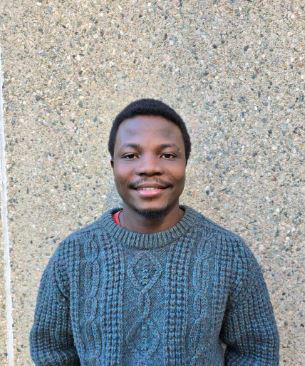
By Ayo Onikoyi
As the global demand for innovation in photonics surges, a rising star emerges in the field: Opeyemi Samson Akanbi, a doctoral candidate at the University of Massachusetts, Lowell, who is carving a niche in integrated and quantum photonics.
Opeyemi’s research addresses critical challenges in photonic integrated circuits (PICs), a field revolutionizing data communication, artificial intelligence, and quantum computing. His recent work on fiber fusion attachment for PICs, detailed in a recently published paper, is gaining recognition in both academic and industrial circles.
“Photonics is reshaping how we process and transmit information, and my work focuses on optimizing the interfaces between optical fibers and photonic chips to enhance system efficiency,” Opeyemi explained.
The paper introduces the use of carbon dioxide (CO2) laser fusion for reducing coupling losses in silicon nitride PICs. Opeyemi’s methodology achieved a measured coupling loss of approximately 2.45 dB per facet for 1550 nm light, setting a benchmark for efficiency in light transmission at optical interfaces.
The potential applications of Opeyemi’s research are immense. PICs are integral to next-generation technologies, ranging from high-speed internet and AI computing to quantum sensors and RF signal processing. One persistent challenge has been creating a robust, low-loss connection between photonic chips and optical fibers. Opeyemi’s innovative approach not only addresses this issue but also ensures efficiency under extreme temperature fluctuations, thereby increasing the reliability of PIC-based systems.
“Reducing coupling losses at the chip-fiber interface is a critical milestone for the widespread adoption of PIC technology,” he noted. “Our use of a CO2 laser for fiber fusion attachment achieved unprecedented results, including a reduction of 0.5 dB per facet in coupling loss and minimal performance degradation after repeated thermal cycling.”
Beyond technical innovation, Opeyemi’s work integrates a novel force sensor into the splicing process, enabling quantitative analysis of fusion conditions. This feature offers valuable insights for optimizing the splicing procedure, particularly for industrial applications.
“The integration of a force sensor ensures precise control over splicing parameters, enabling repeatability and reliability in real-world environments,” he added.
Opeyemi’s academic journey laid a strong foundation for his current success. He earned a Bachelor of Technology in Pure and Applied Physics from Ladoke Akintola University of Technology in Nigeria, graduating among the top 3% of his class. His undergraduate research explored green synthesis of nanoparticles for photovoltaic applications, showcasing his dedication to solving complex problems through sustainable and innovative approaches.
During the early days of his program at the University of Massachusetts Lowell, Opeyemi expanded his expertise to include machine learning and quantum computing, working on hybrid approaches that combine classical and quantum algorithms for pattern recognition and material discovery. His interdisciplinary background in materials science, quantum algorithms, and photonics distinguishes him as a versatile researcher capable of tackling diverse scientific challenges.
“A major part of my journey has been connecting the dots between various disciplines—physics, materials science, and computation,” Opeyemi said. “This interdisciplinary approach has allowed me to contribute meaningfully to fields ranging from photovoltaics to photonics, ensuring my work remains relevant to both academic research and industrial applications.”
Opeyemi’s drive for innovation extends beyond the laboratory. He participated in the prestigious National Science Foundation’s Summer School at the Massachusetts Institute of Technology, where he honed skills in physics-motivated optimization, generative models, and reinforcement learning. “The program reinforced my belief in the power of integrating computational tools with experimental research,” he remarked. His participation in IBM’s Qiskit Global Summer School on quantum computing further underscores his commitment to staying at the forefront of emerging technologies.
Among Opeyemi’s notable achievements is his work on data-driven models for predicting material properties. During his time as a research assistant in Nigeria, he developed machine learning models capable of predicting the heat capacity and bandgap properties of inorganic materials. These efforts have practical implications for accelerating material discovery and optimizing renewable energy devices such as solar cells.
“Science thrives on collaboration and adaptability,” Opeyemi observed, reflecting on his diverse research portfolio.
Opeyemi’s groundbreaking contributions and interdisciplinary approach position him as a leader in photonics and beyond, embodying the innovative spirit required to tackle the scientific challenges of tomorrow.
Disclaimer
Comments expressed here do not reflect the opinions of Vanguard newspapers or any employee thereof.