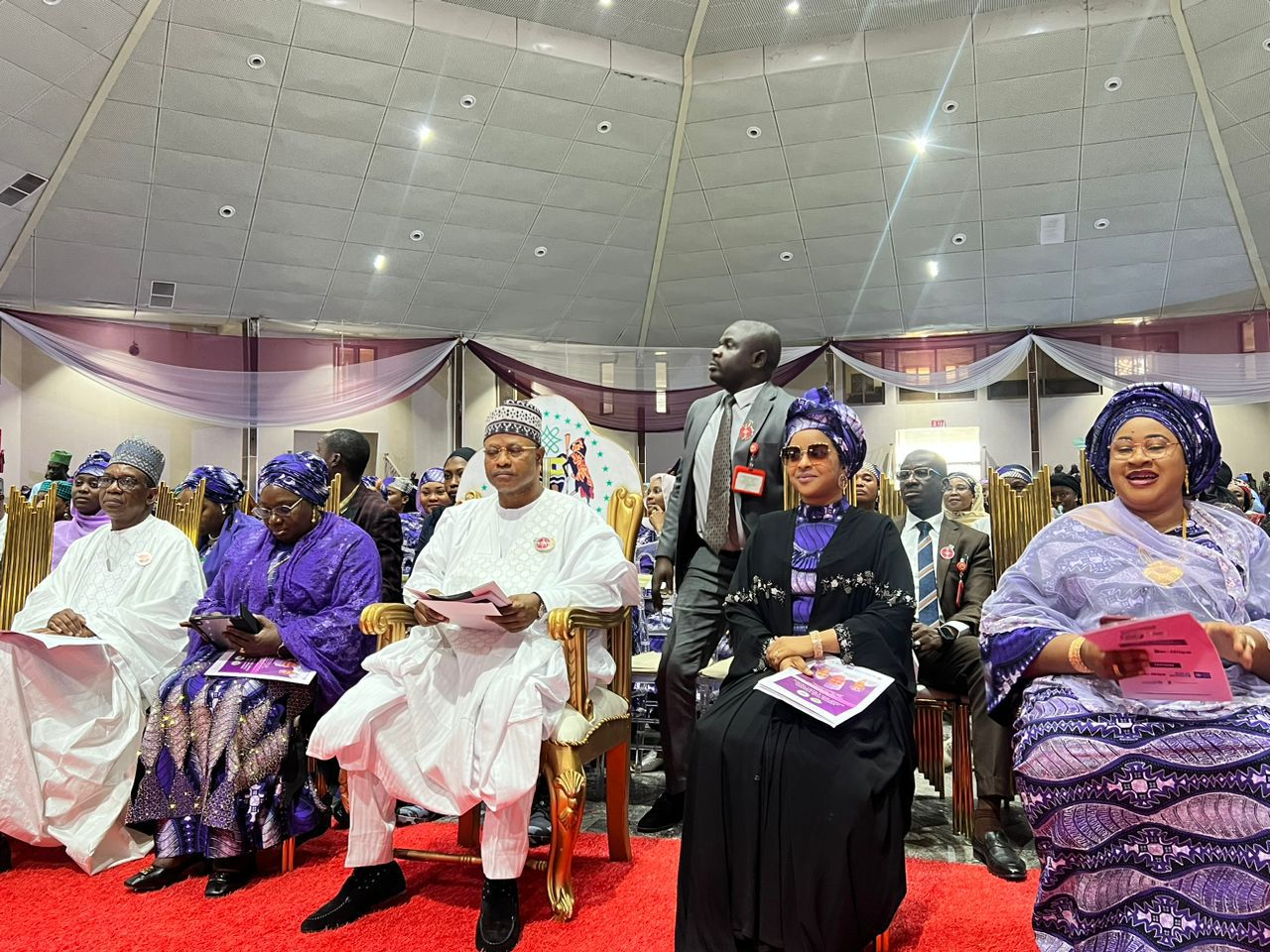
-As DRPC supports 8 other states to domesticate WEE Policy
By Ibrahim Hassan-Wuyo
Governor Uba Sani has described Kaduna State as a beacon of hope for women’s empowerment, youth inclusion and security advancement in Nigeria,insisting that their vision has consistently placed women and youth at the forefront of their development agenda.
He said they understood that women, youth and development thrive in peace, families flourish, communities grow stronger, while their state progresses as a whole.
Speaking during the Kaduna State Economic Empowerment Summit 2024 and Policy Launch on Friday, the Governor told the gathering that the official launch of the innovative and inclusive policies in their state was part of their ongoing commitment to empowering women and fostering gender equality in Kaduna State.
“It is with great pride that I announce the launch of the Kaduna State Women Economic Empowerment Policy, alongside the Women, Peace, and Security (WPS) and Youth, Peace, and Security (YPS) initiatives.”
“Kaduna State has always been a beacon of hope for women’s empowerment, youth inclusion and security advancement in Nigeria. Our vision has consistently placed women and youth at the forefront of our development agenda. We understand that women, youth and development thrive in peace, families flourish, communities grow stronger, and our state progresses as a whole.”
“This policy is not just a document; it is a promise—a promise to invest in the potentials of women and Youths by providing them with the necessary resources, skills, and opportunities to succeed. We recognize that empowering women economically is essential for sustainable development. By fostering entrepreneurship, providing access to education, and ensuring financial inclusion, we are paving the way for a brighter future for all.”
“I would like to express my deep appreciation to all the dedicated individuals, organizations, civil society groups, and government institutions that have worked tirelessly to bring this policy to life. Your commitment and passion have laid the groundwork for what we are here to achieve today.DRPC: Your expertise in policy development has helped shape a robust framework for women’s empowerment in our state.UN Women: Your commitment to gender equality has inspired us and provided the guidance we needed to ensure our initiatives are impactful.Dev Afrique: Your dedication to community development and women’s rights has been a driving force in our collaborative efforts.”
“UNICEF: Your work in promoting the rights of children and women aligns perfectly with our goals, ensuring that we build a brighter future for the next generation.A special thank you goes to our Commissioner of Human Services and Social Development, whose tireless efforts and unwavering passion have been instrumental in bringing these policies to fruition. Your leadership is an inspiration to us all.”
“As we launch these policies today, let us remember that our work is not done. We must continue to advocate for the rights of women and girls, ensuring they have a seat at the table in all decision-making processes. Together, we will cultivate an environment where every woman in Kaduna State can achieve her dreams and contribute to our society.”
“I am calling on private sector partners, development organizations, community leaders, and every citizen to take ownership of this agenda. When women succeed, we all succeed.Let us create a Kaduna State where every girl knows she has the right and the means to dream and achieve, and where every woman knows that she is valued, supported, and celebrated.”
“Today is more than a policy launch—it is the beginning of a journey to reshape the socioeconomic landscape of Kaduna State for generations to come. Let us walk this path together, driven by hope, guided by commitment, and inspired by the knowledge that we are building a brighter future for all.Thank you, and may Kaduna State continue to rise as a beacon of progress and equality.God bless Kaduna State. God bless Nigeria.”
65,848 women have benefited from Kaduna’s Conditional Cash Transfer Scheme – Gov Sani
Governor Uba Sani who launched the Women Economic Empowerment Policy, said that 65,848 women had benefitted from the Conditional Cash Transfer Scheme under his administration,adding that his administration has ‘ramped up the implementation of the Kaduna State Women Economic Empowerment Funds (KADSWEF).
He said, his government has also recorded notable achievements in its Social Investment Programs, adding that, “65,848 women, out of the total 70,051, benefitted from our Conditional Cash Transfer Scheme.”
According to him, KADSWEF is a unique annual support initiative that provides access to financial resources for women.
‘’We provided the sum of N200 million in the 2024 Budget for this Fund. So far, 10,786 women have benefitted from this Fund. Government is set to flag – off the 4.0 tranche distribution to more beneficiaries with women drawn from across women cooperative groups and associations,’’ he added.
The Governor said that his administration has ‘’ trained over 5,000 rural/ semi urban women on large scale rice shelling using modern agricultural techniques in order to increase productivity, high input processing, profit, in addition to reducing labor cost, and improving quality of products.’’
He said that over 120 women and Adolescent Girls have been equipped with various Vocational and Entrepreneurship Development Skills.
Commenting on agriculture, the Governor said the State made history by carrying out the largest free fertilizer distribution in Nigeria and women farmers were key beneficiaries of the exercise, saying that he ‘’approved the distribution of 500 trucks of fertilizer, out of which 240,000 bags has been distributed free to 120,000 smallholder farmers.’’
He explained that his administration is investing in women because doing so is investing in not just in the economy but the future of Kaduna State, adding that that the government is set to intensify efforts in strategic areas towards improving the state’s economic landscape.
The Kaduna State Commissioner of Human Services and Social Development, Hajiya Rabi Salisu, had earlier in her remarks, harped on the socio-economic significance of women and youth in state and national development, pointing out that the Kaduna State Government had recognised and cherished their numerous contributions and would continue to support them.
DRPC Gives Reasons for Supporting States Domesticate WEE Policy
One of the partners in the Women Empowerment Policy, the Development Research and Projects Centre (dRPC) said that, there’s a critical link between women economic empowerment and the prevention of gender-based violence,calling on the state governments across the country to domesticate the National Women Economic Empowerment (WEE) Policy as a key strategy..
Hassan Karofi said that the overarching reason for domesticating the National WEE policy at the subnational level was to serve as a set of principles that guide actions and decisions among policymakers to achieve specific goals of improving the economic well-being of women at that level.
Hassan Aliyu Karofi,Director of Partnerships and Communications, development Research and Projects Centre, Abuja, disclosed that they were supporting eight states—Kano, Kaduna, Borno, Plateau, Kwara, Enugu, Akwa Ibom, and Lagos—to domesticate the policy.
“The National WEE policy is a guidance that provides a framework for decision-making, ensuring that actions, such as budgeting, Annual Operating Plans, etc are consistent with the values and objectives of the state government,” the group stated.
” Many states are at different levels of domestication, with Kaduna State being the first state to do so,” the group stated.
Karofi thanked the Kaduna State Government and “especially the Kaduna State Ministry of Human Services for the opportunity to work together to see this policy’s realisation.”
“I also wish to thank the Ford Foundation under its BUILD Project for supporting this and other interventions to improve Nigerian women’s living conditions.”
“The Drpc is supporting eight states—Kano, Kaduna, Borno, Plateau, Kwara, Enugu, Akwa Ibom, and Lagos—to domesticate this policy. Many states are at different levels of domestication, with Kaduna State being the first state to do so.”
“This is a big kudos to Governor Uba Sani and Hajiya Rabi Salisu for their doggedness and commitment.Already, eleven more states that will meet with us on the 2nd of December 2024 to launch the domestication process in Abuja are joining the journey to improve the lives of women and girls through domesticating the WEE policy.”
“This will make our support for the domestication to 19 states in the first and second phases of the support.
As I said, the overarching reason for domesticating the National WEE policy at the subnational level is to serve as a set of principles that guide actions and decisions among policymakers to achieve specific goals of improving the economic well-being of women at that level.”
“This allows for tailored strategies that address specific local needs and challenges while aligning with the broader national objectives.The intersectionality between WEE policy domestication and implementation and prevention of Gender-Based violence is key to protecting women and girls and improving their economic status.”
“Nigeria has thousands of policies which focus on gender, but there is only one policy on women in the economy – the National Women Economic Empowerment Policy. Of the thousands of gender policies in Nigeria, only one other policy – the National Women Policy, 1999, focuses primarily on women; all others are on gender.”
“The National Women Economic Empowerment Policy provides the most effective framework for tracking how women benefit from the allocation of resources, from release of finances and from access to opportunities in the economy.”
“The National Women Economic Empowerment Policy is Nigeria’s only policy instrument around which a strong economic case can be made for the targeting of vulnerable, at risk and disabled women as well as survivors of violence-against-women.”
“The National Women Economic Empowerment Policy is a Blueprint for sub-national and national development. Women who are empowered economically, will support their family, they will also contribute to their communities and will work for the development of the Nigerian nation.”
“The National Women Economic Empowerment Policy is fundamentally a strong planning tool for coordination of donor programs and for private sector investment in the economy.The National Women Economic Empowerment Policy is a smart way for state governments to bring together all women-focused programs, projects and activities Under-One-Roof to improve coordination, optimize use of resources and avoidance duplication.”
“The National WEE policy is an accountability framework that established standards and expectations, making it possible to hold those responsible for implementable accountable.,The National WEE policy is a regulatory compliance mechanism designed to help in complying with laws and regulations to avoid legal issues and penalties.”
” The National WEE policy is meant to ensure operational efficiency through streamlining processes, reducing ambiguity, and ensuring that operations run smoothly and effectively,”he added.
Hassan Aliyu Karofi explained that empowering women economically strengthens their resilience, reduces vulnerability, and addresses root causes of violence against women.
He commended Kaduna State for becoming the first to domesticate the WEE policy under Governor Uba Sani’s leadership, describing it as a significant step towards improving the lives of women and fostering safer communities. “The intersectionality between WEE policy implementation and the prevention of gender-based violence is key to protecting women and girls while improving their economic status,” he said.
The dRPC is supporting eight states in the policy’s domestication, with 11 more states set to begin the process next month, making the initiative a nationwide movement aimed at transforming the lives of Nigerian women.
Disclaimer
Comments expressed here do not reflect the opinions of Vanguard newspapers or any employee thereof.