By Marie-Therese Nanlong, JOS
The hostilities among communities in Riyom
Local Government Area of Plateau State, mostly between the Beroms who are predominantly farmers, and the Fulanis who are predominantly herders, had lingered for decades and claimed many lives and property in the process.
Read Also: Collapsed mining site kills 13 in Plateau
As a result of the conflict, for over 35 years, Danjuma Dalyop, a Berom farmer from the Rim community of Riyom could not visit Mahanga (a Fulani community) in Riyom due to fear and mutual suspicion.
Indeed, the last time Dalyop visited the community was during his primary school days about 35 years ago. He has never gone to that community ever since and has never looked back given the spate of conflicts and killings that have become the lot of the area in recent years.
The resentment is not peculiar to Dalyop; Fulanis from Bangai also detested the Beroms, especially from the nearby Riyan community.
The bone of contention have been farm destruction and cow rustling, which always trigger tensions and violent conflicts.
But thanks to a new understanding and disposition towards peace as the best option, the situation has changed for the better in the past year as no conflict has engulfed the two neighbours, leading to a peaceful relationship and cooperation with each other.
The prevailing peace and harmony did not come as a surprise but a sustained effort spearheaded by non-governmental agencies, among them, Youth Initiative Against Violence and Human Rights Abuse, YIAVHA, a youth-driven non-governmental organisation.
Unique peace approach:
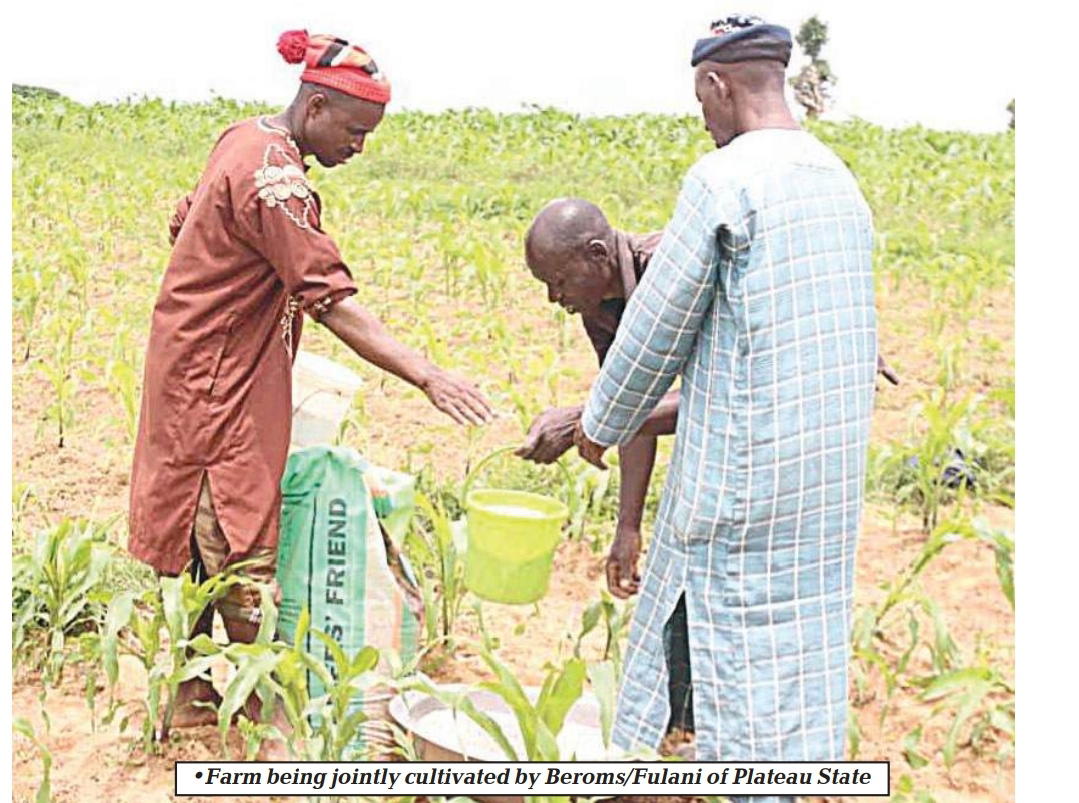
Driving the peace process in Riyom, the organisation adopted a unique approach of having joint farmland cultivation by the Beroms and Fulanis in eight violent-prone communities of Banghai, Riyan, Kwi, Fass, Jol, Mahanga, Ngyelgagare, and Rim.
Dalyop, mentioned earlier, recently returned to the Mahanga community and had meetings with the inhabitants to seek ways the Beroms and Fulanis can move from conflicts to cooperation and sustain the peace process in Riyom.
He said many of his peers doubted if he would ever come out alive from that community and he did.
Hamza Aminu from the Fass community recalled: “The unity we have here is that there are people I have never known or met before, and they are young people like me. Through this farm, I now know their names, have their phone numbers, and we always call each other.”
Idris Muhammad, a herder from the Bangai community added: “When I first heard that an NGO was working to bring both the Berom and Fulani together for joint farming, I thought it was impossible, as it had never been done before.”
Judith Remson, the Monitoring, Evaluation, and Learning Officer of YIAVHA who gave an overview of the project supported by the Knowledge Management Fund (knowledge platform security and rule of law), at the dissemination exercise said the initiative was to build bridges for peace and promote socio-economic integration and cohesion among the farmers and herders.
Her words: “This study project utilized community-based participatory action research to foster socio-economic integration, inter-religious harmony, and ethnic cohesion between farmers and herders.
“By employing a Collective Impact Model and Systems Thinking Analysis, STA, the project aimed at understanding the root causes of farmer-herder conflicts in Riyom LGA because of the persistence of the conflict in that area.
“This project employed the bottom-top approach that involves different stakeholders ranging from community to state and others, all playing a crucial role at different levels of the project.”
Besides the implementation of the joint farming initiatives, she noted there were: “Citizens’ security meetings where series of dialogues were held across communities, intergenerational dialogues, and exchange visits to promote collaboration and open up communities and give young people the space to voice their concerns, local ownership to ensure solutions are community-driven and sustainable.
“The overall goal is to reduce violence, enhance socio-economic stability, and create an environment conducive to long-term peace and coexistence between farmers and herders.”
Findings and recommendations:
However, Choji Pwakim, the Executive Director of YIAVHA who gave the summary of the findings of the research observed, among other things, that most farms are destroyed close to harvest time, at night on Sundays when farmers don’t visit their farms, during prolonged rains, or mostly by underage herders.
He added: “The displacement of farmers and herders has led to increased fear and uncertainty in communities,” among other things. He recommended “the need to implement inclusive resettlement interventions.”
He urged government to “prioritize delivering basic amenities such as schools, healthcare, grading of roads, water, recruitment of teachers to both the farming and herding communities to address perceived bias.”
Earlier, the Chairman of the Board of Trustees of YIAVHA, Professor Patricia Lar; Special Adviser to Governor Caleb Mutfwang (Policy and Governance), Obadiah Afwanks; the State Coordinator of the National Human Rights Commission, Veronica Abe, among others, commended the joint farming approach and unanimously agreed that the concept was well-researched hence YIAVHA should be supported to replicate the model in other communities.
Afwanks stated: “This is pulling down barriers and addressing food security. Without food, the crime rate will increase.”
Disclaimer
Comments expressed here do not reflect the opinions of Vanguard newspapers or any employee thereof.