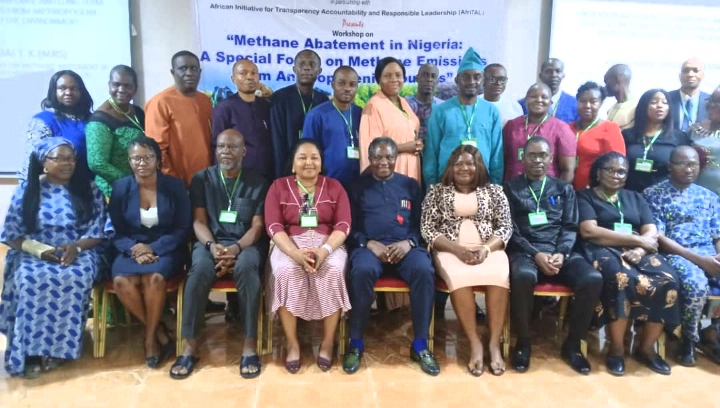
Stakeholders at the Port Harcourt workshop on Methane abatement.
Port Harcourt – GOVERNMENT at all tiers have been urged to lead proactive interventions as organised campaign to tackle methane emissions in Nigeria gathers momentum.
This concern was raised in Port Harcourt, Rivers state weekend during a workshop themed, ‘Methane Abatement In Nigeria: Focus On Anthropogenic Sources’, building on previous gatherings to chart way forward.
Anthropogenic methane emissions are chiefly pollution or environmental changes induced by human activities through unhealthy agricultural or careless waste management practices.
While efforts at methane abatement have been concentrated on emissions from fossil fuel and coal sources for many years, experts warn that largely ignored Anthropogenic emissions are causing as much harm to human health and the environment.
Funded by TrustAfrica, the Methane Abatement initiative is being championed by the Environmental Centre for Oil Spills and Gas Flaring (ECOSGF), African Centre for Transparency Accountability and Initiative (AfriTAL) collaborating with the Stakeholder Democracy Network (SDN) and others concerned.
Dr. Louis Brown Ogbeifun, Executive Director (ED), AfriTAL, noted that methane has been labeled a potent greenhouse gas (GHG) contributing to global warming with emissions degrading the environment and compromising human health if not contained.
Measuring the impact of climate change in a narrative man can relate to, Ogbeifun stated, “Many people are complaining that as the rainy season with flash floods recedes, extreme heat with nocturnal beads of sweat is now occurring, making it difficult to have a refreshing night’s rest when sleeping in a room without air conditioning or a fan.
“Not having recurring, adequate, and relaxing night sleep can gradually lead to sleeplessness, raised blood pressure, low productivity at work, and frequent visits to healthcare facilities.
“It has been stated that over 100 years, methane effects are almost 30 times greater than those of carbon dioxide (Copilot), which makes it an urgent call to action by everybody. Though very useful and naturally occurring in the atmosphere, it becomes hazardous in high concentrations.
“It can cause respiratory tract infections, allergic reactions, increased preterm births, cardiovascular morbidity, and mortality, which will accentuate the risks of stroke.”
Realizing the greater danger as humans continue to inhabit the planet, increase in population, eat and spread waste on the environment, experts at the workshop underscored sustained collective efforts at restoring health of the environment and the air we breathe to promote health of individuals.
Ogbeifun said, “As we advocate for government and corporate organizations to do what is necessary to reduce methane emissions, we must also begin to do our little bits to support the more extensive abatement processes by cultivating habits of recycling our wastes, attitudinal and behavioral changes and advocating regulatory and consequence management measures by the government.
“Livestock farmers should be encouraged to adopt better feeding alternatives with less methane-intensive diets for cattle and adopt technology like aerobic digesters for manure management to turn their waste into wealth.
“Turning waste into wealth should involve collective efforts of governments, corporate organizations, and us, the people. Policymakers should implement policies that incentivize methane reduction while sanctioning destructive environmental behaviors.”
Researcher in biogas digesters, Peter Chukwudi, demonstrated how families, estates or communities can deploy their refuse dumps to generate power and gas cookers.
Soberekon Afiesimama, reflecting on ‘Methane Abatement in Nigeria: A Call to Action’, listed “financial support for methane reduction projects, environmental education, research, regulatory measures and technological innovations, among collective actions needed in Nigeria.”
Christopher Nku, Project Officer, Environment Desk, SDN, said, “While sources from fossil fuels can be detected and quantified, the anthropogenic sources are yet to be quantified. The solution is to create awareness on the release and management of this greenhouse gas to the environment; and to consciously be responsible for our actions.”
Headmistress at the Rivers State University Staff School, Charles Ibifuro, pledged to take the feedback from the workshop back to her place of work, to “educate students on Methane emissions, so they will be conscious of how they interact with the environment.”
Stakeholders left the workshop determined to begin massive awareness campaigns in the oil region to wake the people up and save the environment to save the inhabitants.
Disclaimer
Comments expressed here do not reflect the opinions of Vanguard newspapers or any employee thereof.