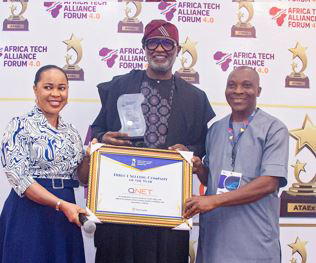
..Wins Afritech’s Direct selling company of year award
By Prince Osuagwu, Hi-Tech Editor
Regional General Manager, Sub-Saharan Africa at direct selling company, QNET, Mr Biram Fall has called for regional collaboration of financial institutions as a way to promote full digital economy in African states.
Fall said this has become more necessary because lack of digital infrastructure and over reliance on cash have frustrated efforts at digitizing Nigeria and indeed African economy.
He spoke at the AfriTech event in Lagos, where his QNET also grabbed Direct selling company of the year award.
According to fall only strong collaboration will break the ranks of paucity of infrastructure in the financial space and dismantle the stronghold of cash attraction on Africans – twin situations which have not let the continent achieve full digital economy.
He said: “Thank you to the AfriTech 4.0 organizers and everyone here today, because your dedication to innovation fuels Africa’s tech growth.
“Today’s theme: Harnessing Fintech Solutions for Financial Inclusion & eCommerce Growth in Africa, speaks directly to the opportunities that financial inclusion and digital solutions bring to economic growth on our continent.
“With over 350 million unbanked adults in Africa, we see an immense opportunity to drive economic empowerment by expanding access to financial tools. According to the World Bank, inclusive access to financial services increases economic resilience and reduces income inequality, crucial for Africa’s socio-economic advancement.
“Financial Inclusion is a key to economic empowerment and it transforms lives. Empowering individuals with basic financial tools like savings accounts, credit, and insurance creates a foundation for economic independence. A report by the International Monetary Fund highlights that when individuals can safely save and borrow, their ability to manage expenses and invest in future opportunities grows substantially, impacting the overall economy. Studies from the Center for Financial Inclusion show that financial literacy and inclusion are key to reducing poverty, improving quality of life, and fostering strong economies across Africa .
Fall highlighted that Africa’s e-commerce sector is projected to reach $75 billion by 2025, driven by rising internet access and smartphone adoption .
However, that while this growth is promising, limited banking infrastructure and a continued reliance on cash remain barriers to full digital economy participation.
He quoted data from the United Nations Conference on Trade and Development (UNCTAD) to indicate that as digital payment adoption grows, it significantly boosts e-commerce and opens new revenue streams for small businesses . Addressing these challenges can unlock unprecedented economic potential.
Tracing QNET’s role in connecting financial inclusion and e-commerce, Fall said: “Financial inclusion is essential to e-commerce growth. Digital payment solutions, such as mobile wallets, make online transactions accessible and foster trust in digital platforms.
“The African Development Bank found that as financial products become more available, consumer confidence in digital payments grows, leading to broader e-commerce participation.
“When secure payment options are accessible, consumers feel empowered to engage in the digital economy, which ultimately drives business growth and community development.
“At QNET, we believe in empowering individuals with knowledge and skills that promote self-sufficiency:
“Through our FinGreen initiative, a financial literacy program, we have already trained over 1,350 young people in Nigeria to make informed financial decisions.
“FinGreen empowers youth and women to achieve financial independence and, ultimately, generational wealth. A 2022 report by FinMark Trust supports that financial literacy programs targeting youth and women effectively bridge knowledge gaps and reduce financial exclusion .
“Through Direct Selling; our e-commerce-driven direct-selling model provides opportunities for income generation across more than 100 countries, helping individuals pursue their goals while contributing to community growth.
“According to the World Federation of Direct Selling Associations (WFDSA), direct selling models have proven effective in low-income regions, promoting entrepreneurship and self-sufficiency by reducing dependency on traditional employment” .
On fostering collaborations, Fall said: “True progress requires a collaborative approach. QNET champions partnerships across sectors to create lasting financial inclusion. Together, we can support innovation and build a future where financial tools are accessible to all, fostering a financially inclusive Africa. The World Economic Forum emphasizes that cross-sector collaboration is essential for tackling Africa’s infrastructure gaps and delivering financial services to underserved populations .
“At QNET, our commitment to harnessing technology and forming partnerships reflects our mission to create lasting impact within communities. Let’s work together to make financial inclusion and e-commerce cornerstones of progress across Africa” he added.
Considering the impact QNET has made both in the technological and financial economies, organisers of the AfriTech bestowed the organization with Direct Selling Company of the Year award.
Co-Convener, AfriTech 4.0 , Chike Onwuegbuchi, says the award was to recognize impact of QNET in the sector, spur it to do more and to incentivize others to borrow a leaf from its corporate strategies.
Disclaimer
Comments expressed here do not reflect the opinions of Vanguard newspapers or any employee thereof.