By Rita Okye
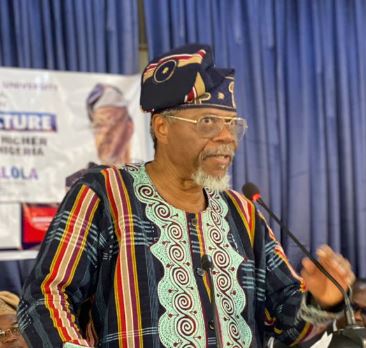
Distinguished historian and university administrator, Professor Toyin Falola has identified incessant industrial actions, lack of pedagogical excellence, among others, as the major challenges facing Nigerian universities, noting that it had become crucial for the nation to arrest these challenges if the nation’s public universities would be the desired destinations of higher learning.
He made this call while delivering the 2024 Open Lecture of the Faculty of Education, Olabisi Onabanjo University, Ago-Iwoye, Ogun State, on Monday.
Falola stated that these challenges have led to the breakdown of societal order and the disconnect between education and cultural development. According to him, “it should be noted that education, specifically tertiary or higher education, serves as the repository of Nigerian cultural heritage; therefore, any gap or disconnect in education would affect that linkage.
“One of the several challenges is the recurrent tussle between the Nigerian government and the Academic Staff Union of Universities (ASUU) on the development of this sector. Various opinions have advanced on this challenge, arguing for and against ASUU. The contention between the government and ASUU has undoubtedly affected the nation’s higher education and public universities. In many instances, the Union has accused the government of not living up to its expectations regarding higher education development and has carried the sole responsibility of ensuring that the latter lives up to its mandate. It should be added that the perennial contention between the duo results from demands such as adequate funding.
“To drive home their demands, the Union often resorts to strike actions that have negatively hampered the higher education system and led to the swift erosion of public sympathy about what the Union represents. This has led to the broader accusations that the Union is also responsible for the decay of this tier of education. This has been widely acknowledged, in some circles, as a valid argument, especially as the body has no other effective strategies besides the cyclical strike actions, which have generated minimal results in recent years.
“If anything, the government has been largely successful in the nationwide negative image of the Union. It is further instructive to foreground that the recurrent industrial actions often lead to a knowledge gap, mainly as universities hastily conclude academic calendars upon resumption in desperate attempts to begin on a new terrain. It should also be added that these actions eventually lead to the production of half-baked graduates because disruptions have hampered knowledge dissemination and production in the name of fighting with the government for better welfare.”
He also fingered a lack of pedagogical excellence as a major challenge in Nigerian universities. “It is important to note that public varsities in the country have experienced an influx of lack of qualified lecturers who often get the job based on what is now known in Nigerian famous lingo as connections. This lack of pedagogical excellence has grossly affected knowledge production in the universities. With the lecturers failing to grasp their field of study adequately, the students are left with no choice but to become half-baked. The proliferation of these unqualified lecturers again foregrounds the corruption in the higher education sector, where degrees and professional certificates can be bought,” he noted.
Falola argued that political interference also remains one of the undoings of Nigerian universities. He opined that the Nigerian political system is complex and complicated, creating several problems with far-reaching impacts, and the higher education system in Nigeria is no exception. “One major political challenge to look at is inadequate funding. This challenge affects higher education, and the whole education sector is underfunded. The effect is more apparent in higher education because many Nigerians cannot afford private universities and go for underfunded public universities. The government’s inability to fund higher education is not encouraging the growth of higher education, as staff are underpaid and often not paid regularly. These hamper them from doing their job adequately.
“The Nigerian government has refused to adopt the UNESCO funding formula for the education sector, which Nigeria is lagging in, causing the quality of higher education in Nigeria to deteriorate rapidly. The inadequate funding of the education sector can also lead to an increase in the fees of public universities, making the students bear the cost of their education since the funds made available by the government are not enough. Also, inadequate funding will cause a staff shortage and equipment necessary to give quality education. The education sector is one of the few sectors in Nigeria not getting the budget it deserves for several political reasons ranging from bad leadership and corruption at the government and university education levels,” he said.
Professor Falola equally bemoaned infrastructural deficit in the nation’s public universities, acknowledging that this has created a gap between where the nation is educationally and where it ought to be. According to him, “standard and adequate infrastructure are needed to facilitate the teaching and learning process. Most government-owned universities do not have the complete infrastructure that proper 21st-century universities should have.
“Infrastructure like lecture halls, classrooms, hostels, laboratories, research rooms, libraries, ICT centers, good road networks, WIFI, and many others should be readily available to enhance learning in the Nigerian higher education system. 2 Besides architecture and buildings, technology is another crucial infrastructure lacking in Nigeria’s education. There are no classrooms with the appropriate technologies, projector, stable electricity, inadequate teaching, nonteaching staff, and sometimes no public address system to address a large class. Also, lecture halls are often overcrowded, which has consequences for the future of higher education in Nigeria.
“Giving schools and colleges all the proper infrastructural facilities will make them run without any troubles or drawbacks; it will help students to concentrate on their learning. Today’s many studies prove that students who were taught in properly maintained classrooms perform better in academics than those who were taught in a classroom with poor structures. Proper infrastructure will help students learn better because access to appropriate facilities, such as functional labs, computer systems, or clean learning spaces, can reduce concentration, engagement, and academic performance.”
Disclaimer
Comments expressed here do not reflect the opinions of Vanguard newspapers or any employee thereof.