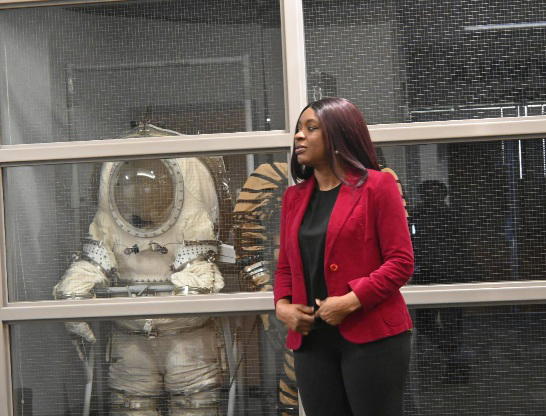
By Ene Susan Ajonye
As the world celebrates new milestones in space exploration and technology, there is a growing realisation that women play pivotal roles in this once male-dominated field. Women are increasingly at the helm of cutting-edge space projects, from engineers to astronauts, data scientists to mission directors. But, as we look deeper, questions arise: How far have we come regarding gender equality in space technology? And what more needs to be done, particularly for women in Africa?
A Historical Perspective: Women Breaking Barriers
Historically, the contributions of women in space technology have been groundbreaking, yet often underappreciated. Several pioneering women have made significant contributions to the field, often working behind the scenes to advance space exploration.
Katherine Johnson, a mathematician whose calculations were critical to the success of early space missions, worked at NASA from 1953 to 1986. Her work on trajectories for the Apollo missions helped the U.S. achieve one of the greatest milestones in human history: landing a man on the moon. Despite the challenges of working in a male-dominated and racially segregated environment, Johnson’s legacy is now celebrated as one of NASA’s most important contributors.
Margaret Hamilton, who led the development of the software used in the Apollo missions, served as Director of the Software Engineering Division at MIT Instrumentation Laboratory during the 1960s and early 1970s. Her software development work ensured the safe landing of Apollo 11 on the moon in 1969, and she is now recognised as a pioneer in computer science and software engineering.
In 1963, Valentina Tereshkova became the first woman in space, shattering the notion that space travel was exclusively a male pursuit. Aboard Vostok 6, Tereshkova orbited the Earth 48 times, paving the way for women in space exploration. Her groundbreaking flight in the Soviet space programme remains a symbol of women’s potential in space.
These trailblazing women set the foundation, but today’s landscape for women in space technology is both promising and challenging. Women’s participation has grown significantly, but there is still a need for greater representation in leadership roles and technical positions.
Women in Space Today: Leading the Charge
In today’s space industry, women are making strides in various leadership and technical roles. For example, Ellen Stofan served as NASA’s Chief Scientist from 2013 to 2016, where she helped guide the agency’s scientific direction and played a key role in shaping the Mars exploration strategy. Her leadership demonstrated the value of women at the highest levels of decision-making in space exploration.
In the private sector, Gwynne Shotwell has been the President and Chief Operating Officer (COO) of SpaceX since 2008. Under her leadership, SpaceX has achieved remarkable milestones, including the development of reusable rockets and missions to the International Space Station (ISS). Shotwell’s role at SpaceX underscores the significant contributions women are making in commercial space endeavours.
Women are also making historic strides in space exploration itself. Christina Koch, an astronaut with NASA, set the record for the longest continuous time spent in space by a woman during her 2019-2020 mission aboard the ISS, staying in orbit for 328 days. Koch’s mission contributed valuable data on long-duration spaceflight, which is crucial for future missions to Mars.
Additionally, Mae Jemison, the first African American woman in space, made her historic flight aboard the Space Shuttle Endeavour in 1992, breaking both racial and gender barriers in one of the most prestigious scientific fields.
Challenges for Women in Space Technology in Africa
While women across the world face significant challenges in the space sector, these hurdles are often amplified for women in Africa. Despite a growing number of African space initiatives, including Nigeria’s space programme, the challenges faced by women aspiring to enter the field are substantial.
1. Lack of Access to Education and Resources
In many African countries, women and girls have limited access to quality education, especially in science, technology, engineering and mathematics (STEM) fields. Societal expectations and traditional roles often discourage women from pursuing technical careers, leaving them underrepresented in key sectors like space technology. Even those with an interest in STEM may face financial barriers or a lack of institutional support.
2. Gender Bias and Cultural Norms
Deep-seated gender biases and cultural norms remain a significant barrier for women in Africa. Women in science and technology often encounter discriminatory attitudes that suggest they are less capable than their male counterparts. This bias extends into workplaces, where women are sometimes overlooked for promotions or high-level roles, despite their qualifications and experience.
3. Lack of Mentorship and Networking Opportunities
Women in Africa aspiring to build careers in space technology often lack access to mentors and professional networks that can provide guidance, opportunities, and support. Organisations like Women in Aerospace and Women in Space play crucial roles globally. However, there is still a need for more region-specific support systems that can help African women navigate the unique challenges they face.
4. Limited Representation in Leadership
Women remain vastly underrepresented in leadership positions within African space agencies and scientific institutions. This lack of female role models in leadership can discourage young women from pursuing careers in space technology, as they see few examples of success they can aspire to.
NASRDA’s Role in Empowering Women in Space Technology
The National Space Research and Development Agency (NASRDA), Nigeria’s flagship space agency, has played a significant role in advancing space technology across the country. NASRDA encourages women’s participation in key scientific and technical roles, focusing on climate change, environmental modeling, and satellite technology. Through initiatives such as mentorship, training programmes and workshops, NASRDA has provided a platform for women like myself to grow and contribute to national projects. However, challenges still exist. More efforts are needed to support women in rising to leadership roles and gaining access to high-level technical training. NASRDA’s continued investment in women’s development will be crucial for achieving gender parity in Nigeria’s space programme.
Women in Space Groups: Fostering a Global Community
One key driver for increasing female participation in space technology is the formation of organisations dedicated to supporting women in the field. Groups like Women in Aerospace and Women in Space are fostering communities where women can connect, collaborate and mentor the next generation of female space scientists and engineers.
Women in Space is a global initiative highlighting women’s accomplishments in various space-related careers. It aims to increase female visibility in the field by hosting conferences, workshops and mentorship programmes. The organisation is committed to breaking the isolation many women feel in male-dominated fields and encourages networking and knowledge-sharing. It also advocates for the next generation of women through scholarships and outreach programmes to inspire young girls to pursue STEM careers.
These organisations are essential because they help address some of the systemic barriers women face in entering and thriving in space technology careers. By providing mentorship, networking opportunities and platforms for leadership, they create an ecosystem where women’s contributions to space technology are not only recognised, but also amplified.
Looking Forward: Encouraging the Next Generation
Encouraging more women to pursue careers in space technology starts early. There is a critical need to engage young girls in STEM education and dismantle the stereotypes that dissuade them from pursuing careers in science, technology, engineering, and math. Schools, universities and governments must work in tandem to create initiatives that inspire girls to see space as a place where they belong.
It is also crucial to create visible role models. The more we celebrate women like Mae Jemison and Christina Koch, the more young girls can envision themselves in these roles. Representation matters and the stories of these women can ignite the dreams of future female engineers, astronauts and scientists.
Conclusion: Toward a More Inclusive Space Sector
Women have always been an integral part of space technology, even if history has not always recognised their contributions. Today, the role of women in space technology is expanding, but there is much more to be done to close the gender gap, especially in regions like Africa, where systemic barriers are higher. By fostering a culture of inclusion, supporting female-led initiatives and promoting education for the next generation, we can ensure that women continue to play a critical role in humanity’s exploration of the final frontier.
In the future, as we journey to the Moon, Mars and beyond, it is essential that women are at the forefront – not just as participants, but as leaders, innovators and visionaries in space technology.
Ene Susan Ajonye is a Principal Scientific Officer at the National Space Research and Development Agency (NASRDA), Nigeria. With extensive experience in climate modeling and space-based environmental monitoring, she has made significant contributions to the use of satellite technology in addressing climate change and sustainable development. She is also an advocate for increasing the representation of women in space technology and STEM fields and actively supports initiatives that encourage young women to pursue careers in these areas, especially in Africa.
Disclaimer
Comments expressed here do not reflect the opinions of Vanguard newspapers or any employee thereof.