By Ayo Onikoyi
As an aerospace engineering expert, I am addressing a fundamental challenge in aircraft design: understanding the complex airflow dynamics within jet engines.
Traditionally, researchers have measured airflow by placing sensors at the entrance and exit points of the engine. While this method provides some data, it doesn’t offer a comprehensive picture of what happens inside the engine, especially within the custom components that play a crucial role in determining an aircraft’s performance.
During my doctoral research at the University of Cincinnati’s College of Engineering and Applied Science, I recognized the limitations of existing measurement techniques. Computer simulations can offer insights, but they are not always precise, and inserting physical sensors into the chamber can disrupt the airflow dynamics.
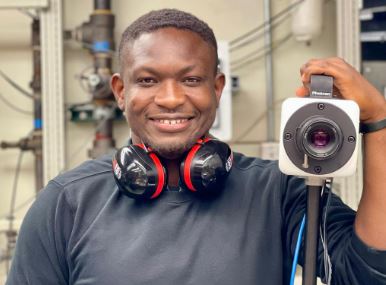
These challenges motivated me to use advanced laser diagnostics and high-speed cameras to capture the intricate airflows within jet engines with often complex internal geometries.
By employing an innovative experimental approach, we can now observe internal airflow in ways that were previously impossible. This method allows us to obtain detailed data that enhances our understanding of airflow dynamics, which is crucial for making incremental improvements in engine performance that can lead to significant fuel savings and enhanced efficiency in commercial aviation. Our project aims to generate high-fidelity experimental data that can be used to refine and validate computational models of airflow. These models have the potential to revolutionize how we design and optimize jet engines.
Understanding the flow field within complex geometries, such as those found in jet engines, involves dealing with significant flow turbulence. This turbulence plays a crucial role in determining the overall airflow dynamics, which must be thoroughly understood to improve engine performance. My aerospace training, combined with my participation in the recent Burgers Program Summer School on Turbulence, has equipped me with the necessary tools to tackle these challenges. The program’s intensive focus on turbulence modeling provided me with advanced techniques that have proven invaluable in my research.
My journey into aerospace engineering was inspired by my uncle, a retired aerospace engineer who worked on NASA’s space shuttle program at Boeing. His stories and photographs of the space shuttle ignited my passion for aerospace technology. My background in mechanical engineering in Nigeria laid the groundwork for my current research, and my experiences have only strengthened my resolve to contribute to transformative aerospace innovations.
One of my career aspirations is to contribute to NASA’s 10-year New Aviation Horizons Initiative, which focuses on developing technology that significantly improves aircraft efficiency and performance. My work on new jet engine designs aligns with these goals and promises to offer insights that could be applied to various aerospace applications.
In addition to my research, I had the opportunity to intern at Tesla, where I helped design experimental protocols to study vibration in the Cybertruck. This experience in advanced measurement techniques has been invaluable, providing me with unique insights into the challenges and potential solutions in both aerospace and automotive engineering.
Our current project is still in its early stages, but I am optimistic about the impact our findings will have on airflow dynamics understanding. The system we developed will not only enhance our ability to predict air flows accurately in complex systems but will also serve as a foundational tool for aerospace companies like GE.
In conclusion, addressing the fundamental challenges of airflow measurement within jet engines is essential for the continued advancement of aerospace technology. Through innovative research and collaboration, we are laying the groundwork for breakthroughs that will shape the future of aviation.
Disclaimer
Comments expressed here do not reflect the opinions of Vanguard newspapers or any employee thereof.