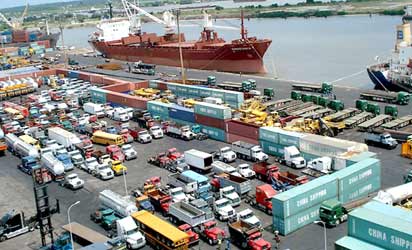
…Sea port
By Martin Nwamadi
In recent years, the global logistics industry has seen a shift towards Port automation in container terminals.
Container terminals in seaports constitute essential connections between sea and land in the global supply chain and this is why they face increasing demand for service that influence the outcome of everyday operation.
Advancing technologies and the demand for efficient and sustainable supply chain solutions are leading Port terminals to increasingly rely on automated solutions that optimize operations, improve productivity and increase competitiveness.
Recently, the Executive Secretary of Nigerian Shippers Council Barrister Akutah Pius Ukeyima announced to stakeholders that 90 percent of port processes and operations have been automated in Nigerian ports. He made the pronouncement during the breakfast meeting organized by the Maritime Reporters Association of Nigeria (MARAN) in Lagos.
He revealed that the automation of the Port process has had significant impact on Nigeria’s economy through increased revenue generation. Also, the cost of doing business in the ports has drastically reduced which has further led to increased trade and investments with a positive impact on the overall economic growth of the nation.
The first automated container port was developed in Europe in the early 1990s.Sequel to the above, port managers had to adopt automation so as to drive and meet global competition. Automated ports are safer than conventional ones as number of human-related disruptions is low while performance becomes more predictable. A digitally operated ports generates more value for Port operators, suppliers and customers Alike. they generate vast amounts of processed data that aids in planning.
McKinsey, a global agency conducted a survey which showed that automation of ports has become a trend. In that survey,80 percent of the respondents expect that at least half of all Greenfield port projects will be semi or fully automated while 35 percent believe that the proportion of automated ports will rise above seven in ten.
Automation of Nigerian ports gained traction in the year 2020 when the former ES/CEO Nigerian Shippers Council Hassan Bello began a campaign that for Nigerian ports to be competitive, we must embrace automation of the Port process. As our ports continue to face challenges of globalization, and increasing scale and utilization of vessels, we must continuously look for ways to improve efficiencies. To achieve growth, shipping companies and Port operators must look for smarter ways to deliver against those expectations.
The target was that by the last quarter of 2020, all port processes should have achieved 90 percent digitalization. According to Bello, most of the ports in the world are digitized and Nigeria cannot be an exception. We cannot have a multitude of people going into the ports every day, human contact in the ports is very dangerous as it breeds corruption.
Statistics available on the level of digitization achieved by shipping companies as at last quarter of 2020 showed that Grimaldi has achieved 88 percent, Ocean Network Express 76 percent, CMA/CGM 63 percent while the seaport terminals like PTML achieved 92 percent and Intels, BUA, WACT achieved 70 percent each.
Emphasizing how automation promotes cleanliness in the port environment, Managing Director of Grimaldi Shipping Asconio Russo said that all aspects of the clearing process in his company from the arrival of the vessel, through filing of document, payment of duty and taking delivery of the consignment have all been digitalized. “If you want to pay for your duty, there is an option to do it online. All our clients are electronically registered in our database. Our processes are real time online,” Russo admitted.
Maritime industry is Nigeria’s economic centre of gravity and one of the most important sub-sectors is the port industry which has a huge competitive advantage. In fact, if our ports are well managed and duly automated to become smart ports, it has the potential to attract cargo from other Sub-Sahara countries. Nigeria’s total annual freight cost is estimated at between $billion and $billion and this places Shipping at the very heart of the country’s economic growth.
Furthermore, it is estimated that maritime sector handles over 95 percent of our international merchandise trade, with a total trade value reaching N71.9trillion in 2023.As at today, there has been increased vessel turnaround, enhanced cargo dwell time, berth occupancy, speedy cargo delivery, reduced congestion, less human traffic as operations in the ports now are transparent, predictable and consistent in line with International best practices. A better-connected port would invariably bring about a more productive, efficient and effective run ports.
Port automation is an enabler to attracting investments into the economy as processes are unencumbered thereby providing a conducive environment for operators to work. In his contribution Mohammed Mojeed of Association of Nigerian Licensed Customs Agents (ANCLA)said that Port automation has reduced the under-table costs of cargo clearance, illegal financial demands as technology has taken over face to face transactions and negotiations by port operators.
According to Mojeed, since the spear heading of the automation campaign by Nigerian Shippers Council, it has brought about an effective service delivery and expansion of the revenue base of the economy.
He commended the shipping companies and other service providers for their increasing level of digitization, stressing that many shipping companies had increased their level of online services for the process of clearing goods at the ports. “We at the National level of ANCLA, are organizing training sessions for our members to key into the ports automation process “,Mojeed disclosed.
As automation becomes the norm in global maritime competitive edge, the management of Blue Economy must therefore set up efforts to acquire talents and build appropriate opportunities that must create innovative solutions geared towards seamless Port operations.
While demonstrating capacity to build a 100 percent port automation, Akutah stated that his recent tour of shipping companies and terminal operators has again re-assured him that Port processes have achieved unprecedented 90 percent level.
Riding on the crest of this noble achievement that has positioned Nigerian ports to enjoy competitive edge at the global maritime space, the Council boss revealed that the robust revenue generation now is due to the use of appropriate technologies, compact monitoring system that ensures that servers are of optimum service which enhances operational efficiency. “It is heartwarming to all of us that companies and terminal operators have ensured full automation of their processes especially in cargo clearing, payment and invoicing are now mostly done electronically. “This process has drastically reduced the time taken to move a vessel at port from anchorage to berth from 5hours to 90mins for boarding while examination of containers at some port terminals have been reduced from 120 to more than 230 a day.
Another striking feature of Akutah’s burden which is the drive to ports automation is that he is working round the clock to ensure that there is no draw back. He has built a template with stakeholders in the port value system on data formulation, human-machine interface, technical infrastructure to ensure synergy. What is more, Akutah has robust engagement with terminal operators, shipping companies, freight forwarders, Nigerian Customs Service to ensure that systems integration is not compromised for enhanced value as it is a win-win situation.
As we inch into Artificial Intelligence (AI) in the ports, we hope that this achievement will be a steppingstone to heralding AI into the Marine and Blue Economy.
Disclaimer
Comments expressed here do not reflect the opinions of Vanguard newspapers or any employee thereof.