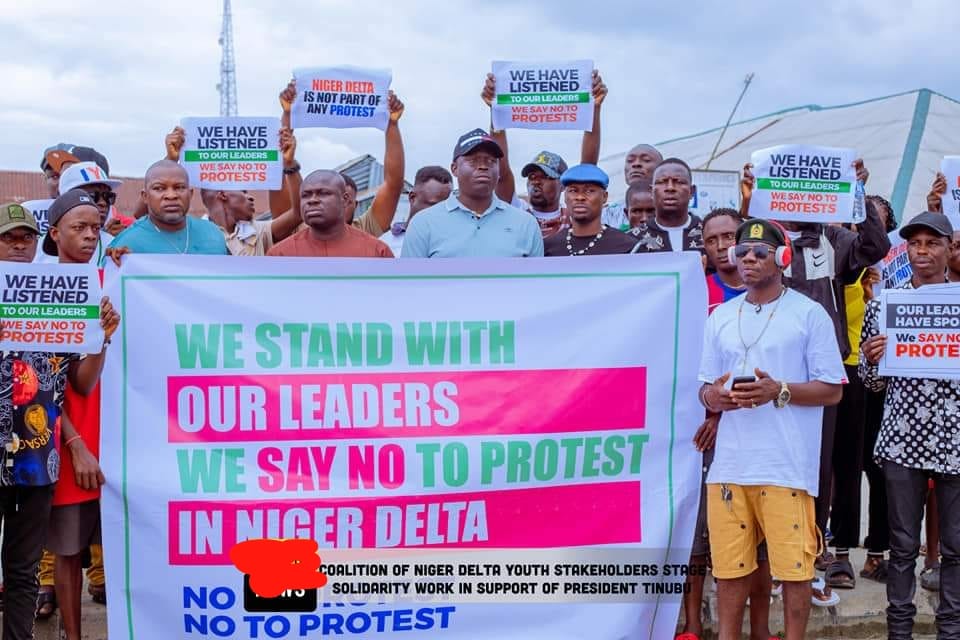
#EndBadGovernance protesters
By Emma Amaize, Regional Editor, South-South; Sam Oyadongha, Jimitota Onoyume, Egufe Yafugborhi, Chioma Onuegbu, Dan Abia, Ochuko Akuopha, and Paul Olayemi
The Federal Government, using the police, other security agencies, and the respective Governors in the South-South region did everything to halt the #End Bad Governance protests that started on Thursday. But the protesters resisted their tactics and overtures.
Meanwhile, follow today’s live updates of the protests on Day 3 HERE.
There were subtle threats and underground moves to deter those who would dare protest, and some known activists were invited by the Commissioners of Police and heads of the Department of State Services (DSS) in the different states.
The Commissioner of Police gave tough conditions to the protesters to allow the demonstration, including the organizers yielding to full disclosure on the assembling point and route of the proposed protest, expected duration of the protest, names and contact details of protest leaders and organizers, and measures to prevent hijack by criminal elements.
On Day One of the protest, security operatives, including the Nigerian Army, Nigeria Security and Civil Defence (NSCDC) Police, and others positioned themselves on the major streets.
The protest gathered momentum on Day Two — Titus, A-Ibom protest leader
While the initial hurdles dampened the force of the protest on Day One, in Akwa Ibom State, by Day Two, the protest by the undeterred populace was already gathering momentum.
Under the platform of “Good Governance Renaissance”, the refrain on the lips of Akwa Ibom protesters is “We are tired of bad governance.”
Jonathan Titus, leading the charge, had said from Day One, “We are in Uyo to make a statement, that Akwa Ibom people are not happy. Today begins the 10-day nationwide hunger protest and we will be here till the last day of the protest.
”It is incumbent on us, the youths, to make it clear to those we gave our mandate to represent us at the local, state, and federal government levels, to address the insecurity and economic hardship in the country. That is why we are here.
”Why is it that travelers can no longer move freely in the country without being afraid of abduction, either by bandits, kidnappers, or terrorists? We have what it takes to make this country a haven for everyone.
”They are giving us palliatives, for how many Nigerians and how long can they feed us with palliatives? They said about 10 trucks of rice were sent to Akwa Ibom. How many people can that feed and for how long? Therefore, we are saying that we do not need their palliative.
”Why are they weaponizing poverty? That is why we are here to make a statement. And we want all the market unions disbanded because their activities exacerbate the cost of food items in our markets.”
Titus explained that they did not embark on street procession to avert hoodlums infiltrating the group to cause violence in the state because of what happened during the #EndSARS protest.
Our leaders are unbothered by our plight — Nta, another protest leader
Another leader of the protesters, George Nta, asserted, “This protest is for people who do not have food to eat and are tired of bad governance. Our political leaders are not concerned about what is happening, and how the poor masses survive.”
How police tried to weaken protesters in Uyo
Every Akwa Ibomites knows that multipurpose Ibom Plaza, once a bubbling business and entertainment hub now turned den of hoodlums and teenage prostitutes by night, remains the focal point of all mass movements in the state.
While the leaders of the #End Bad Governance protest made the multipurpose Ibom Plaza their point of convergence, the Police had a different thought. Convinced that allowing the protesters at the Plaza would spike its force, and impact, they overruled its use for the protest.
Explaining the police attempt to weaken the protest on Day 1, George Nta, one of the leaders of the protest in Akwa Ibom, said, “Initially, the Plaza was announced as the rallying point, but after we met with the Commissioner of Police, last night, he enforced the Cenotaph, along Udo Udoma Avenue on us on the perceived possibility of the protest being hijacked by criminal elements.
”That confused our group members but by Friday, we would have finalized the location. We are tired of bad governance. Remember this protest is not about people who can afford three square meals daily.”
Sen Enang stings Eno
A former presidential adviser and chieftain of the All Progressives Congress (APC), Sen Ita Enang, said under the incumbent governor, the state was receiving triple what came in as monthly allocation under his predecessor.
“This is the best time for APC to take over the state. Akwa Ibom now receives three times, what Mr Udom Emmanuel received as monthly allocation.
“We have seen commissioners resigning to contest local government chairmanship. As far as my knowledge of governance is concerned, being a commissioner and member of the State Executive Council is higher than being a local government chairman.”
He noted that under the previous administration, local government chairmen received far fewer funds, but “no one can see what they (current local government chairmen) have done with the money.
He alleged the commissioners’ move was driven by “greed,” as they want to “feast on the increased money that has arrived in the local government areas.
Gov Eno’s effort to stop protest
Before the protesters stormed the streets on Thursday, Governor Eno, harping on his ARISE Agenda, at a stakeholders’ conference in Uyo, said it would be better if the youths in the state shunned the protest and maintained peace.
He asked: “Should the protest take place here, given our people-friendly disposition, deep and abiding concerns for the welfare of our people, workers in the public service, care for the poor and most vulnerable, intentional concentration of resources to giving hope to the hopeless, and the ARISE Compassionate Homes we have built?
“I appeal, if at all, you will participate in the planned protest, (since youth from many states have opted out), to please do so peacefully. You must ensure that miscreants and hoodlums do not hijack your protest.”
Aside from the governor’s appeal, some youth leaders, CSOs, and others largely perceived as sponsored also spoke against the protest, pledging support to Eno’s administration and resolve of all youths to boycott the protest in the state.
Pocket of protesters defy threats to protest in Bayelsa
Contrary to the fear in some quarters that the #EndBadGovernance protest would overwhelm the security agencies and paralyze socio-economic activities in Bayelsa State, the situation in the predominantly riverine state had been relatively calm, except for the reported attack on the protesters by some hoodlums around the Biogbolo axis of the Melford Okilo Road in Yenagoa, the state capital.
However, checks revealed that a combination of factors helped in taking out the steam from the anticipated mother of all protests, known for its history as the epicenter of youth restiveness in the blighted Niger Delta.
These include the continued engagement of genuine groups such as the Ijaw Youth Council (IYC), student leaders, and other stakeholders on the need to shun the planned protest, the last-minute shuttle to the state by the Minister, Senator Lokpobiri, who also held an interactive meeting at Ijaw House with youths of Ijaw ethnic nationality and others on the eve of the planned protest.
The leadership of the APC also threatened to sanction any of its members who participated in the planned protest. The Minister, during parley, told the youths that other countries in the world have their problems, ranging from inflation, and economic hardship, adding that protest was not a solution to any of those problems.
He also reminded the youths about the #EndSARS protest in 2020 where several properties were destroyed, and people killed, and at the end of the day, the protest did not change anything.
Lokpobiri advised the youths to continuously engage President Tinubu and give him time to work for the good of the region and the country.
While many of the youths, including students from the state-owned higher institutions, who ordinarily would have participated in the planned nationwide backed out, a pocket of protesters still swarmed major roads in Yenagoa to join the nationwide protest against economic hardship, demanding action from the government to end the high cost of living and hunger.
Armed with placards with various inscriptions such as “Restore fuel subsidy”, “Reduce the price of petroleum products now”, “We are dying of hunger in our own country”, “We are suffering so much now” and “We can no longer feed our children”, among others, the protesters whose sponsors remained faceless, marched peacefully through the Yenagoa-Mbiama Road and the Melford Okilo Road, disregarding the morning showers to register their grievances.
Unlike other states completely shut down by the protest, government offices in Bayelsa were opened with civil servants sighted at their duty posts.
There were free vehicular and tricycle movements in Yenagoa and its environs with people going about their normal businesses.
Some shops were not open for fear of the unknown. While some banks were closed for business, others rendered skeletal services to customers through the back door. Also, the Tombia, Okaka, Kpansia, and Swali markets were operating.
At Amassoma in Southern Ijaw Local Government Area of Bayelsa State, the situation was calm as students of the Niger Delta University went about their routine academic activities.
Also, in Yenagoa, a coalition of youths in the state held a solidarity rally commending Governor Douye Diri on his administration’s achievements.
The Director-General of the Prosperity Youth Coalition, Mr. Doubara Kumokou, said Bayelsa was a peaceful state and the group would not allow anyone to disrupt the prevailing peace in the guise of protest.
Checks within Yenagoa and other towns indicate heavy deployment of police and other security agents at strategic locations.
As at the time of filing this report, armed soldiers and police operatives were reinforced at the strategic Edepie Roundabout in the heart of the state capital, which connects communities in Southern Ijaw, Sagbama, Kolokuma-Opokuma, Ogbia, and Nembe local government areas of the state.
Also at the Nigeria Content Development and Monitoring Board, an armored vehicle was stationed in front of the building with security personnel guiding the premises. The same applied to Central Bank of Nigeria premises, and other government facilities in the state capital. At the NNPCL Mega Filling Station, vehicles were seen in a queue for fuel while the whole area was peaceful.
Pro, anti- protest demonstrators lock horns in Asaba
Despite efforts of stakeholders, security operatives, religious bodies, ethnic leaders, and youth groups to disabuse the minds of organizers and youths against participating in the #endbadgovernanceinnigeria protest, aggrieved citizens turned out to express their frustration with anti-people policies of the Federal Government that have led to the hardship and hunger they are experiencing.
Before the commencement of the protest the State Commissioner of Police, Mr. Abaniwonda Olufemi ordered the massive deployment of police officers across the state to forestall the breakdown of law and order.
In the early hours of Thursday, fierce-looking police officers and soldiers were stationed in the Inter-Bua Roundabout, the Chike Edozien State Secretariat, and other strategic locations in Asaba, the state capital.
Patrol vehicles drove around major streets in the metropolis.
It is unclear who spearheaded the protest, various groups of protesters defied the heavy presence of security operatives, and trooped out at about 11 am, displaying placards, and chanting songs of grievance.
Some anti-protest groups were also present during the protest, particularly the Inter-Bua Roundabout where they manhandled some journalists, who wanted to take their photographs and interview the protesters.
The police, however, dispersed the protesters with tear gas at the Inter-Bua Roundabout with the police commissioner, Abaniwonda Olufemi, saying that they were uncoordinated.
“If you look at what happened in Asaba, innocent citizens are being assaulted and forced to join the protest. Protest is supposed to be a voluntary thing, but if it comes that people are being coerced to join, then, it is no longer peaceful, therefore, the Nigerian Police has to ensure that this is peaceful,” Olufemi said.
The Police Public Relations Officer of the State Command, Mr. Bright Edafe, said about eight persons were arrested at various locations across the State.
Commercial activities were grounded in the metropolis as shops, petrol stations, banks, and other businesses were shut down for fear of hoodlums invading the shops to loot and vandalize properties.
As of noon on Friday, there was normalcy in Asaba with no group of protesters yet to be seen in the state capital. Commercial activities were in full swing in the metropolis, and security operatives positioned themselves in strategic areas.
The governor, Sheriff Oborevwori expressed delight with the peaceful manner Deltans conducted themselves across the State.
Oborevwori, in a statement by his Chief Press Secretary, Sir Festus Ahon, said: “My dear youths of Delta, I thank you for the way and manner you organized yourselves today. ”
“We are aware that Section 14(2) (b) of the Constitution of the Federal Republic of Nigeria 1999 provides that the security and welfare of the people shall be the primary purpose of government. We shall continue to protect the lives and property of our people.
“As a state government, we remain committed to the ideals of good governance anchored in our MORE Agenda.”
Security operatives stall protest in Warri, Effurun
Fragmentary attempts by some youths to protest in Warri and Uvwie on Thursday met overwhelming resistance from security agents, so they had to give up.
The protest was unsuccessful in the twin cities. Security operatives took over major strategic positions around the ever-busy Delta Steel Company (DSC) and Effurun Roundabouts early in the day on Thursday.
Few business shops operated. Markets were opened but with some degree of vigilance on the part of the traders. They came out with a few wares in case protesters stormed the markets. Buying and selling went smoothly at Effurun, Igbudu, and other small markets.
At the time of the report on Friday, Day Two of the protest, there was no sign of protesters in the twin cities of Warri and Uvwie. Security operatives were still on standby to nip any act of lawlessness in the bud.
Protesters undeterred in Sapele
In Sapele, Delta State, what happened was more than a mere protest, it was a boil out of frustration and anger at the biting reality of economic hardship.
At dawn on Thursday morning, protesters adorned in the vibrant colors of the Nigerian flag and others in mufti converged at the Olympia Roundabout. They carried placards bearing inscriptions, “Bag of rice na N87, 000, while salary na N70.000,” and, “You told us Buhari that we will remember you, today we remember you.”
The familiar rhythm of solidarity songs filled the air as they marched down Okpe Road with a watchful convoy of soldiers, police, paramilitary forces, and vigilante groups closely trailing the crowd.
At the Amukpe Roundabout, the express connecting Warri and Benin, the protest transformed into a human barricade, their chants loudly as music boomed from a nearby truck.
Among them, a septuagenarian affectionately called “Action Mama,” captivated the crowd with her dance moves. Between steps, she lamented the stark difference between the Nigeria of her days and the harsh realities of today.
”We entertained friends when they visited us, we were our neighbors’ keepers, now, we cannot keep our brothers,” she said.
While some protesters headed back to town, others were steadfast, they chanted a steady drumbeat of resistance. As the aroma of roasted goat meat filled the air, a sense of defiance took hold.
A live goat, sacrificed for a greater purpose, was being prepared into bowls of Ukodo, a local delicacy. Stanley, a protest leader, explained the significance of the act. His words: ”We will try to sustain this for as long as we can but this hunger is biting hard on everyone and we are dying.”
At the Okirighwre Junction, a makeshift stage had been erected, a DJ spinning a soundtrack of revolution that spurred the crowd on. Even as the heavens opened, unleashing heavy rainfall, the protesters did not bother.
Drenched by the downpour, they continued dancing, their movements a testament to their undying spirit. A middle-aged woman became the unlikely star of the downpour, her infectious dance moves drawing an audience that showered her with naira notes.
Delta State Commissioner of Environment, Mr. Ejiro Jamani arrived at the protest ground when the rain intensified, hoping to appeal for calm, but they rejected his appeal.
As dusk approached, the resolute crowd made their way to the Olympia Roundabout, their numbers swelled by those who had retreated earlier. Music blared, emergency chefs tended to bubbling pots of Ukodo, and the air crackled with exhaustion and exhilaration.
Samuel, another protest leader, addressed the crowd, his voice hoarse but filled with passion. “Our demands are not much,” he bellowed, his words met with thunderous applause. “We only want him (President Bola Ahmed Tinubu) to bring back subsidy. The removal of subsidy brought this whole hunger, let him save us from this hunger.”
As the sun set, casting long shadows across the heart of the timber town, one thing was clear: the fight was far from over. The people had tasted defiance, seasoned with the comforting familiarity of Ukodo and fuelled by the embers of hope.
Disclaimer
Comments expressed here do not reflect the opinions of Vanguard newspapers or any employee thereof.