By Victor AhiumaYoung
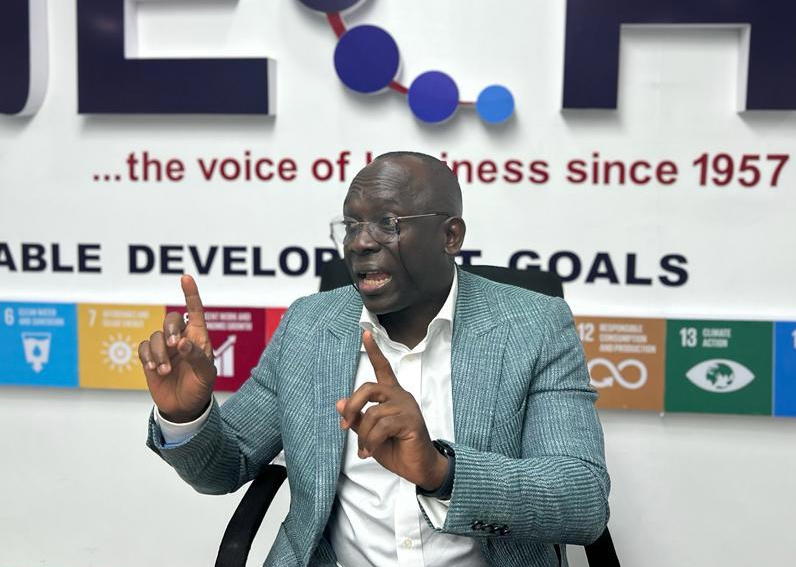
Director-General of the Nigeria Employers’ Consultative Association, NECA, Adewale-Smatt Oyerinde, in this chat, spoke on the economy, the minimum wage and challenges businesses are currently facing, among others, saying it is in the enlightened interest of employers to protect jobs.
2024 ILO conference
During the just-concluded International Labour Conference, ILC of the ILO, there were conversations on the platform and care economy as well as fundamental principles on workers’ rights. Part of the wins for us at the ILO was to deepen conversations on local content, where we will come up with policy working groups that will drive conversations on the global stage. For instance, at the ILO, there are policy working groups on apprenticeship, skills development, green economy and just transition.
They also have policy working groups on platform economy, because platform economy is the next big thing that will happen.
We significantly met our objectives which are fundamental to us and to deepen conversations at the global level. There has not been a conversation about productivity and everybody has been shying away from it. I strongly believe that the next conversation we should be having is about wages. This is already happening in the private sector. What should drive wages? I think what should be first is productivity, your competence, the value you are adding. Those are what should drive wages above the minimum wage.
Minimum wage
As far as we are concerned, the Tripartite Committee on the New National Minimum Wage has submitted its report and has done what it was created and supposed to do. Beyond the distractions, the committee submitted a recommendation to the president, who has the sole responsibility to address and announce a new minimum wage. We stand on the rule of law which all of us must respect. This ecosystem thrives on the rules, regulations and frameworks that we set for ourselves. Unless you run a business or you have a family member who is running a business, you probably will not understand the issues that the business person is facing.
When we came up with our list, we did not factor in the fact that we pay 10 per cent of every staff payroll for pension, put the employee and his family on HMO, one per cent on Industrial Training Fund, ITF for training, one per cent for Nigeria Social Insurance Trustfund, NSITF, in case of accident and injury at work. These are not factored into what we are talking about.
Those are real figures. They are besides the rising interest rates and the reality of the interest rate is that if I borrow N100,000 today at 10 per cent interest per annum that means at the end of one year, I will pay N110,000 back to the bank. If by next week the interest rate jumps to 20 percent that means the 10 per cent which I have borrowed will change. Now, the cost of the goods must be factored into the cost of production.
I cannot arbitrarily increase the cost of the goods because if I increase the cost of goods above a margin and the consumer cannot buy, if the consumer cannot buy, it creates unsold stock for me. Having looked at all the issues with organised business, no business has made 100 per cent profit or employed 100 per cent staff in the last five years. Rather, we have businesses leaving, some shutting down and reducing their capacity utilisation.
When a business says it is changing its model, it is either reducing capacity utilisation and all these things have consequences for jobs. Even when there is acquisition, there are consequences for jobs. We looked at everything together and we tell you, the best we could do was N54, 000 which was then 80 per cent above the N30,000 minimum wage.
We have explained that the private sector is huge with different sectors. As of today, some are paying N30,000 to N35, 000, while some are paying up to N70,000 to N75, 000. You cannot lump everybody together and say since we have some that are paying N75, 000, let everybody pay N75,000. Once the Minimum Wage Act is passed and becomes a law, it compels everybody to pay, and then you would have jeopardised those that are below level. The best option is to look at the modal payments of what we call the first quartile, second quartile, third quartile and fourth quartile. The first quartile is the minimum, below which anybody cannot pay. You look at the first quartile and the middle of the first quartile; so, pick the middle of the first quartile.
This is where most people will move up. If you compel people to move up to this first quartile, middle of the first quartile, which is the minimum, those that are up there are already paying above whatever you are paying; nobody is coming down because they stay there. What we are talking about is the minimum below which nobody should pay, and it is to protect the most vulnerable so that nobody will exploit anybody. It was a painful decision to negotiate up to N62,000. But we just had to agree so that the country could move on and also to demonstrate our goodwill to our colleagues. But our position remains the same. Fundamentally, what we are negotiating is a minimum wage and not a living wage.
Employers, organised labour
If you take out a conflict from industrial relations, then you do not have industrial relations. Inherent in this is the conflict of interest. It is not every time we must align. Perhaps we disagree to agree, and our position and long-term objective are to protect labour because the more we employ, the more members organised labour has. The more the private sector downsizes, it is labour that it would affect. For all of us, our strength is in our membership. Our long-term objective is to protect the direct and potential members of labour. The issue of conflict is normal. There are many battles we have to fight together.
While we do not agree sometimes it is because we are neither an affiliate of labour nor the government. We are independent and we extract our independence within the context of enterprise sustainability. That is the direction for us. Each party in the tripartite is independent and being an independent entity, there will be alignment in your conversation but nothing like agreement. This alignment played out in 2019, during the minimum wage negotiation. What the committee did was a recommendation and the president said he would only approve what the economy can pay, which is correct. If the economy starts improving, then there can be a raise.
The issue of a living wage is misleading. Is there a need for a living wage? Absolutely and the employers will support the need for a living wage. Let us wait for the concept of the living wage as we are all at this. Labour cannot say they are not part of it because the employer, the workers’ union, and the global union where they belong, were part of it when the ILO adopted the report of the Committee of the Expert on Minimum Wage. So, what we are doing is minimum wage, not living wage. Although it is tempting to mix them up, they are never synonymous.
Energy cost, others
The electricity tariff is part of the contradictions. The government is giving the relief with one hand and still collecting the relief back with the second hand. The government cannot play the ostrich and say it is the Nigeria Electricity Regulatory Commission, NERC. The Federal Government is accountable for businesses shutting down and multinationals leaving the country due to the harsh operating environment. When we say businesses are paying over 60 different taxes, levies, and fees, some might think it is just 60, it is much more than that.
We must do everything to protect the Small and Medium Enterprises, SMEs. The SMES are probably the biggest employers of labour globally. If you don’t protect them, you destroy the economy. A company that is paying about N2 million as electricity bill, when the new tariff came, the first bill they gave the company in April was about N15 million. That is N13 million difference, where are they going to put it? It must go somewhere. For us, it is simple arithmetic, if you cannot pay, no gun can be put in your head to pay.
That is the reality of it. If you cannot pay, then you cannot pay. If you cannot pay and the gun is put on your head to say you must pay, then the most practical thing for you to do is to reduce staff strength. When you reduce staff strength, you create further problems for the economy because the rate of insecurity will probably increase.
Disclaimer
Comments expressed here do not reflect the opinions of Vanguard newspapers or any employee thereof.