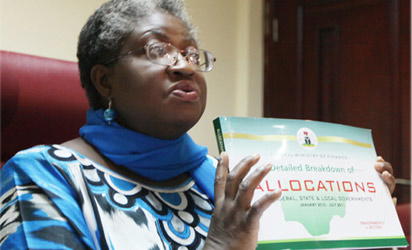
Finance Minister, Mrs. Ngozi Okonjo-Iweala
By Babajide Komolafe
The idea was part of the Strategic Agenda for the Naira announced by the CBN in 2007, which was abruptly aborted. But before then, it had long being advocated by Les Leba, a columnist in Vanguard Newspaper whose real name is Henry Boyo, the Managing Director Chief Executive Allied Technologies.
Revenue accruing to the federation accounts should be shared in dollars. The present and long standing practice of sharing federation revenue in naira, according to Boyo, does not make economic sense, and it is the major culprit for most of the macroeconomic problems in the country, especially excess liquidity. Under the present practice, the three tiers of government share the naira equivalent of federation revenue approved for sharing by the Federation Accounts Allocation Committee.
The CBN holds the dollar federation revenue and issue naira funds equivalent to the statutory allocation to the various tiers of government. But, as rightly noted by Boyo, naira funds issued by CBN results to excess liquidity and the concomitant problem of speculative foreign exchange demand, and inflationary pressures (as more money chase few goods.
In response to this self inflicted problem, the CBN adopts tight monetary policy measures. It sells treasury bills to banks to mop up the excess funds from the banks ( and in the process incur cost as interest rates are paid on the bills on maturity), raises the benchmark interest rates and hence increases cost of funds in the economy, and indirectly cost of goods and services.
To Boyo, the country and the economy can be and should be spared these monetary problems by stop sharing federation revenue in naira but in dollars. Since the revenue is being earned in dollars, it should be shared in dollars, and there would be no need for the CBN to issue naira in the local economy, which is the root cause of the country’s monetary problem.
To financial sector operators, it is a good but risky idea because of its potential to increase corruption.
“It is a good idea worth looking at. But my fears is that can trust the governors not to corner the foreign exchange for themselves”, said Victor Ogiemwonyi, Chief Executive of Partnership Investment Company PLC.
The sharing federal allocation in dollars is invitation to more corruption, opined three senior bank treasurers.
“Considering the system where we are, I will say we are not ripe for it”, said one of them, who chose to be identified as Lukul. “Corruption is very endemic here; I believe such idea will encourage corruption as there would be no way to detect foreign exchange arbitrage.

Finance Minister, Mrs. Ngozi Okonjo-Iweala
The state governors can negotiate with the banks to understate the exchange rate at which the dollar was exchanged. Furthermore, it can affect the value of the naira reduce availability of foreign exchange to productive sectors. Once you hand over the dollar to the state governors, you can’t force them to sell it to anybody or bring it into the system.
Consequently the foreign exchange could be diverted to purposes that will not add value to the system. In fact, because of desire for higher exchange rate, the foreign exchange will go into the black market and the official market would be short of dollars. I believe that centralizing the foreign exchange through the CBN is a way of managing the nation’s currency.”
According to Ragi, who also spoke on condition of anonymity, except the CBN can put in place a strategy to check mate the corruption of the governors, sharing federal allocation in dollars would be good for monetary management. You know in Nigeria, when you introduce something that to benefit the economy, some people will sit down to look for ways to abuse it for their own selfish purpose. If there is now strong control measures, the foreign exchange can disappear into thin air or the governors can collude with banks to understate the exchange rate at which they converted the dollar. So, my advice is that it is good for consideration but there must be measures to check corruption.”
Harrison Owoh, Managing Director, H.J Trust BDC however was of the opinion that there federal allocation should not be shared in dollar. “Since the various tiers of government spend naira, why should they be paid in naira. The CBN, according to the constitution is the banker to the nation and hence should keep the dollars on behalf of the country and pay the government in naira. I don’t support such idea as it would also mean giving more powers to the governors and more opportunities for corruption”.
Boyo however dispels these fears and assertions. “The present system has greater risk for capital flight, foreign exchange speculations and abuse that what we have been canvassing for,” said. Explaining his proposal, he said, “Under the proposed system, the three tiers of government will not get the dollars in cash but would be given dollar certificate of the allocation. These certificates would be taken to bank of their choice for conversion to naira.
The banks would confirm the details of the dollar purchase from the official beneficiary to the Central Bank, so that its accounts with Central Bank will be credited with the values of dollar purchased from each official beneficiary (i.e the state of local government), while the beneficiaries of dollar account with the CBN will be debited by equal sum.
Industrialists and importers, who require dollars for their supplies would approach the banks with proforma invoices and pay naira for the dollar required to cover their purchase at a naira/dollar rate that is determined based on supply/demand!
“The banks would provide an endorsed copy of the bill of lading relating to the order to the Central Bank, after goods have been shipped in accordance with the invoice terms. The Central bank will be instructed by the banks to remit the invoiced sum to the supplier, in accordance with the invoice terms.”
“From the above, it will be clear that a deregulated forex market will turn the table in favour of the naira, such that there would now be speculative demand for the naira rather than the dollar, thus, strengthening the value of the naira, and minimizing the threat of capital flight.
In this event, actual dollar sums remain under the control of the CBN, who will ultimately also disburse the sum to overseas supplies of bona fide exports (goods and services) to Nigeria, thus reducing the opportunity of round tripping and capital flight.
In addition, this arrangement is certainly more transparent, as it provides clear and detailed information on cash movements and nature of transactions relating to the use of federal allocations,” he averred.
The Professor Soludo led CBN in 2007 not only agree with Boyo, the dollar sharing of federal allocation it introduced also bears a significant semblance his proposal.
The Monetary Policy Committee (MPC) of the CBN has approved the sharing of part of the Federation Account allocation to the Federal Government and the State Governments in US dollars. The Local Governments are excluded in this phase”, Soludo said on August 14th 2007.
In an address titled, “Strategic Agenda for the Naira”. He he said, “For the Central Bank, this could also provide an additional instrument for effective liquidity management as we migrate to inflation-targeting framework.
The proportion of the Federation Account to be distributed in dollars will be determined from time to time, but largely dependent on the assessment of the forex market as well as the liquidity management requirements of the CBN. Both the States and Federal Government will be required to open ‘Special Domiciliary Accounts’ with commercial banks of their choice. The special account can only be accessed by monetizing the balances into Naira.
In other words, the Governments cannot withdraw dollar cash but may also utilize part of their domiciliary accounts for settlement of external obligations (e.g. opening of letters of credit). From September 2007, the exchange rate that will be applied in the monetization of Federation Account as well as the ‘Special Domiciliary Accounts’ will be the inter-bank rate on that day.
As the market deepens, the CBN will gradually withdraw from the WDAS, and only intervene in the market (buy or sell forex) as may be required to achieve defined policy objectives.
This new policy thrust is expected to deepen the forex market, promote financial market development, and improve the degree of integration among the domestic markets and with international markets.”
Disclaimer
Comments expressed here do not reflect the opinions of Vanguard newspapers or any employee thereof.