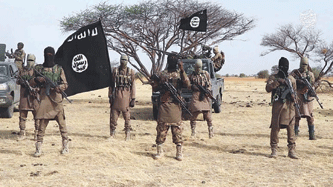
Reports of a recent upsurge in violent crimes allegedly being carried out by the so-called repentant Boko Haram terrorists did not come as a surprise to concerned Nigerians. It was bound to happen because of the shoddy manner that their “de-radicalisation” programme was conceived by the military under former Army Chief, Lt-General Tukur Buratai, during the regime of former President Muhammadu Buhari.
Smack in the middle of the military campaign to crush the jihadist terrorists, recover the territories they occupied and rescue those they took into captivity, the Buhari regime came up with the queer idea of offering a “de-radicalisation” package to the terrorists who surrendered and claimed they had repented.
Thousands of the jihadist fighters were accorded almost the same reception reserved for our heroic sportsmen and women who make Nigeria proud at international competitions. They were gorgeously outfitted and placed in boot camps, after which they were released back into the populace with cash gifts.
Obviously, those who packaged the “de-radicalisation” programme were trying to re-enact the post-amnesty programme for the repentant Niger Delta militants. Even the “bandits” in many parts of the North-West and North-Central were also enticed with a similar “amnesty” package which some accepted but quickly returned to the bushes shortly after.
Reports had it a fortnight ago that the surrendered Boko Haram fighters have been attacking police stations in Maiduguri, Borno State, to rescue their members arrested for various offences. Borno State Police Command Spokesman, Kenneth Daso, also told newsmen recently that the hoodlums have attacked checkpoints manned by the Nigerian Immigration Service, NIS, and the National Drug Law Enforcement Agency, NDLEA, in the state capital.
Their female counterparts are also trapped in the social stigma of alienation. Many of them have been sending distress messages to their community leaders about their rejection and difficulty in finding marriage suitors. With thousands of women facing social rejection, there are fears that some of them might return to their male colleagues in the bushes.
This is what comes of politicising crime. The Niger Delta is now next only to the South-East in terms of security of lives and property, while the North-East, the Boko Haram theatre of insecurity, is next only to the North-West in terms of security threats.
The de-radicalisation programme was totally misapplied due to politics. Such programmes are conducted inside prisons for those who genuinely repent. They are also properly resettled when they have done time.
But in our case, amnesty was granted to active fighters in the bushes without ascertaining the genuineness of repentance, or providing adequately for life after.
If care is not taken, we may be back to 2009 when the late Islamist, Sheikh Mohammed Yusuf, started Boko Haram in Maiduguri, a vicious circle.
Disclaimer
Comments expressed here do not reflect the opinions of Vanguard newspapers or any employee thereof.