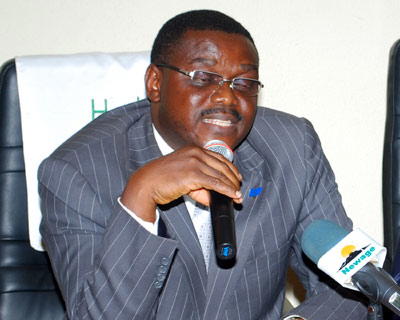
Health Minister, Onyebuchi Chukwu
By Chioma Obinna
Why should Nigerians suffer needlessly from preventable diseases? After 51 years of independence, why should we not have access to adequate and universal healthcare? What steps are being taken to address the situation? These are just some of the plethora of questions posed by Denrele Animasaun – a London-based registered nurse and health promotion specialist.
Denrele, an experienced and active healthcare provider based in the United Kingdom, is a firm believer in the tenets of providing the right information and education to people in the interest of ensuring qualitative healthcare.
Bringing home her wealth of experience in healthcare management, she asserts that Nigerians need not die in silence if they are adequately informed and educated about their own health issues. In this encounter with Bashir Adefaka, she gives insight into a unique initiative that would ensure prioritisation of the health of the average Nigerian: Excerpts:
The silent killer diseases
Silent killer is often a term used for diseases that produce minimum or no symptoms and is capable of causing death if not treated. Major silent killer diseases are; heart diseases, hypertension and diabetes. As well as are other lesser known silent killer diseases such as breast cancer, prostate cancer, renal cell cancer , pancreatic cancer, hepatitis B or C infection to name a few.
Our health should be top priority and not an option. I have found over the years of working with the black community that we do not place high priority on our health as we do in other areas of our lives. We should, because if we are healthy we can do a lot of things including being around for our loved ones for much longer and contribute the social and economic of our country.
Why is this problematic? There is a delay to act within the black communities in terms of these silent killers, as if to play a wait and see game ,or that there will be some divine intervention . This is quite concerning as hypertension and diabetes which are quite endemic in our community amongst others such as malaria, sickle cell, asthma, prostrate and breast cancers.
Black men are three times more likely to develop prostate cancer that their white counterparts. As with breast cancers, our females are sometimes have the very aggressive ones that can benefit from early presentation rather than wait until it becomes terminal .It is important to raise the awareness of this hidden cancers.
Most of these diseases run in families and based on our lifestyles, stress, poverty, and lack of awareness so we could make the shift if we are aware of our health history and lifestyles. In the case of heart disease , the risk is increase if you have a male relative with coronary heart disease under 55 or a female relative under 65 and or you are obese , overweight high cholesterol diets, you eat too much salt; you don’t eat enough fruit and vegetables; you are not active enough; you are overweight; or you drink too much alcohol.
Primary steps
We need to make health education more accessible, interactive and participatory and let people know that they have to take control of their health by raising awareness making it more vivid ,innovative to clearly understand what the main causes of diseases that affects us as members of the community.
It is important that you know your blood pressure; the normal range for blood pressure readings is 120/80 to 140/90, although many healthy people have a lower blood pressure than 120/80. If it is higher than 140/90 seek medical help, look at your lifestyles and make changes. If yours is consistently high, you have a greater risk of developing coronary heart disease and having a stroke. Ask your doctor to check your blood pressure.
For a few people, friendly eating habits may help them to avoid medicines altogether.
For healthy weight, it is good to lose weight and watch what you eat and drink – the healthier your eating habits are, the lower your blood pressure will be.
Need to set up
I subscribe to the maxim that charity begins at home, since I have worked in the health field for close to two decades in the United Kingdom. Now seems to be the right time to bring it home. One of the most disturbing statistics indicate that people from the black community are less likely to access health care and more likely to suffer from high blood pressure, diabetes, sickle cell , mental health problems, breast and prostate cancers.
Health programme for the Nigerian community
“Improving the health of our communities” is an innovative health programme designed to encourage local people to seek help for their health concerns. It is based on the successful main stream community health programme in the United Kingdom called “Cares of life service.”
The service set up the barbers and hairdressers Network in South East London. We know everybody goes to their barbers and hairdressers regularly. It is aimed at making use of long established , non – medical support system alongside social ,community networks such as the Faith groups, churches, mosques ,market people and actively involve them in health promotion campaigns .
At the barbers’ and hairdressers’, it is more than a place for grooming, it is news room, advice centre, and more goes on in these places that it was important to harness this, after all everybody talks to their barbers don’t they? Barbers and hairdressers can then provide free signposting service and advice to their customers. Health social issues that can be addressed include domestic abuse, diabetes, high blood pressure, sickle cell, glaucoma, breast and prostate cancers and many other social and health issues.
Aims and objectives
The aim of this new health initiative will be to focus mainly on six aspects of health and social concerns prevalent in the local communities: Diabetes, high blood pressure, Sickle cell, prostrate and breast cancers, domestic violence and high maternal mortality rate. We will train and recruit a pool of workers which would include volunteers, faith groups, barbers and hairdressers trained and supported by professional health care workers. 
It is an established fact that black people are culturally and generally unlikely or hesitant to access health services. It is imperative that we need to tackle ill health at an earlier stage and work with younger people so that the health seeking behaviour changes for the better and over time with a sound and robust health care programme.
Lay workers will be trained to identify signs and symptoms of basic health and social concerns and sign post people needing specialist help to appropriate and participating agencies.
Target audience
We aim to signpost local people especially from the socially deprived area needing health care and social support to local and appropriate health professionals. It will be free at point of access, for adults 18 -65 years old and in time it can be open to all if need be, for instance, in the case of health promotion and social information in schools or in case of domestic violence, which can be made accessible to all and in different setting.
With the assistance of the state commissioner, health and information departments, we will map out local community zones; doctor surgeries, hospitals and medical centres.
Health professional can harness these resource and provide free screening and early intervention and in time will result in reduction and better prognosis.
Barriers
I have been told that things take time in Nigeria, to take root especially non profit programme such as this, I believe where there is a will there will be a way.
I strongly believe that health is not an option it is a priority, and more so, if we are to have a strong economy . This would not be the case if the young, economically viable people are dying needlessly, it is about time that we realise that we are economically haemorrhaging manpower and potential earnings at its prime and it will ultimately affect the social and economic fibre of our society.
·That politics will play a part in it and may hinder its progress. The programme is for the people and that it is bigger than any political partisanship. In fact I welcome any Governor or Ministry of Health who want us to roll out the programme to get in touch with us we will be happy to do so.
· -That seeking set up capital will be a problem. Other than initial set up capital this is a health programme will pay dividend and cheaper in the long run and it can form part of an established health programme.
·What’s in it for me culture may railroad or stall the programme , this programme is run a an altruistic principle: it is our collective responsibility that it works the more we work towards a collective goal the better for all us.
Cost implication
Initial set up running costs though can cut down costs when it forms part of the established community frame work and we can plug in the NYSC programme so gain access to established resources and manpower –National Youth service Corps, Nursing students and other health allied professionals.
All data collated are fed back and shared with numerous strategic bodies within the Health department and Primary health care. It can be used to form future health programmes and identify health issues and distribution of resources.
About Cares of Life service
It is a mainstream community health promotion service that works to improve the health service provision for the black community living in the Borough of Southwark, London. It is an award winning service, it won the British diversity award 2003, 2004, the charitable foundation award for innovation 2005; in 2009 won the certificate of recognition for preparing young people for adult life by the Lewisham business education Forum.
The service has been a standard bearer and has been used as an example of good practice. . The service has received visits from New Zealand, Denmark and South Korea by health service experts keen on learning more and with the view of setting up similar services .
The service has featured in BBC health programme and Channel 4 as well as the national service journals and cited in many others locally, nationally and internationally. The service uses its extensive local knowledge to build capacity within the local community and the health services. We have an ongoing working partnership with Kings College Hospital breast cancer care team the Renal research UK , Diabetes UK, the Lupus UK, the British Heart foundation, Prostrate Cancer , the Sickle cell society and the Glaucoma campaign.
The disproportionate gap between the white and the black community was a singular drive that led me to work at Cares of Life service. The Service was set up Dr Dele Olajide a renowned consultant psychiatrist and an expert. The Service is a trail blazer, very innovative , harnessing grassroots support and enable the local community to help themselves.
Its unique selling point is the way it provides health intervention with culturally appropriate services, projects and training to health professionals, carers, voluntary services and statutory personnel and connecting health care services with local BME communities and meeting in an effective and targeted mental health needs . Using innovative and creative tried and tested methods to deliver an effective and efficient health programmes to local population or target groups.
Disclaimer
Comments expressed here do not reflect the opinions of Vanguard newspapers or any employee thereof.