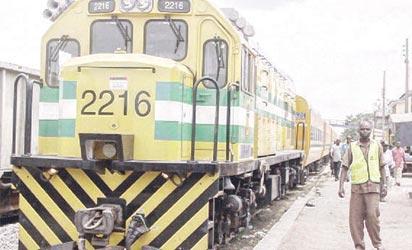
*File photo
By Ikeddy ISIGUZO, Chairman Editorial Board
I LOVE trains. I grew up using them. Every men tion of them floods me with memories, among them a speck of coal (coal powered the trains then) which fell into my eyes and left me with an uncomfortable red eye for days.
Each time we ask about palliatives for the subsidy that government has removed from petrol, we are given fanciful pictures of trains, some looking like magnified snakes. We have lived without functional rails for more than 30 years, yes after the Indians, owners of the world third biggest rail system.
Our rails died before the 100th anniversary of their existence. Indian rails will be 160 years old next year. They are the biggest employers in India, running about 7,500 stations covering over 114,500 kilometres of track and moving more than 10bn passengers annually. They link India to Bangladesh, South Bhutan, Nepal, and Pakistan. Also proposed are links to Vietnam, Myanmar, and China. The Ministry of Railways is one of the most vital in India.

By 1895, India was building its own locomotives and the following year sent its engineers to build the rails in Uganda. Indian Rails employ 1.36m people, carry 30m passengers daily, an annual average of over 10bn passengers, and earned revenue of US$18.62bn in 2011 and net income US$1.82bn in 2010.
We are not talking about this type of rails. Are we? Nigerian Railway Corporation, NRC, is more than 100 years old, beginning with the Lagos Government Railway in 1895.
It is practically dead with its properties massively sold off in the past 20 years. By 9 December 1995, the Federal Government had spent US$528m in a contract awarded to the China Civil Engineering Construction Company, according to the company.
The Obasanjo administration drummed up a 25-year-old rail programme awarded to the same company for US$8.3bn.
The contract is mired in allegations that it could have been inflated by about US$5.8bn. Former Auditor-General of the Federation Robert Ejanavi told a Senate public hearing on transportation that N124.9bn was spent on rail projects from 1999 to 2008.
He gave an example where a contractor was paid $250m as mobilisation fee but curiously, a payment of $175m was made into his foreign account and the remaining US$75m was paid into his Nigerian account. Another contractor allegedly paid US$1.5m has no record with the Ministry of Finance indicating he was paid. NRC did not know about the payment to the contractor.
These backgrounds paint gloomy pictures of the rails and definitely not one to deliver the trains I am waiting for to take me not “from Lagos to Ilorin” alone, as the government is proposing, but to all the places I have been with the train earlier.
All my growing years were about trips on trains. From Omoba, 10 minutes from my village, I could board the train to anywhere in Nigeria, which I did – Aba, Port Harcourt, Mbosi, Enugu, Isiochi, Makurdi, Bukuru (Jos), Kano, Zaria – and I knew that Kaura Namoda was the great station where the trains from the South changed direction to the West, all the way to Lagos. The trains worked, and nobody told us stories about placing conditions on their existence.
Their voracious volume took all the produce from villages that were productive economic units with the rails as catalysts for their activities. Garri and palm wine from my village had markets that awaited them in the North. Palm oil, palm kernel, cocoa, coconuts had buyers or exporters in Port Harcourt, the trains took them there. As the rails died, they killed the productions in those places.
Mention of the rails evokes deep memories. Some of those who string words about rail transportation do not know what it meant to the economy; otherwise, they would have built on the thriving rails system that they abandoned.
I am excited about
travelling by train again. From Lagos to Calabar, possibly stopping at Aba. I want to make Jos from Abuja in less than an hour. It is a long time I was in Sokoto. How about doing that from Port Harcourt by rail?
Sadly, nobody would do the rails, not even activating the old system that served this economy well, and would have improved if we were interested in making life better for
Nigerians. The condition for building the rails (removal of subsidy) tells me that they would never be built.
Government will not save any money from subsidy because there is no such money to save. The capital outlay for getting the trains working requires more strategy to acquire than pinning it on subsidy removal.
The frustration of those protesting the new petrol price is that government had no plan. Every plan is a reaction to demands of the crowd. What is the plan for this economy? There is appears to be none. Listening to government officials, the main reason for the increment is to beat a cabal that government cannot fight and to match the prices in neighbouring countries.
I am waiting for the trains. I want to travel by rail. I want to see our country again with the trains activating the various dormant economic centres in our small villages. Millions of Nigerians are waiting for the trains. Will they get the trains or are government hands tied again?
We do not need subsidy removal to fund the rails, have functional education, hospitals, and a transportation system in which the rails would be a part. Government can go ahead and remove the subsidy, but when will the trains arrive?
PS: There are too many grievances that I doubt that merely reverting to N65 will assuage the anger of people and take them off the streets.
Disclaimer
Comments expressed here do not reflect the opinions of Vanguard newspapers or any employee thereof.