By Chioma Obinna
The 23rd President of the National Postgraduate Medical College of Nigeria, Dr. Peter Ebeigbe, has attributed the health system’s brain drain to economic factors and called for urgent intervention from the Federal Government to prevent the collapse of the health system.
Ebeigbe, who claimed to have experienced a medical brain drain under the government of General Mohammed Buhari, stated that the number of candidates registering for examinations has dropped due to the large number of resident doctors leaving the country, including trainers.
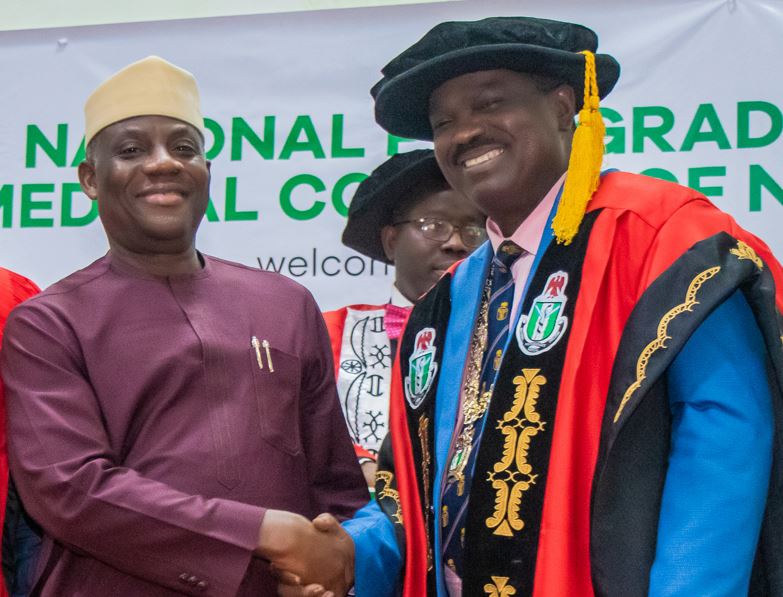
The new College president, who lamented the severity of the situation in his inaugural address said he saw a core department in the institution depleted from eight lecturers to only one, adding that the situation has led to severe shortages of health manpower in most tertiary hospitals across Nigeria.
“The root cause of the brain drain is economic and economic interventions are urgently needed to stem the worsening cascade and prevent a collapse of the health system.”
Ebeigbe who regretted what he described as ‘sickening data’ of the brain drain, said: “Due to the decrease in the value of the naira to the dollar, the most senior Nigerian Consultant earns the equivalent of 300 dollars monthly outside any earnings for extra work. This is a decrease from the equivalent of around 1,450 dollars as of January last year. This amounts to an annual salary of about 3.600 dollars. Meanwhile, his colleague, who has travelled to the Middle East, earns up to 10,000 to 12,000 dollars in a month equivalent to his/her three years’ earnings. It will not be considered strange if any rational healthy human being asks him/herself why he/she is still here.”
The College President however, applauded the Federal government’s directive to the MDCN to increase the quota of all medical schools to increase the number of doctors produced by the country and the government’s willingness to help meet the extra personnel and equipment needed to attain the new quotas.
Ebeigbe also commended the Federal government’s directive to increase the quota of all medical schools and the government’s willingness to help meet the extra personnel and equipment needed to attain new quotas.
He also commended the federal government’s planned upgrade of over 12 tertiary teaching institutions nationwide.
However, he urged the Federal Government to intervene with deliberate measures to ensure that medical teachers and specialists stay back in the country through an urgent review of salaries and provision of other incentives.
“I urge the Federal Government to urgently intervene with deliberate measures that will keep the necessary personnel back home so that the massive investment of resources into actualising the two interventions do not end up being a waste of limited public resources.”
Noting that the College has made significant progress which has been speeded up in recent years, he said his tenure as president would continue building on the foundation over the next two years.
READ ALSO: Humanitarian aid: Ukraine donates 25,000tons of wheat to Nigeria
He said in the next two years, they will be enhancing the speed and efficiency of all their college processes, adding that, the College will keep engaging with the resident doctors, who they relate with among other relationships.
In his address, the Minister of State for Health and Social Welfare, Dr. Tunji Alausa, who spoke at the Investiture said the Federal government has substantially increased allocation to health and social services in the 2024 budget to address the financial challenges preventing Nigerians from accessing quality health services.
Alausa said the Government has also developed a new strategic blueprint centered around the provision of universal health coverage (UHC) with the objectives of “saving lives, reducing both physical and financial pain, improving population health outcomes, accountability, maternal and child health, governance, affordable and quality health services for all Nigerians.”
He announced that the College in collaboration with the Ministry is establishing training in many other subspecialties to be able to treat Nigerians, reduce medical tourism and enhance research. “Our population’s health needs are becoming increasingly complex, necessitating a cadre of highly skilled specialists who can address these challenges with proficiency and precision. “To meet these demands, we must prioritise the training and development of medical super-specialists across various disciplines.”
He said research must be at the heart of the college as it not only drives innovation and advances in medical science but also enhances the quality of patient care.
Alausa said in the quest to expand the pool of specialists, there was a need to harness and leverage the power of technology such as telemedicine, artificial intelligence, and digital health solutions as they offer unprecedented opportunities to extend the reach of specialist care, particularly to underserved regions.
He challenged the College to contribute to the government agenda by training more specialist doctors who will provide improved health care to the populace through state-of-the-art clinical practice, research, and teaching; and actively regulating postgraduate medical education in Nigeria.
He maintained that the training of medical super-specialists, investments in research, harnessing technology, and collaboration with Nigerian specialists in the diaspora are all vital components of the government’s efforts to enhance the quality and accessibility of healthcare in Nigeria.
With over 2000 training programmes in 223 accredited institutions nationwide, he charged the college to accredit more training institutions to give more opportunities for Nigerian doctors to train locally.
He commended the College for creating offices in the six geopolitical zones of Nigeria for the proper monitoring of the Medical Residency Training Programme and the administration of the training fund which would enhance efficiency and effectiveness in this process at all levels.
While congratulating the new president, he expressed hope that his tenure as president would continue to foster excellence in medical education at the highest level to achieve the mission of producing medical and dental specialists of the highest standards who will provide world-class services in teaching, research, and health care.
He pledged to look into the request of the college including special funding to establish and equip central simulation centres in Lagos and Abuja to further augment the training of specialists, improved access to funding by the Tertiary Education Trust Fund (TETFUND) and direct budget line by the Government for the College to plan, develop and implement programmes for Residency training program under the Medical Residency Training Act among others said the landscape of healthcare is evolving rapidly, and with it, the demand for specialized medical care is burgeoning.
Disclaimer
Comments expressed here do not reflect the opinions of Vanguard newspapers or any employee thereof.