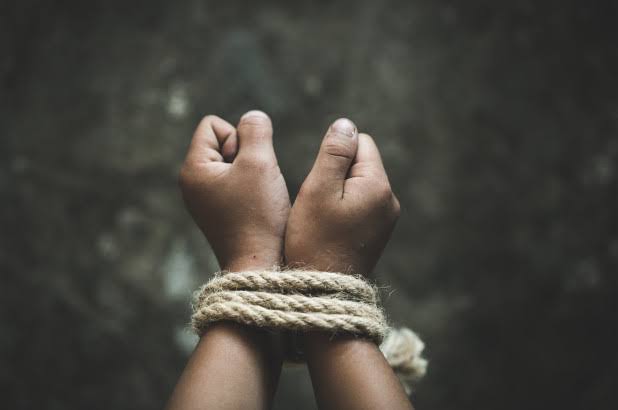
as captives’ families shun
Defence Minister’s warning
•Mixed reactions trail Badaru’s statement
By Kennedy Mbele and Esther Onyegbula
As kidnappers across the country continue to operate freely, families of captives
appear to have no choice than to keep paying ransom to secure the release of their loved ones from captors despite the warning by the Defence Minister, Alhaji Mohammed Badaru, that such payment was illegal.
Reports say families have been secretly negotiating and paying ransom to kidnappers to free abductees because they do not believe in the capacity of security agencies to help.
Perhaps two recent incidents seem to illustrate the situation which curiously saw security agencies claiming to have rescued captives whereas families’ sources suggested ransom was negotiated and paid prior to victims regaining freedom.
In the kidnapping of the six Ekiti schoolchildren, two teachers and their driver, penultimate week, reports quote sources close to the captives’ families as saying N15 million was paid to the kidnappers to secure freedom.
Recall that on the eve of the victims’ release, the families had said crowdfunding for the ransom demanded by the captors had yielded N7 million only for them to be freed the next day.
The children and teachers spent five days with the kidnappers while the driver did not make it out alive.
Only last Tuesday, reports emerged that the Deputy Vice Chancellor (Administration), Abia State University, Professor Godwin Emezue, who was abducted on January 26, 2024, had regained his freedom but not without ransom paid to his kidnappers.
The erudite scholar was said to have been abducted by unknown gunmen at a petrol station in Umuahia, the state capital.
His abductors allegedly demanded for N25 million ransom but later reduced it to N20 million.
Although the amount the family eventually paid to secure his freedom is uncertain, reports said sources insisted that ransom was paid before he was freed.
Other recent kidnapping incidents in which ransom has been demanded include the abduction of a bride and 35 wedding guests in Katsina State penultimate Thursday.
This was described as the largest in a series of recent abductions in the country. The guests, mainly women and said to be accompanying the bride to her groom’s place, were believed to have been attacked in Sabuwa area of the state.
Analysts say the kidnapping was aimed at collecting ransom.
In Ekiti local government area of Kwara State, gunmen, who killed a traditional ruler, Oba Olusegun Arami Cole, kidnapped his widow and one other person and later reduced the ransom they were demanding from N100 million to N40 million.
The captives have since been released according to reports.
Meanwhile, Sunday Vanguard learnt that crowdfunding for ransom to secure the release of kidnap captives in different parts of the country is ongoing on different platforms, including WhatsApp groups, unknown to security agencies.
Illegal payment
Defence Minister Badaru had said, on Tuesday, January 17, that ransom payment would only embolden kidnappers to make more demand thereby jeopardising public safety, warning that payment to kidnappers was illegal.
He spoke on the heels of the claim by members of the Al-Kadriyar family who reportedly paid ransom to kidnappers for the release of five of their six girls amongst the 23 persons abducted on January 2, 2024, in the Bwari area of the Federal Capital Territory.
While four of the captives were reportedly killed by the kidnappers including the eldest of the six girls, Naheeda, on the grounds that ransom payment was delayed, the remaining 19 persons regained freedom.
Two uncles of the Al-Kadriyar girls, Abbas and Sherifdeen Al-Kadriyar, later debunked reports by security agencies that the girls and other victims were rescued through their efforts, saying the family paid ransom to the kidnappers.
Sherifdeen Al-Kadriyar said: “We paid a ransom for the release of our girls. A ransom was paid, and the police were not involved. The children called me, and I went to pick them up.”
The monarch, who was kidnapped from his residence in Orodo Mbaitoli LGA, Imo State, on January 6 and released 13 days in captivity after allegedly paying ransom, said: “Contrary to what the police said about my release, there is no hiding the fact that the police never played any role. I do not want to speak on this but I am doing it just to set the records straight”.
Badaru, who spoke after a Federal Executive Council (FEC) meeting, said President Bola Tinubu, at a meeting with Service Chiefs, had directed security agencies to intensify efforts in flushing out the perpetrators of criminal acts in the society.
“Yesterday, we are aware Mr President called us and all the service chiefs to discuss this issue. So, concerted efforts are being done by security to stop it immediately.
“As you are aware, people are saying FCT, FCT, these kidnappings happen around the suburb, around locations that are bordering Kaduna and Niger states. And this is a result of the current operations going on in the North-West and some parts of North- Central”, he said.
“The bandits are fleeing and they are getting shelters around these areas and the security agencies are working very hard to push them out, block the movement and finish this thing once and for all”.
The Minister added, in apparent reference to the Terrorism (Prevention) Act 2013 (Amendment) Bill, 2022, that raising funds to pay the ransom was an illegal act and an action that would further encourage the perpetrators in their nefarious acts.
Badaru urged Nigerians to avoid discussing security issues in the public or the media because of its implications for thwarting criminals by security agencies.
He said Nigerians should manage the kidnapping situation intelligently and quietly to achieve a productive resolution of the incidences.
Former President Buhari had signed the Terrorism (Prevention) Act 2013 (Amendment) Bill, 2022 into law after the National Assembly amended Section 14.
The Section says: “Anyone who transfers funds, makes payment or colludes with an abductor, kidnapper or terrorist to receive any ransom for the release of any person who has been wrongfully confined, imprisoned or kidnapped is guilty of a felony and is liable on conviction to a term of imprisonment of not less than 15 years.”
Some Civil Society Organisations (CSO), which spoke to Sunday Vanguard on the question of the legality of ransom payment in the face of the lack of capacity of security agencies to rescue abductees, reacted differently.
Those who spoke include ActionAid Nigeria, Edoka Suleiman Onoja Trauma Care Centre Peace Initiative, Hannis Foundation for Gender, Inclusion and Health (HaFGIH) and Women Trafficking and Child Labour Eradication Foundation (WOTCLEF).
Andrew Mamedu, Country Director of ActionAid Nigeria, said the group encourages a multifaceted approach to addressing kidnapping and its root causes.
Emotional toll
Mamedu said: “ActionAid Nigeria acknowledges the complexity of the issue surrounding the payment of ransom for the release of kidnap victims.
“From a legal perspective, it is important to adhere to the law, which makes ransom payments illegal.
“Upholding the law helps to prevent further incentivisation of criminal activities such as kidnapping and contributes to the overall safety and security of society.
“However, we recognise the anguish and desperation experienced by the victims and their families in such harrowing situations.
“The emotional toll of having a loved one abducted cannot be overstated, and the instinct to do whatever it takes to secure their release is understandable.
“ActionAid Nigeria encourages a multifaceted approach to addressing kidnapping and its root causes. This includes strengthening law enforcement agencies’ capacity to prevent and respond to kidnappings, improving socio-economic conditions in vulnerable communities to reduce the likelihood of individuals turning to crime, and providing support and assistance to victims and their families.
“Ultimately, while the payment of ransom may provide short-term relief for victims and their families, it is imperative to prioritise long-term solutions that address the underlying issues contributing to the prevalence of kidnapping in Nigeria.
“This approach is essential for fostering a safer and more secure society for all.
“International standards on this matter, however, generally emphasise the importance of prioritising the safety and well-being of individuals while also upholding the rule of law and human rights principles.
“In the past some European governments have been alleged to pay ransoms for the release of their citizens to Al Qaeda through proxies.
“While some countries and international organisations advocate for a strict non-payment policy, citing concerns about funding criminal activities and potentially incentivising further kidnappings, others recognise the practical dilemmas faced by victims and their families and adopt a more flexible approach”.
Ransom reality
On her part, Ene Ede, CEO, Edoka Suleiman Onoja Trauma Care Centre Peace Initiative, said, “It is very easy to draw conclusions on ransom payment if you are not directly involved.
“A lot of people have condemned paying ransom in the past. It is one thing to make a political statement and another to see the side of reality.
“There are people who said they will not succumb to traumatizing situations.
“Today, many in complex situations find ourselves in complex trauma as individuals, families and groups.
“We don’t just declare kidnapping a criminality. We should chase it out alongside the criminality element; look at the network: How did we come to make it to become a business?
“If we deal with that aspect of it and look at who are in the chain of that business, it is easier. I studied economics, accountancy and journalism.
“I know that if we have good economic governance, it is possible to have good political governance and you have peace. “But as you can see, we have serious challenge with economic governance, so how do we manage the gap such that we don’t allow criminality to expand?
“People find it very easy to join criminal elements to demand ransom. The immediate past Minister of Communication and Digital Economy was quoted as promising to raise N500 million for the family that was kidnapped in Abuja, which unfortunately lost one of its members in that captivity.
“So when you are connected, it is very easy to run and look for money even from pensioners like me. This is because we live in community and, as such, share one another’s pain.
“Again, in our practice of religion, we would feel guilty if we don’t raise the money. For me, let’s leave the symptoms and deal with the root cause of this ugly trend.
“Who are the ones involved? Who are the ones paying the money and who are the receivers? Who is the go in-between?
“Many families have been made to pass through trauma as a result of ransom. We are all involved and we should condemn it totally. We should rise against it.
“Any country that rises collectively without sentiments can deal with any issue successfully.
“Kidnapping is not a small matter for us to be playing about.
“We are just terrorizing ourselves. We have become so vulnerable to very minute elements.
“The criminality is expanding and the perpetrators are getting more sophisticated. “Look at how they jerk up ransom in millions and get paid even in hard currencies. How can tax payers’ money be used to fund criminality? That should not be allowed. “Let’s chase terror out of the country. That is why I have devoted the rest of my life to promoting energy trauma therapy; energy psychology. A lot of people are traumatized”.
Reactive
Also speaking, Hannatu Pamela Ishaya, Executive Director, Hannis Foundation for Gender, Inclusion and Health (HaFGIH), said, ”I think government is being reactive instead of proactive. How can government or its officials be part of arrangement to pay ransom to kidnappers?
“Do you know that paying ransom to kidnappers means empowering them?
“Agreed, relations of kidnap victims and the kidnapped would be eager to do anything to save lives under captivity but no responsible government should descend so low.
“Protection of lives is the number one responsibility of any government and if our government cannot live up to that expectation, then we are all in trouble. “Remember that government is next to God, if I may put it that way.
“On the other hand, it is said that there is no smoke without fire. Government should find out the major causes of kidnapping and address them squarely.
“Meanwhile, I see payment of ransom as an indirect sponsorship of kidnapping. Be that as it may, this should not be criminalized until government is able to guarantee the safety of her citizens.
“Interestingly, body language alone can send kidnappers packing but treating them with kid gloves will not help us.
“In a nutshell, government should wake up to its responsibilities now and save Nigerians from unnecessary trauma.
“Already, government has succeeded in compelling Nigerians to adopt certain lifestyles, they should also compel kidnappers to leave their nefarious activities.
“How many kidnappers do we have in Nigeria that should overwhelm the security architecture of the entire nation like Nigeria? Something must be wrong somewhere and government and the service provider should wake up to their mandate”.
Questions
The Head of Women Trafficking and Child Labour Eradication Foundation (WOTCLEF), Mrs. Sanusi Iniobong, contributing, said: “I will say that the move to criminalize payment of ransom will be effective if there is indeed security of lives.
“I will answer your question by asking the questions: How do people get to raise ransom in the first place? If people do not pay, will the victim be spared? Again, if they pay, will the victim be spared? What measures are in place to deter perpetrators? Why has ransom demand and payment become so common and rampant?
“The sole responsibility of government is security of lives of its citizens”.
The Evans case
Dickson Osajie, a security expert, also spoke, saying: “Insecurity is disturbing and presently kidnapping is taking the boom, it is on the rise. A lot of criminal elements are looking into the area because that’s one of the fastest ways to make money without much threat.
“Kidnapping has been happening in Nigeria for decades but was under-reported. The first major outbreak of kidnapping in Nigeria was the one carried out by Evans the billionaire kidnapper and that was when people got to know that there are billions to make from kidnapping because of the publicity given to Evans which led to the rise of kidnapping in Nigeria till date.
“Meanwhile nothing has been heard from the case of Evans the billionaire kidnapper, which also is a demoralising factor to the security agencies and many people think they can commit crime and go scot-free or experience delays in judgment”.
Osajie noted that kidnap-for-ransom in many other climes doesn’t happen because they don’t pay ransom to eliminate the business.
His words: “A lot of people pay the supreme price especially in the advanced world. The reason they don’t pay ransom is because their security capabilities are effective. They have effective security capabilities to rein in criminals.
“Immediately they get information that one person has been kidnapped, they go man-hunting.
“You see a helicopter going on aerial surveillance chasing these criminals. On the road, you see lead and chase of these criminals by their security agents.
“But here we allow criminals to come into our space, fetch Nigerians, take them to their hideouts, relax and beat them up, rape some, subject them to all sorts of indignity.
“These kidnappers are daredevils, they are demons and they should be wiped out without delay.
“In the area of ransom payment, there are issues. People claim to pay ransom but the police are saying they carry out rescue mission. Who do we believe?
“But what we need to understand is that life is at stake. With the vulnerable state of security, no family wants to lose their sons or daughters to criminal elements; they want to pay the money.
“So if we want to talk about no ransom payment, it won’t work because we don’t have the security capacity.
“Now look at what we are experiencing because of those we granted amnesty. I believe some of them are now into the business of banditry and kidnapping.
“That is where we need to be very careful about appeasement, because where you do appeasement, it means your enemy is stronger than you or you are giving up because you can’t engage the enemy”.
Trust
Also speaking on the issue, the President of Eastern Union, Charles Anike, said: “The claims and counter-claims by the police and the families of kidnap victims over ransom are not new.
“The police, like other government officials, can no longer be trusted. The truth of the matter is that nobody will ever believe the police due to their antecedents.
“The earlier we accept the bitter truth that our security systems have been badly corrupted and compromised and for now everyone is left for himself/herself, the better for us. There’s sabotage everywhere across every section of the society and nobody is ready to bell the cat.
“The only way out is repentance and subsequently restitution by the actors. Otherwise one day and of course very soon the country will collapse.
“Let those who stole the people’s mandate and those who facilitated the stealing do restitution so that God will take control.
“You can’t plant cassava and expect to harvest yam. Whatsoever a man soweth, he must surely reap. Those who imported the plague (insecurity) into Nigeria are moving freely and are still in control of power and pretending to have solutions to the menace”.
Complicated situation
Similarly, CEO, Badinson Security Services, Matthew Ibadin, said: ”It is a very complicated situation in the sense that the police say bail is free, but if you are a suspect and you pay for bail, do you have proof for the payment?
“If the family of a kidnap victim says they paid ransom, what is the evidence that they paid? Is there a receipt; is there documentation that ransom was actually paid?
“If the police say they rescued without paying ransom, do you have evidence to prove it? What I am trying to say is that it is a very complicated issue.
“Many people have been kidnapped and you cannot be released without paying something. Kidnapping is a huge business, one of the most lucrative businesses in Nigeria today.
“Previously what we had was armed robbery, now people don’t move with cash; so what we have now is kidnapping.
“Some of us in security business were once victims. Most kidnapped victims don’t speak out because of the stigma associated with it. For instance, when you say my wife was kidnapped, or my daughter was kidnapped, the next thing in the mind of people is, was she raped? People will be reading meaning to it.
“It is between you and your God to know how much you paid. What matters most is that there is a negotiation that has taken place and you have regained your freedom.
“Even when a US citizen is kidnapped, they send people to negotiate. There is nothing wrong in negotiating when a loved one is kidnapped.
“I see it as a win-win situation; it is not about blaming the police or the victim. No one has the documentation to say this is how much that was paid. So it is a secret deal.
“I am not saying people aren’t paying ransom but the police are saying they didn’t pay because there is no documentation to prove it.”
Disclaimer
Comments expressed here do not reflect the opinions of Vanguard newspapers or any employee thereof.