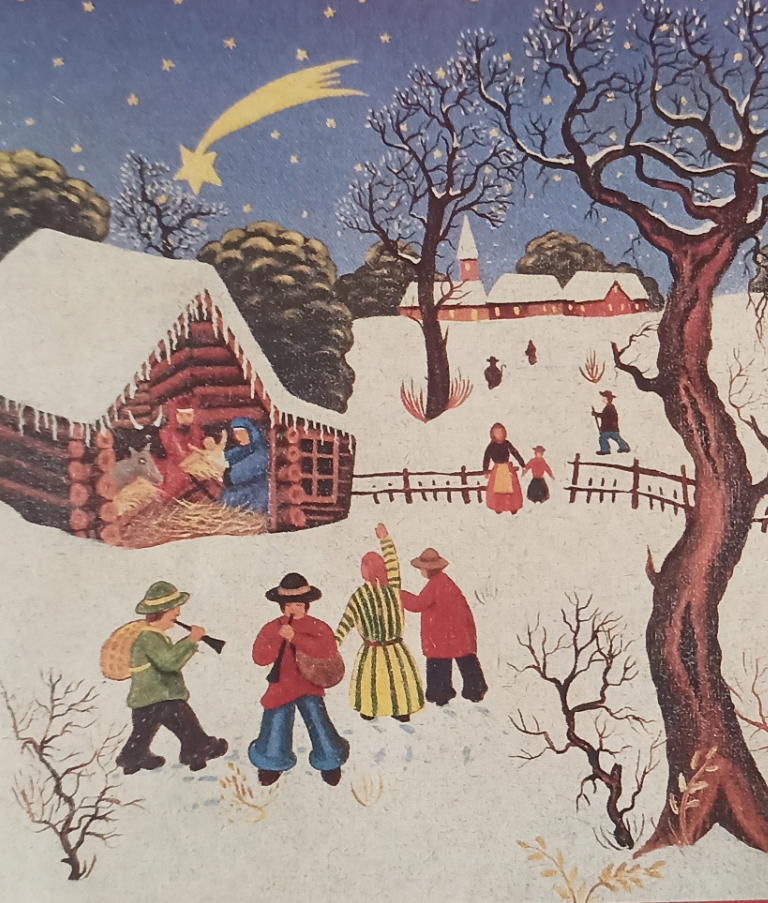
Nativity Scene: The Star of Bethlehem, by Russian artist, Konstantin Rodko.
‘Those who would rule by force are destined to fall, while the King of Kings shall reign forever’
By Norman Vincent Peale
At this time of year, we celebrate the birthday of the mightiest figure who ever came into human history. There has never been anyone else who even remotely approaches Him in stature or in long continuing influence. His is the wisest, the kindliest, the most penetrating personality in all history.
We are celebrating the coming of the King. And what a coming it was! Only God could have conceived it so. The sophisticated dramatists and stage directors of our day would have managed it very differently. They would have surrounded it with the trappings of pomp and circumstance. They would have painted it in glamorous colors, and preceded it with fanfare. But, you see, they are not subtle and wise in the ways of human nature. God ordained that the coming of the King was to be in circumstances of humility, simplicity, poverty, humanity.
For many years, I wanted to visit the Holy Land. If I were to live my life over again, the first thing I would do as a young preacher would be to go to the Holy Land and walk those sacred fields, while I still had the great gift of youthful appreciation and enthusiasm. I was past 50 when I did go, but even so, it gripped me.
I shall never forget the day when I went up to Bethlehem. All my life I had heard of Bethlehem: “O little town of Bethlehem, how still we see thee lie.” I can remember the excitement in my heart. At last, I was going to see Bethlehem of Judea.
We went up a twisting, turning road, through the desert of Judea, barren and rocky, devoid of all life: alkali fields receiving the burning sun and making the heat almost unbearable, blinding our eyes with the dazzling light. It was through this same desert that Mary and Joseph had come that day, long ago.
Then we came to the fields where the shepherds were – a place still called the Shepherds’ Field. I looked down upon the field and wondered about what those shepherds had experienced. This was the same sky in which they had seen the mystery and the glory. Who were they? They were just simple, untutored men – living with their sheep under the open sky. That they understood the magnitude of what they saw and heard, there is no doubt, for they said, “Come on! Let’s go to Bethlehem! Let’s see this wonderful thing that has happened…” (Luke 2:15, THE LIVING BIBLE).
Bethlehem was in sight as they said this, for it is on the hills nearby. Driving there, you emerge from the desert into a land flowing with milk and honey. The grass is green, there are olive trees and pomegranate groves. Bethlehem means, in the ancient sense, “house of bread,” or “place of fruit.” There it was before me: Bethlehem – where He was born.
The living reality of it all, the spanning of the centuries, was then made real to me by a small incident. At the intersection of a little roadway, I saw three people and a donkey. On the donkey was seated a young woman. She wore a long, white, flowing garment. In her arms was a baby. The donkey was being led by a stalwart man with a brown face and dark eyes. He wore a little pointed beard, a white headdress, and flowing robes.
The woman looked at our group. There was a very sweet look on her face. Then they passed by, up the road to Bethlehem. And I had to rub my eyes, for it was as though 20 centuries had fallen away. The entry of Mary and Joseph into Bethlehem must have been very much like that.
Is it not amazing that out of such humble circumstances there should have come a figure who won, as no other man who has ever lived, the undying devotion of multitudes beyond number; and who has so profoundly affected civilization over 20 centuries; a figure whom millions love and follow, generation after generation, while so many other celebrated leaders rise and fade away?
I visit Paris now and then, and I usually stay at a hotel in the Place Vendome. It is in an old-fashioned square, lined with buildings that go back over 300 years. In Paris, they wisely maintain the old facades and put modern buildings behind them, so that you have both the charm of the old and the comfort of the new.
In the center of this square is a monument to Napoleon. It is a tall shaft of bronze, on the top of which stands the figure of the Emperor. In his time, Napoleon was quite a man. He made himself lord of Europe. Under his magnetic personality, great armies came into being, and he swept over the European continent until he dominated it all.
Finally his empire crashed, as do all empires built on force. The end of it came at a place called Waterloo. Later, some years after his death in exile on Elba, Napoleon’s aged mother witnessed the erection of that monument in the Place Vendome. She looked up at it with dim eyes and said, “The Emperor has come back to Paris.” But he had come back only as a bronze statue.
The tall shaft of the monument, they tell me, is made from Napoleon’s melted-down guns – guns that thundered at Austerlitz, Marengo, Moscow, and Waterloo. Sculpted in bas relief on the sides of the shaft are scenes from those great battles. Ceremony, circumstance, fanfare, trumpets, banners, scepters, and orbs. That was Napoleon the Great.
And what did Napoleon say about the Baby born at Bethlehem? He said, “Caesar, Charlemagne, and I created mighty empires. Upon what did our genius depend? Force. Jesus founded His empire upon love and spiritual truth. Our empires faded away. Millions hold Him in devotion.”
That is a statement that has great meaning for all of us today. It points us to the only answer to the problems of our time. We will not save modern civilization in the chancelleries of Europe, or at the State Department in Washington. The future of the world will be saved in the hearts of simple people of all countries who believe in Jesus Christ and who, as a mighty flood, wash moral force up into high places, until the leaders of the world have to go for it. That is it. It has taken a long time coming, but in the end it prevails.
“Though the mills of God grind slowly, yet they grind exceeding small.” And you might add, they grind continuously, eternally, on and on. Today, we have a sense of the value of humanity that the ancient peoples never developed. Thanks to the influence of Christianity, the individual human being, whether black, brown, white, or yellow, has come to be regarded as a sacred child of God.
We also have ideals of freedom. We have ideals of peace today that men did not have even 50 years ago. Enough has happened in the past year to have brought on a third World War – if there hadn’t been something that wouldn’t let it come. That something is the dynamic Gospel of Jesus Christ.
You may say I am optimistic. Certainly I am optimistic. No pessimist has the right to preach the Gospel of Jesus Christ. How can you read the Bible and be a pessimist? The Gospel tells us unmistakably that nothing is too good to be true. That is why Jesus is King. Jesus taught some subtle truths, and in the end His truth prevails. It is strange about His teaching. It is subtle and yet simple, so simple that it baffles the sophisticated mind.
How to get along with people
Jesus has a wonderful way of putting things into an easily understandable form. He tells us quite simply to quit hating and start loving one another. He says the way to get along with a person isn’t to resist him, but to do good to him. He says instead of fighting with people, treat them kindly.
Yet, so many persist in believing that the only way to get anywhere is to resist. We have a lot of people today who say, “Nobody’s going to push me around.” Whenever you hear anyone saying that, it means the person is riddled with an inferiority complex. But Jesus taught that the way to get along with people is to love them, to be kindly.
Television’s Garry Moore once told me an interesting story about two Chinese gentlemen. One was Ling Toy, owner of a marvelous restaurant where wonderful food was served, and a place everyone visited. Mr. Toy was a magnificent host and his business prospered. Besides, he had the field all to himself. That is, until a young Chinese by the name of Wang came along and started a new restaurant across the street.
“What right has he to come in here and challenge my business? I will ruin him,” Ling Toy said.
So he told everyone that Wang served out of a dirty kitchen, that he kept customers waiting too long, that he didn’t know the skillful art of blending Chinese foods. He just filled the community with criticisms of Wang.
Now, Wang was a Christian. He was a follower of the King and he used the subtle wisdom of the King. When anyone told him what Ling Toy said, he replied, “Oh, no, Ling Toy would never have said that. He is a gentleman, a great and kindly Chinese gentleman, and one whom I honor as a genius. Besides, I’m only Wang, a young restaurateur, and not worthy of his notice.”
When people told Ling Toy all the things that Wang had said, he was astonished. He went across the street into Wang’s restaurant and told him that he would like to be friends.
Garry Moore later went in to compliment Wang on his victory. “Don’t compliment me,” he said. “Let me show you the ancient wisdom of China.”
And he took Moore back where he had a sign over the door to the kitchen where he, Wang, saw it every time he went by. “That enemy is best defeated who is defeated by kindness.”
It is an ancient wisdom. It is a subtle truth. It is why Jesus said, “Love your enemies…pray for them which despitefully use you (Luke 6:27-28).” Did He say this because it was some kind of idealism, unrooted in practicality and truth? No. He said it because it works and that is why He is King. If you love people, people will love you. And, in any case, your love activates dynamic forces of good. Jesus is no impractical visionary, His teachings actually work, in any situation.
A Pastor who hated another Pastor
THERE WAS A YOUNG MINISTER who once came to see me. He had just gotten out of the seminary and he thought he knew all the answers. “How are you getting along in your church?” I asked him. “Well,” he replied, “not so good. But,” he added, “the Baptists aren’t doing any better.” It was as if he had said, “I’m not doing very well, but thank God the Baptists aren’t any better than I am.”
I said, “Do they have a good preacher at the Baptist church?”
“Well,” he said, “he’s a nice fellow, but….”
“Is he a good preacher?”
“Yes. Well, he uses a lot of words, but….”
“Is he a fine man?”
“Well, he’s all right, but….”
I never heard such a string of “buts” in my life. “Could it be, son,” I asked, “that you don’t like this Baptist preacher?”
“Oh, no,” he said. “I like him. I like him. But I don’t have to be a buddy of his, do I?”
“Well,” I said, “no, you don’t, but why don’t we get down to the facts. You don’t like him.”
Then he started beating around the philosophical and psychological bush.
“You hate him,” I concluded.
“I am a minister,” he blustered.
“Yes, but you’re also human. The centuries of civilization have put a veneer on us, but down underneath is still the old Adam.”
“Well, what do you think I ought to do?”
“Why don’t you pray about it and get the wisdom from Jesus?” I asked him.
“Don’t go telling me that love is the answer.”
“That is exactly what it is,” I said. Strange that I had to convince him. “Here is what you do. Every night and every morning, pray that the Baptist church will be filled to overflowing with people, and pray for the Baptist preacher, that he shall be filled with the power of God.”
“Well,” he said, “where do I come in?”
“The more you give out, the more will come in.”
Well, that young man was basically all right. He said, “I’ll do it.” And he proceeded to crown his preparation for the ministry with a real conversion to Jesus Christ. He prayed so well that the Baptist church filled up – and so did his church. And today, these two ministers love each other.
That is why Jesus is king; because His Gospel works. It works in all human relationships. And if you can make it work between two people, you can make it work between two thousand, two million, even two billion people. The principles are sound and, when practiced, they prevail. That is why Jesus is King. Through His greatness, He can make you great. So, at Christmas, believe in His power to change you and to change the world.
First published December 1991, by Plus, The Magazine of Positive Thinking.
The Peale Foundation © 2023
Disclaimer
Comments expressed here do not reflect the opinions of Vanguard newspapers or any employee thereof.