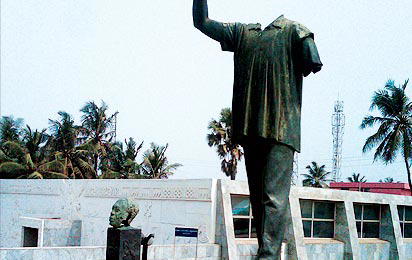
Kwame Nkrumah’s destroyed sculpture at the memorial park
By McPhilips Nwachukwu
The caption of this story is shaped by the experience of this reporter during a three day intensive media workshop appropriately tagged; Annual Course for Reporters organized for journalists by Guaranty Trust Bank Plc last week.
Held in Accra Ghana, and right in the bowel of prestigious MovenPick Hotel in the central business district of that bustling city, the programme was designed for reporters that cover arts, business, brand, money and capital markets.
The occasion was a beautiful moment of remembrance in two senses : First, in the sense that the organizers, GTbank remains the only financial institution in the country, which has designed such a training programme to help deepen the professional growth of journalists who cover the bank’s activities.

Kwame Nkrumah's destroyed sculpture at the memorial park
One may wonder and ask, why training for the arts and entertainment reporters by an organization that its business is deeply structured into business and allied financial affairs?
The answer is very simple: and lies in the commitment of some of the founding fathers of the bank, and especially in the vision of late Tayo Aderinokun, former Managing Director, who under his leadership the bank demonstrated and has continued to show undeniable corporate interest in the promotion of arts and literature.
Besides, as an innovative bank, there is no doubt that the bank would soon become one of the leading banks to cash into the emerging and promising African arts market, which in the last few years following world global economic recession has shown prospect of great economic fortune.
Apart from the fact that GTbank is known in the visual art circle of Nigeria as one of the biggest corporate collectors of African art, a fact which is demonstrated in almost all its branches where ever it operates, recent art auction sales in Lagos and around the world concerning African art has shown that investment in art and entertainment will soon turn to gold.
In the course of the three day training under the theme, Today’s Journalism for Sustainable Development, reporters were taken through classes in different aspects of media by renowned professionals in the industry.
For instance, Professor Emevwo Biakolo of the Lagos Business School discussed, Professionalism and Social Responsibility of the Media while his colleague Austin Nweze looked at Economics and Business Journalism. While Mark Leftly of The Independent of London spoke on Sourcing, Contact Building and Effective Communication : A British Reporter’s Perspective on Modern Journalism, brand expert, Tunji Olugbodi of Orglyv talked about branding.
The three day programme, which was attended by participants from Nigeria, Ghana, Sierra Leon and Liberia also provided opportunity for reporters to share cross country and cultural experiences about the prospects and challenges of journalism practice in Africa.
During the intensive training programme richly laced with fantastic aerobic exercises, participants, especially those that write arts discovered further openings in reporting the arts, especially from the point of view of business and political economy.
In the course of enjoying this moment of remembrance, which the bank extended to these journalists, another opportunity was also provided to look around town: first, to go on a courtesy call to the Ghana branch of the bank and second, to visit the popular Kwame Nkrumah Museum, popular known as Nkrumah Memorial Park in Ghana.
The Park, which houses the mausoleum erected for the first President of Ghana, Osagyefo Dr. Kwame Nkrumah has an arresting imposing sculptural monument of the late liberator adorning a vast area of land beautified with engaging water works.
It is dedicated to him for his outstanding campaign in the liberation of Ghana(by then Gold Coast) from colonial rule in 6th March,1957. The Museum houses the late leader’s personal effects including household furniture, books, pictures, publications and cars.
At some place in the park is another headless sculpture of the late President, which is said to have been destroyed by mob during the 1966 coup that toppled Nkrumah’s government from power.
By the side of this great sculpture was the decapitated head, which a park attendant explained was taken away by a patriotic Ghanaian and preserved for forty years in the United States before being handed over to Ghanaian government.
Today that decapitated sculpture and the head, that was previously mounted opposite the country’s parliament building is now resting in the peaceful and well attended home of the memorial park.
Is there a more beautiful way of remembrance? For all the good that Nkrumah stood for, Ghana and Africa? And how else, can the country keep alive the spirit of such a hero and dogged defender and fighter for his people except through this way?
But wither Nigeria and late Nnamdi Azikiwe? The first Governor General, Premier of Eastern Nigeria and frontline nationalist? Since 1996 that the late Owelle of Onitsha died, the place approved at Innosi Onira near Army Barracks in Onitsha to construct a final rest house for the former Governor General has not seen the light of the day.
According to an internet sourced report published in The Nation Newspaper of 16/10/11, it is alleged that “About N125 million frauds has been uncovered in the award of contracts for the renovation of Nigeria’s former President, Dr. Nnamdi Azikiwe. This is coming just as part of the perimeter fence of the mausoleum collapsed.”
Following this kind of report and the politics also alleged to have trailed the completion of a befitting monument for this iconic leader, the first among his equals in many ways in Africa, one begins to wonder if Nigeria like Ghana is observing a befitting remembrance for Zik of Africa.
Disclaimer
Comments expressed here do not reflect the opinions of Vanguard newspapers or any employee thereof.