By Fortune Eromosele, Abuja
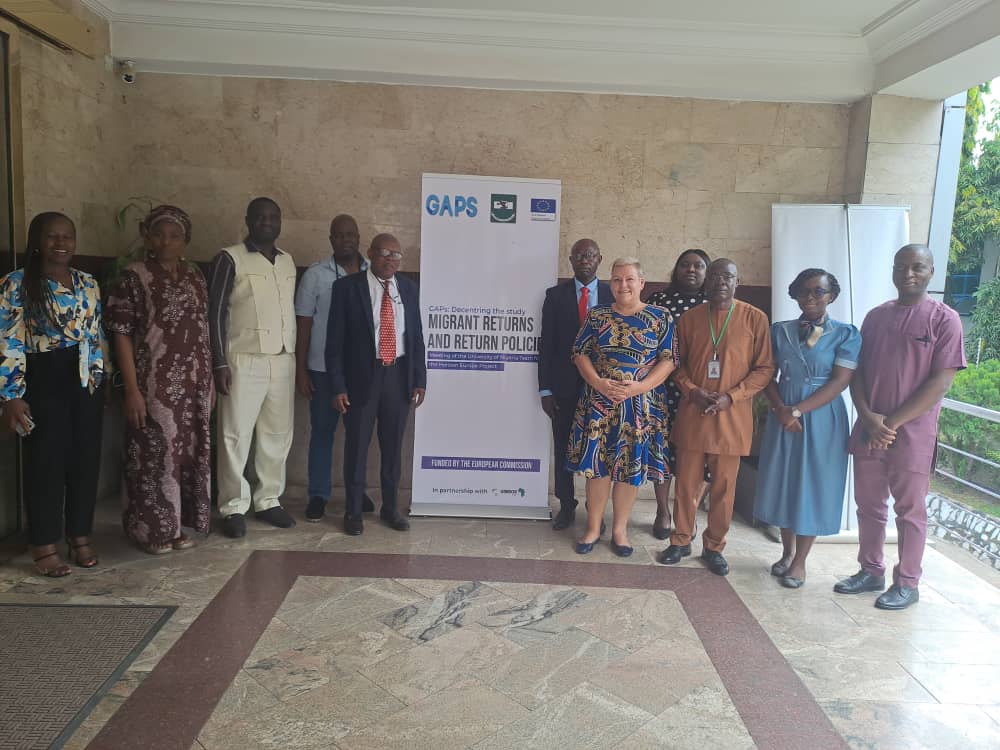
Stakeholders drawn from international development agencies, civil society organizations, research institutions, and government institutions have converged to brainstorm on a research project called GAPs, which is a comprehensive, transnational and interdisciplinary research project focusing on the drivers of return policies, bilateral cooperation on returns and the experiences of migrants in the process.
The project examines the disconnects between expectations of return policies and their actual outcomes by decentering the dominant, one-sided understanding of “return policymaking.”
GAPs will scrutinise the shortcomings of the EU’s governance of returns internally and externally and examine the complex interactions of policymakers and local actors involved in return processes to shed light on cooperation failures. It will also analyse the perspectives of migrants themselves to understand their knowledge of return policies, aspirations, and experiences.
By taking a close look at governance, cooperation and actor’s agency, the project can suggest new avenues for international cooperation, develop recommendations for stakeholders and explore alternative pathways to returning migrants.
The project involves wide-ranging and innovative impacts, including the creation and works of an interactive data repository on returns, a return cooperation index, return governance indicators, policy briefs and workshops, the formation of stakeholder expert panels, a digital storytelling and video series, the launching of Massive Open Online Course (MOOC), as well as open access policy and scholarly publications.
The GAPs project which is funded by the European Commission consists of a consortium of researchers from 17 renowned universities and institutes from North America, Europe, Africa, and the broader Middle East seeking to examine the disconnects between the expectations of EU return policies and the actual outcomes and shed light on the perspectives of returnees. A team of researchers from the University of Nigeria Nsukka (UNN) is the Nigerian partner.
Speaking to Vanguard exclusively at a stakeholder meeting on the GAPS project on Tuesday (14th November 2023) in Abuja, a member of the Nigerian team on the GAPs project and the Deputy Provost, College of Postgraduate Studies, the University of Nigeria Nsukka, Professor Chukwuedozie Ajaero, explained that the GAPS project serves the purpose of interrogating EU return policies and the outcomes of the implementation of those policies.
He added that the success of the project does not only rely on one actor, like the government, but all relevant stakeholders such as migrants, CSOs and other research institutes.
According to him, “There are policies developed by the European Union on how to return migrants and reintegrate them, which is a model they provided. But this project is trying to interrogate even within the EU themselves, the levels and differentials in commitment and implementation from country to country.
“The shared experiences that people have like being forcefully returned from Europe are what the Nigerian government and policymakers can now use to engage these countries and the European Union.
“We believe that the result of this is to pull everyone both the government, CSOs, and research institutes to come and rub minds. We don’t want one narrative; we want to look at multiple opinions on the issues of return and reintegration”.
Speaking in the same vein, the UNN Principal Investigator for GAPs and the Lead Consultant of GIMBOS Plus, a local partner in the GAPs Project, Ngozi Uzomah, also gave further insight into what the GAPs project intends to achieve.
He said, “This initiative is a research project that is funded by the European Union to investigate the disconnect between the policies of return migration made in Europe by Europeans and the actual outcome in countries like Nigeria, Afghanistan, Turkey, Iraq and others.
“The project will investigate to find solutions to the inadequacies in the return governance and reintegration of returnees into the society. That is one of the objectives of the research. To find out the problems and make recommendations which will be in the form of scholarly publications policy briefs and digital story telling among others.
“Key informants from international development agencies, and government agencies such as the ICMPD, NCFRMI, IOM, and GIZ as well as the returnees will be interviewed during the project from 2023 to 2026, to understand their views and find solutions to the problems”.
On his part, Professor Ignatius Madu of the Department of Geography and Environmental Sustainability, UNN, who is also a member of the Research Team, called for more collaboration and funding.
He said, “This research involves other institutions in the world and the University of Nigeria Nsukka is the only partner in Nigeria. One of the challenges is funding as the fluctuating Naira makes it impossible to have an equivalent amount of money like the foreign counterparts. This makes it difficult for us Nigerian team to execute the research seamlessly.
“We are asking for organizations and industries to assist us by funding the research so that the outcome will meet up with the standard that other partnering universities and institutions in other countries will have”.
Disclaimer
Comments expressed here do not reflect the opinions of Vanguard newspapers or any employee thereof.