By Obinna Chilekezi
I came to know Chief Mbey without the Emmanuel or Agha, as we know him at the Nigerian Insurers Association (NIA) as not just one of our printers but a close friend to our then now deceased Director-General, Chief (Reverend) Funmi Adeyemi.
There was this widely held belief then that for one to be in the good books of Chief Adeyemi, one must be an angel. Chief Adeyemi was not just thorough but a perfectionist. But we observed that he never for one day criticized or condemned Chief Mbey’s work. The friendship between Chief Mbey and Adeyemi was seamlessly transferred to his successor, the late Mr Ezekiel Chiejina and down to those of us who were line managers at the Secretariat.
I think it is appropriate for me to recall a personal experience with Chief Mbey that came to endear him to me to date and will continue for as long as God keeps us. It was in August 2008, when a new Chairman took over the reins of the Association, and whose first great achievement was to ask me to leave the NIA for no reason. However, on my part too, I felt it was a clarion call to go and test the waters outside the ocean. I resigned and left the NIA. For those of you who know what it takes to facilitate some activities like supplies and printing among others in many organizations in Nigeria will know that at festive periods like Christmas, suppliers and service providers will always come to “say thank you”.
In the year that I left the Association, I had worked independently mostly with two printers – Mbeyi & Associates (Nig.) Limited and another whose name I would not like to mention. I did not tell any of them that I had left the organization, so the other printer came with his bag of rice and asked after me, and was told by my former colleagues that I had resigned. But he could not leave the bag of rice in the custody of the organization nor find a way to reach me, rather he told my colleagues that it was no longer necessary and he went away with the bag of rice supposedly meant for me. During the same period, Chief Mbey came with his bag of rice and was also told that I had left the NIA and was told to drop his bag of rice. He politely refused, but rather took it to his office, put a call to me to first inquire why I resigned, and finally arranged how his thank-you bag of rice could get to me. That’s the man Chief Mbey for you!
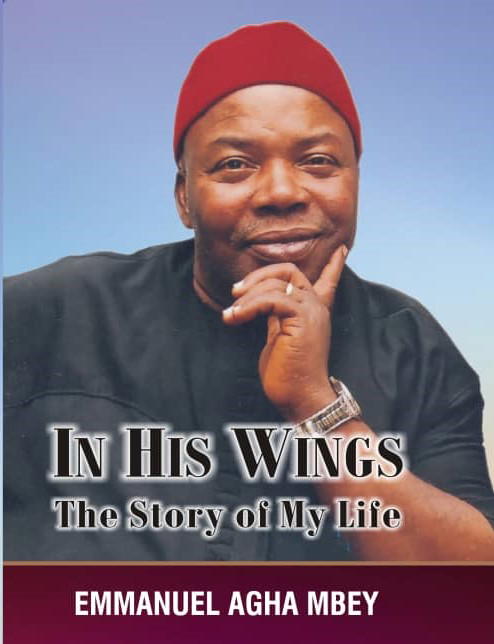
I think it is this attitude of appreciating others that drives his lifestyle. Little wonder his memoirs are titled: In His Wings. Yes, in His wings, God is taking him higher and higher in life. My first impression of the book is that this is another Things Fall Apart as the language and the historical background of the events that took place in Igbo land at various times, but this time, from the Afikpo perspective is well detailed. We cannot expect anything less as Chief Mbey has been at the forefront of documenting events in and around Afikpo in his now-rested Afikpo Today magazine – a magazine that although an Mbaise man, I was opportune to read from one edition to another from 2003 when I joined the Nigerian Insurers Association until when the medium left the journalism space.
Now, the Book
This is a nine-part book with forty-five chapters with varying number of pages but consisting of 508 pages, which I believe would be tiring for a lazy reader to go through in a record time.
Part 1 1952 – 1959
This part is made up of three chapters with the theme: “My Earliest Years.” Chapter one focuses on the history of Afikpo from the author’s perspective, citing Ralph Oko Aja to support his claim that Afikpo is one of the oldest settlements in Igbo land. This chapter tells us that Afikpo is in the league of towns whose names were bastardized by white colonialists as towns like Owerre, which became Owerri, Awka instead of Oka, and the funniest among them all, Eho Igbo or Afo Igbo, which later became known as Afikpo. One good thing with this chapter is that it brings us a brief the history of Afikpo.
Another major take in chapter one is the explanation of the matrilineal lineage system or matriarchy in Afikpo, which is not too pronounced in other Igbo towns and how it allows them to avoid marrying blood siblings from their mother’s side, but they can marry from the father’s side, which other Igbos forbid. It removes this “shock” of I don’t understand Afikpo, Arochukwu, Ohafia, Abiriba, etc., people who marry their sisters! Sisterhood is seen in these areas from a different cultural lens different from other Igbo-speaking areas. Chapter two tells the story of the beginning of Chief Mbey’s earthly sojourn.
On names, I am fascinated by the way people from Afikpo and their neighbours bear names. I have this friend whose name is double-barreled: Imo Imo. What a marriage of names as I never fully understood such double-barreled naming, until I read Chief Mbey’s In His Wings.
The last chapter in this part is on the need to acknowledge good people. The lesson from this chapter is that in this world, there are still good people like Mama Mgbo-Inya Okogwu, and that we will all reap whatever we sow.
Part 2 1960 – 1969: My Growing Up Years
This is an eight-chapter part, but to make my task easier, we may ignore some chapters. However, I must say that all the chapters are important and close-knit as they help us to know the subject of the autobiography better. Chapters 4, 5, 6 and 7 focused on the author’s early childhood, which could be summed up beautifully by using the words of Prof. Oko Okoro, who had noted in his Foreword to the book that:
“The author lived through a very challenging childhood. But, the true child of destiny that he is, God has indeed wrapped His protective wings around him. And each time that all appears lost, there is always divine intervention of sorts, and succour is never too far out of reach”.
This early childhood stage is stranger than fiction, and better left to the readers to dig into the book themselves to find out what it is all about. His love for his father is immeasurable.
Chapter 8 tells the story of HRH Ezeogo Michael Akpu Chukwu, whose name he first heard from his stepmother. A man who was highly admired by Afikpo people – an admiration that made the author decide to be like the man when he grows up; hence the chapter is titled: “HRH Ezeogo Michael Akpu Chukwu as My Role Model.” According to the author, “whenever I heard Mama Ubeyi-Eze shower praises on him, I usually said to myself: that is the man I want to be like when I grow up, a man whom people will speak very well of.” Little wonder Chief Mbey ended up as the Akpu Chukwu of his own time.
In chapter 9, Chief Mbey recalls his relationship with HRH, Ezeogo John Obeni Ekuma. He made us to note that the late Ezeogo was one of the great sons of Ugwuegu Community, as well as his hero and mentor. The Ezeogo aside from teaching him in Infants I & II took interest in his overall development as a person, and encouraged him to eschew bad behavior in his growing up years.
This chapter also recounts some cheery experiences in the life of Chief Emmanuel Mbey, which ultimately rubbed-off beautifully in the life-long relationship he had with the Ezeogo. Another interesting story is his being drafted to the Ezeogo stool by the youths of his community and his refusal based on personal reasons, and how through his suggestions the youths chose Mr. John Ekuma for the Ezeogo stool.
Chapter 10 is on his primary school education. According to the author, on an evening in January 1960, the then Mr. John Obeni Ekuma, who later became the Izuegu Afikpo Autonomous Community, visited his aunt, Mama Anwara-Aka and requested that he joined his mates who were already in School. This was how he was enrolled at St Mary’s Primary.
That was how he started his primary school education, which he completed in 1966 after seven years. The author wrote on how good life was for him in school due to his interest in learning and the love his teachers showered on him because of his intelligence. His education was however cut short by the war.
Chapter eleven focused on the rich culture and state of Afikpo community in his growing up days in the sixties. It is titled “The Afikpo I Grew Up In.”
Part 3: 1967-1969 – The Nigerian Civil War Years
This part contains 7 Chapters. Chief Mbey in these chapters recounts his experiences during the war – a period that could be described as the darkest period in the history of Igbo land and of the Igbo people. Reading this autobiography, one can gauge his feelings on the Igbo question in Nigeria and more so, the relationship between us now, after the war and to date. I seek your indulgence not to make further comments on how I feel as an Igbo man living in a country that does not want me to be fully a part of it, and yet does not want me to chart my course. What an irony!
Afikpo like most other towns in Igbo land fell to the superior fire power of the federal government fighting alongside its British, American, French and Russian allies. Yes, Afikpo fell to the “Terror from the Air” manned either by a Russian, an Egyptian or an American. Our people became refugees and displaced persons, lacking everything that made life worth living. We suffered kwashiorkor and all kinds of degradation.
If it were today, not even the ants would have been spared. But Igbo ga adi! The war was not without its own bitter tale as most homes were destroyed – a testimonial of the superior might of the federal soldiers. But there is God oooo! The war has ended, but has it really ended?
Chief Mbey acknowledged the support the people received from charitable groups like the Caritas of the Catholic Church and the World Council of Churches. I pray God to continue to bless them. The question that should bother us today is this: if the war actually ended in 1970, how come we still hear of MASSOB and IPOB? Something must be wrong somewhere, I cannot say more than this.
Part Four 1970 – 1979: The Learning Years
It is made up of nine chapters beginning with chapter nineteen. In the chapter titled “Goodbye, Afikpo,” the author lamented the loss of Biafra and the associated pains during its short existence. It was this fall and may be the pains experienced in Igbo land that propelled the natives to “leave” their ancestral homes in the quest for survival soon after the war. This migratory trend took the Igbos not just to many cities in this country, but to every nook and cranny of the world. The Igbos became a global people all thanks to the short-lived Republic of Biafra.
This was how Chief Mbey left Afikpo in May 1970 with his uncle to Lagos – the then capital of Nigeria and where this book presentation is holding now. Chapter twenty further dwelt on the transitional and cultural shocks he experienced in Lagos – the surprises and contradictions that makes, and still makes Lagos what it is. Not forgetting the glistening side of Lagos, which the author had subtly described his experience, thus: “I almost got sucked into this ‘strange’ culture when one of the girls in our compound started calling me all sorts of derogatory names for not yielding to her amorous advances in 1971”. Thank God he did not cave in. For if he had, maybe we would not have the Chief Emmanuel Agha Mbey we are celebrating today.
Chief Mbey the young entrepreneur is the subject of chapter twenty-two. This chapter should be a manual for young entrepreneurs, as it unveils the entrepreneurial lessons they will not teach you at Harvard, which is “hold-on tight” irrespective of the current business situation. At the thick of the suffering in Lagos then, his uncle called him out with these consoling words: “Mbey, I know that we are suffering, but be assured that what is hot today will one day become cool (sic)”. That’s it, and that became the guiding mantra in the later years of Chief Mbey. Chapter twenty-four dwelt on how his uncle started business afresh, while chapter twenty was on the warm relationship between him and his younger brother, Sunday Agha Mbey.
An interesting part of this chapter is the part where Chief came up with the suggestion that he and his beloved brother should separate from the joint-ownership of the business they both established. That was the mark of entrepreneurship, which makes the book a manual for young business owners – little wonder it is said in some quarters that Igbos are born business people. The author exhibited much of this “business sense” from a very early age in life.
Chapter twenty-six revealed how he and his cousin, Daniel Egwu grew the thirteen pounds given to them by their uncle to thousands of naira in just two years. This chapter showed what dedication and “girding of one’s loins” could do for young people who want to grow their business enterprise. According to him, “We worked day and night to grow the business our uncle handed over to us with vigour”. He also narrated the problem encountered during the changing of currency from pounds, shillings and pence to naira and kobo in 1973. This means that this ‘Emefiele” problem is not new to our financial and monetary system.
Chapter twenty-seven dwelt on his quest for economic security. Chapter twenty-eight is on his quest for education and self-improvement and how he wrote his first-ever published article. In Chapter twenty-nine, he talked about how his enterprise continued to flourish, and the ventures that gave them so much money and increase.
Part 5: 1980 – 1989: The Foundational Years of My Business
It contains five chapters, with chapter 28 captioned: “Yet, Another Beginning.” This chapter is devoted to how he and his brother decided to leave their master and uncle to set up their own printing company.
Part 6 1990 – 1999: The Growing Years of My Business
This part narrated the events in his life from 1990 to 1999. One of the interesting things with this part is that the first chapter dealt with the kidney stone problem he had in 1990. This shows that our super man is human after all. Chief recalls his encounter with the Nigerian medical practice or rather his journey to Germany for eventual treatment.
Chapter thirty-three dwelt on the launching of Afikpo Today Magazine. I must confess that I am not from Afikpo but all the same, I enjoyed reading every edition of Afikpo Today while it lasted. I thought that by now someone else would have taken over that magazine instead of allowing it to go comatose. There is no doubt that Chief at some point got tired of the mounting challenges of publishing such a high quality magazine, and painfully decided to rest it after holding on for twenty-two years. But then, I challenge the people of Afikpo not to allow the magazine to die because it is all about Afikpo Today and not about Chief Emmanuel Agha Mbey Today. In Chapter thirty-four, Chief wrote about the relocation of his then flourishing printing press from Surulere to Okota where the press still is till date.
Part 7 2000 – 2009: The Years of Consolidation, Trials and Tribulations In this part, the author recalls remarkable incidents and his sad experiences from 2000 to 2009. In chapter 38, he talked about his heroes and mentors – men, women and friends, who were there for him in his business life and gave him jobs, which enabled his business to flourish. He still cherishes his relationship with all of them, including those who have passed on.
Part 8 2010 – 2022: The Years of Preparing for Retirement
This part is about how age is creeping up on him and how he is preparing for the inevitable retirement that must follow. Thank God he is making preparations for retirement even though he still looks too young to retire.
Part 9: My Nuclear Family, Christian and Social Life
In this part, the author talked about how he met his wife. He also talked about his children. His Christian life started in 1959 and he was baptized in 1965. He also talked about his membership of some societies in the Catholic Church.
One interesting thing in this chapter is how Chief joined Afikpo Town Association here in Lagos at a very young age. He also talked about his activities in his community union.
Conclusion
In His Wings: The Story of My Life is not just about Chief Emmanuel Agha Mbey. It is about entrepreneurship, tenacity and hard work, and one every young entrepreneur must read. It is also a historical and sociological book on the people of Afikpo, and one that brought to light the travails Igbos suffered during the Nigeria-Biafra Civil War, and still continues to suffer in the contradiction called Nigeria.
This is a book that is unputdownable! Once you start to read it, you will not stop until you gulp in the last words.
Distinguished ladies and gentlemen, please join me in congratulating Chief Emmanuel Agha Mbey for not just telling us the story of his life, but for also giving us a well told story not only about the issues that mattered to him, but also issues worth thinking about.
Thank you for your attention.
Disclaimer
Comments expressed here do not reflect the opinions of Vanguard newspapers or any employee thereof.