Fish farmers groan as climate change, inflation, others impede sustainability
By Ebunoluwa Sessou
Climate change, inflation, exchange rate, VAT, flooding, unfavourable tax policy, insecurity among other challenges have been identified as impediments to the progress of fisheries in coastal areas of Nigeria.
For female farmers in Epe, Badagry and Ikorodu area of Lagos, Nigeria, staying in business and making profit to earn a living, as well as maximizing opportunities involved in fish farming are challenges they face daily making it almost impossible to progress.
Hearing their stories from different parts of the country, these women’s voices echoed the need by the government to give enabling environment for fish farming business to thrive.
Their demands include favourable tax policy, VAT removal, security, robust economic stability, good climate condition, conducive environment among others that would ensure total freedom and financial enhancement.
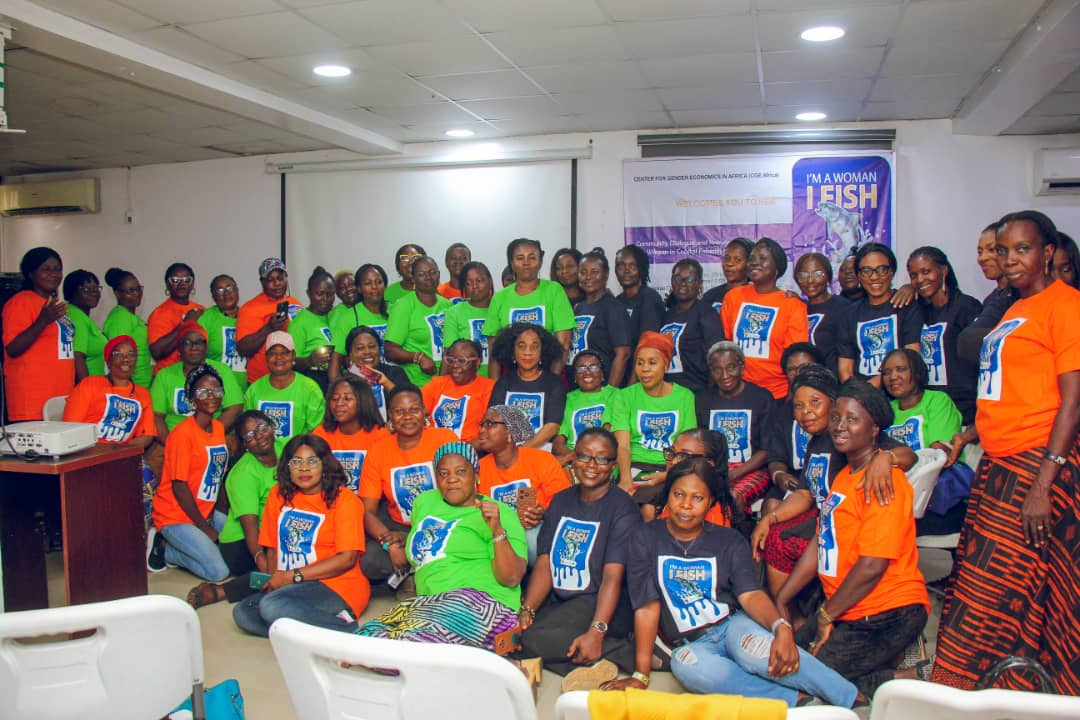
In the just concluded Project, Community Dialogue and Knowledge Sharing for Women in Coastal Fisheries, with the theme, ”Women empowerment in coastal fisheries in Nigeria: Increasing Resilience to Climate Change Adaptation through Films and Dialogues’, funded by the Africa Centre for Energy Policy (ACEP) and organised by Center for Gender Economics (CGEAfrica),the Executive Director, Uchenna Idoko, disclosed that the NGO is engaging with policymakers, executives, and the community to create innovative solutions for achieving economic equality, advancing work, and creating financial security for women.
According to her, the project was set aside to shed light on the challenges and aspirations of women involved in coastal fisheries in Nigeria.
“Coastal fisheries pay a vital role in the livelihoods of countless women in Nigeria, yet their voices and experiences often go unheard. Hence, this platform is dedicated to for women to come together, engage in open discussions, and share their experiences, challenges, and aspirations within the coastal fishing industry.
“A contribution that will significantly enrich the broader discourse on gender equality and sustainable fisheries in our nation”, she said.
Challenges
Sharing her experience, Kemi Esan, a farmer in Ikorodu, said, the challenges, female farmers have in fish farming include, high cost of feed. “The cost of feed is high and it is still increasing on a daily basis. Unfortunately, you cannot make a projection because you are not sure of what the price would be when you get to the market. The selling price does not commensurate with the cost of production because those who want to buy are not willing to pay for the cost of production that would enable us to make profits.
“We have the challenge of low quality of feeds. The total number of bags that we used to feed fishes in those days that would give us results within four months, cannot be compared to what is obtainable now. The quality of the feeds has been reduced. We have adulterated feeds in the market now.
“We also have challenge with the workers who cannot know the number of fish that would survive in a day. We used to have mortalities and most workers know all the loopholes in the business.
“There is another challenge with government policies that are not favourable. As much as we need to stay in business, it is very difficult and challenging.
“Neighbours complain of the smell of water. We want the government to help strategise on how to channel the water. If all the drainages are working, there would not be clogged water everywhere. Nobody will know that fish water is being discharged.
“We have the storage challenge. There are times we produce and the market women will take advantage on our produce because we do not have storage facility. If the government buys produce off farmers like developed countries, to the end users, it will help us. And it will be bought at a price that would be profitable. Unlike when the fishmongers take advantage of the producers because we need to sell off your products.
“We also have mortalities because of the movement of the fishes from one place to another. We have global warming challenges especially for those using earthen ponds. There is a flooding challenge. And when the dams are opened, it is an avenue for our fishes to be flushed out.
“Flooding affects fish farming as a result climate change and most times, the opening of the dams and rainy season are all effects of climate change. When the water changes, it affects fishes negatively. Fishes would survive in a very conducive atmosphere. But, if the temperature of the water is too high, it affects their growth. If the water is too cold, it is also very dangerous and that is why most times, as farmers it is important that we check the PH of the water. If the water is too harsh, it will affect them, if it is too cold, it affects the production and at the end of the day, it slows down the growth and affects the profits of the farmers.
In her contribution, Akanmu Adeola, a farmer whose business is in Badagry lamented that, the greatest challenge they experience as farmers is climate change.
“As a result of climate change, we experience salty water. This comes at a season. From April, we experience salty water and because of this, it is difficult for us to harvest. The salty water kills our fishes.
“We have no means for good lightening system, no security, no good storage system for our feeds. No power supply and that is why we are glamouring for solar system. We also experience adulterated feeds. And because of the adulterated feeds, the growths of the fish is compromised. There is high cost of feed. We also have issues with speed boat transportation which affects our fishes.
“The waves on the ocean also collapse the cages and this affect the fishes as many of them escape into the sea. This occured recently during our tilapia harvest, the speed boat was troubled by the ocean and as a result the cages collapsed.
Also Oluwatoyin Ajisegiri , corroborated that, due to the unavailability of power supply, it is difficult to sight the cages on the sea and because there is no light to signify that something is on the road, this allows the boats to collide with the cages and this causes the fishes to escape.
“Another challenge is inferior materials used to construct the cages. If good materials are used, a cage should be used for five years. But, because of inferior material, in under a year, they will have to construct another cage. There is no storage facility.
“We need the government’s intervention because we cannot handle it alone. Some of the villagers are extorting us because we cannot bring workers from outside.
“In Badagry, we have tilapia and catfish. We nurture our tilapia fishes in the sea. Those who are into earthen pond, also face the same challenge,” she said.
In Epe, Olugbemi Blessing, lamented the quality of water is always at interval within the year due to climate change. “We also have the problem of water hiscent. Water hiscent is a weed that grows in the water. When it surrounds the ponds and the cages, it reduces the quality of life of the fish because it will be feeding on the oxygen that the fishes need.
“We have problem with theft and unavailability of quality feed. We have problem with maintenance of the cages. The maintenance of cages is high. We have challenge with transportation. We do not have boats to ourselves. We only wait for others to come before we could go to where our fishes are.
“Governmental policy is affecting us. These policies are injurious to us. We have the challenge of water wave. At times, the wind and water will be high at the same time. There was a time, I could not go to feed my fishes until night,” she added.
Success story
Talking about their success stories, all the farmers also have something to share. In Ikorodu, Kemi Esan said, “Our success story is that fact that we can add value to all of our production.
“We are adding value to all our production. We are not stagnant. We are adding frozen catfish and introducing it to the cold room. We also have smoked catfish in our supermarkets, it can be delivered to homes, it can be exported if well-spiced. We have catfish in fillets. We are also producing fish oil”, she said.
In Badagry, Oluwatoyin Ajisegiri, said, “Our passion for the business is what is keeping us and motivation from our fellow farmers from other areas.
The World bank and Lagos state government through APEAS have been generous to us as well.
“On networking with those in Ikorodu and Epe, she said, they have clusters of farmers and as much as their location differs, they still connect,” she disclosed.
For Olugbemi Blessing in Epe, the success story is the fact that, they have a good location. “We have good location because our cages are situated in a proper and conducive place. We do not have a problem with sales. We have good water and a friendly environment. We have a reliable staff and good seeds. So far, we have good harvest and we are in charge of the price. We farmers control the pricing of our fishes.
“In Epe, we specialise in tilapia fishes, catfish, and shrimps and 80 per cent of the fish farmers are women,” she said.
The Call
In Ikorodu, the farmers are appealing to the government should come to their aid. “In developed countries, the government buys the produce of farmers and sells it to end users. The government should have processing plants in communities. The government should remove all the taxes and import duties on all our feeds so that the cost of production will be reduced. Once the cost of production is reduced, our profit margin will go up and the selling price will not be too high. This would enable everyone to be able to afford fish because we know that it is healthier to eat fish than meat. The government can give us grants, it can empower us through training.
“Every house should be encouraged to do fish farming to have plenty of fish in the market,” they called.
In Epe and Badagry, their call is that the government should provide life jackets and give an enabling environment to expand their businesses. “We are not meeting up to 2 per cent of the demand in the market. We need power boats, we need quality feeds. We need favourable governmental policy. We need quality materials to build our cages. We need an upgraded security system. We need cooling fans for easy transportation of our fish. Tilapia fishes do not have the strength to withstand heat. They die easily. We need blast freezers for tilapia fishes.
“We are looking at exporting our fish to neighbouring countries and we can not do it without blast freezers. We also process the fish by drying and we need a smoking kilm for that,” she said.
In a chat with the Executive Director, of CGEAfrica, Uchenna Idoko, lamented, “In Nigeria, women who engage in coastal fisheries face a multitude of challenges that impede their ability to thrive in this crucial sector. These challenges include limited access to essential resources like fishing gear, boats, and credit facilities, hindering their capacity to engage in effective and sustainable fishing practices.
“The impacts of climate change only exacerbate these problems, as rising sea levels, ocean acidification, coral bleaching, and shifting fish migration patterns disrupt the availability and productivity of fish stocks, further endangering the livelihoods of these women.
“Coastal women in Nigeria lack crucial climate information, hindering their fishing planning and adaptation. Gender inequalities and societal norms limit their participation in decision-making, hindering their voices in climate policies.
“Financial exclusion adds another obstacle, making it hard for them to access services and invest in climate-resilience technologies.
“To empower these women, collaborative efforts from government, NGOs, and the international community are essential for sustainable climate adaptation.
“Our project empowers women fishers to challenge gender norms and stereotypes, fostering recognition and active participation.
“This inclusive approach promotes innovative solutions in climate adaptation, policy, and resource management, ensuring a more equitable and resilient future for coastal women in Nigeria.
“We hope to build their voices by broadcasting it through short films for policy advocacy”, she said.
Disclaimer
Comments expressed here do not reflect the opinions of Vanguard newspapers or any employee thereof.