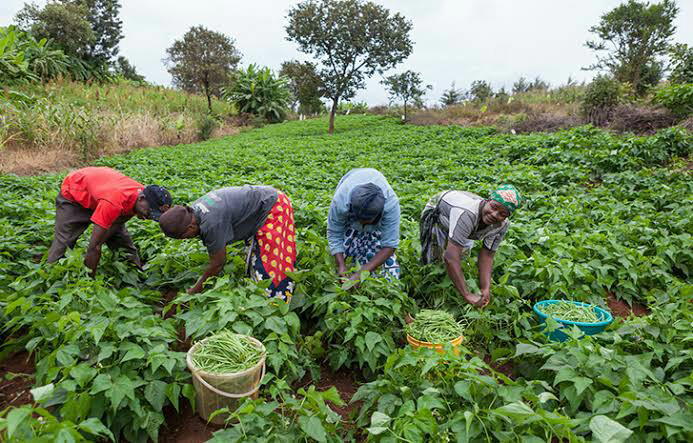
FILE IMAGE
….want use of flood water for crop, livestock productions
By Gabriel Ewepu, Abuja
As activities continue to mark 2023 World Food Day, WFD, the Food and Agriculture Organisation, FAO, Nigeria, and the Consortium of International Agricultural Research Centers, CGIAR, Thursday, counseled the Nigerian Government and farmers to transform the food system in order to tackle nutrition, climate change and population growth challenges.
Speaking on the sidelines of Agricultural value chain exhibition as part of activities of the World Food Day, jointly organized by the FAO and IITA, in Abuja, Head of Sub-office, FAO, Maiduguri, Al Hassan Cisse, explained that the WFD is not just an occasion but also for stakeholders including the farmers themselves, Civil Society Organizations, CSOs, private sector, donors, and technical organisations, therefore, pointed out that the theme of 2023 WFD, ‘Water is Life, Water is Food. Leave No One Behind,’ is towards the transformation of the food system, which is very necessary.
Cisse said: “The theme of the World Food Day of this year is on water and but to do not leave anyone behind, the transformation of the food system in this world is necessary. It is necessary because, in 2050, we will be having 9 billion people in the world.
“So we can’t continue to do as we used to do. It means that we have to transform our food system from the input to the consumption.
“We have to transform our food system, it means a lot of things, there are different factors that we need to take into consideration. One aspect we need to take into consideration is climate change. So the climate is changing, we need to find new way of adapting to climate change.
“The second one is what is the need of the population and how we are making sure that it is culturally environmentally acceptable so that we are meeting the need as well as not compromising the future generation.”
However, he acknowledged that FAO cannot tackle these issues, bit needs the collaboration and synergy of the government, farmers and other organizations.
“But all of that we cannot do it alone. We have to do it all together; all the stakeholders including the government, including the donors, the technical organization is that the Food and Agriculture Organization, FAO, the farmer, and private sector.”
Meanwhile, in mitigating the challenges occasioned by climate change, he explained what FAO has been doing in that regard, “FAO first of all is a technical organization. We are working with the government to advise and support them in policy design, as well as supporting the community in the field.
“Just to give an example in climate change what we are doing here today, we are working on anticipatory action, but we are working also to make sure that data are available so that we can prevent any shock.
“In the Northeast where we have one of the biggest programmes, what we have done is support the three states of Borno, Adamawa, and Yobe, BAY, to have climate-smart agriculture profile and also Climate Smart Agriculture investment plan.
“It contains all elements that are needed to deal with climate change and its effects on the population. Just to give an example on one effect of climate change is the drought and the flood.
“So the drought affects the population in a way that it reduces the crop production and also the livestock production affects the livestock production.
“When we have flooding also have a lot of damage on crop production. So what we are doing is to develop climate-smart variety in supporting the community.”
He also said the flood water should be used as a resource to boost food production.
“The float should not be considered as a calamity or as a disaster itself. We should find way of using the rainwater harvest for agriculture and livestock.
“For instance, why not, FAO is working with the government over the years to develop a scheme of rainwater harvesting that will be used not only for crop production but can be used for aquaculture and livestock,” he added.
Meanwhile, the Country Convener, CGIAR in Nigeria, Aline Mugisho, while explaining the essence of the exhibition said it is a partnership between the CGIAR er, the French Embassy, the Federal Ministry of Agriculture and Food Security and many other partners.
“We produce innovation and technologies and cultural innovation technologies for food system transformation.
“So the innovation here today is to make sure that we can communicate the different research crop variety policies that have been developed across the board to make sure that the Nigerian food system is put in good shape, and then we can also accelerate the Sustainable Development Goal, SDG, number 2, which is Zero Hunger.
“Most exhibitors are farmers, and this is one thing we trying to change the face of the farmer.
“For a very long time when they see a farmer, the image has been surrounding a very old, not-so-good-looking person. That farming is a business; all the food we eat comes from the farm and sometimes the medication we have in the pharmacies come from the farm, which means they are very wealthy people but badly portrayed.
“Part of our goal is to really emphasize that agriculture is a business and business people, farmers are businessmen like any other businessmen. The ones here are exhibiting their enterprises. So we are into production just the way any other producer is like the pharmacists and so on. If you go into a laboratory, we are also part of the laboratory processes because we are research institutes.
“And so that is the face of farming we are trying to portray and that is the image of the farmer that we want to do.
“Above all, we have young farmers here, which for a very long time is the ideal situation is that young people should not be in agriculture but that is a myth. They are interested in agriculture, but we have not developed it as a system that makes it attractive to them.
“From the exhibition, we have mechanized tools, which means mechanization, in agriculture today, it does not have to be hard labor only, it can involve digital technologies, and farming machinery, and that is part of our process to accelerate the food system transformation”, Mugisho said.
According to her, the whole process of climate-smart agriculture is to make sure that aspects of climate that are affecting food production are factored in and to make sure that the aspects of climate change that are impacting the result of food systems of farming and food production are mitigated as much as we can.
“And so the weather patterns, we have digital tools that we have developed that are looking at weather predictability, informing farmers timely of what needs to be done, also we have a mechanism, FAO for example, in the Sahel, developed a couple of years ago, a system to store rain in the Sahel region so that they can have water systems across the years even though they just have a very small period of rainfalls.
“So those are some of those collaborations we call them win-win partnerships where we can really capitalize on the low-hanging foods to accelerate food production and indeed leaving no one behind”, she added.
Disclaimer
Comments expressed here do not reflect the opinions of Vanguard newspapers or any employee thereof.