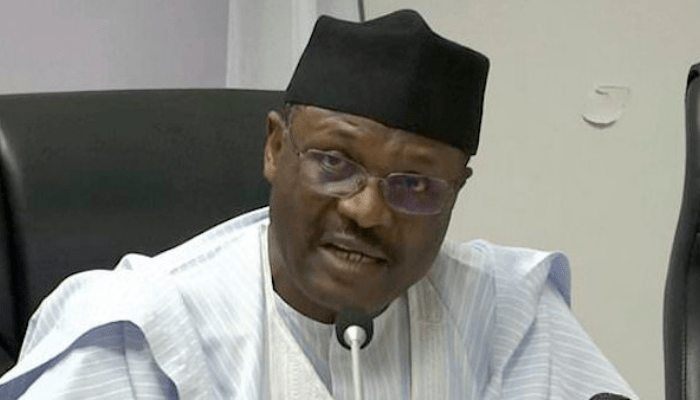
Yakubu
Omeiza Ajayi
The Independent National Electoral Commission INEC has again restated its position on the transmission of election results, saying what most partisans refer to as e-transmission has no place in its books, as what it does is only to upload, not transmit, polling unit-level results on its results viewing portal IReV using its Bimodal Voter Authentication System BVAS.
INEC which urged a careful usage of words especially by the media, also called on political parties to adhere to all extant laws ahead of the November 11 off-cycle governorship elections in Kogi, Imo, and Bayelsa states.
It urged political parties to carefully study the Constitution, Electoral Act, Police Act, and Public Order Act to ensure peaceful campaigns, devoid of abusive languages that could harm religious, ethnic, tribal, or sectional sentiments.
INEC Chairman, Prof. Mahmood Yakubu, made these remarks on Monday in Akwanga, Nasarawa State during a 2-day capacity-building workshop for members of the INEC Press Corps as part of its preparations for the elections.
“The method is as provided by law, electronic accreditation, electronic upload of results on the IREV portal and that is why we are doing this mock”, he had earlier said at the weekend.
Yakubu who was represented by a National Commissioner and Chairman of INEC’s Information and Voter Education Committee, Sam Olumekun at the Monday workshop urged the media to engage in fair reporting of the electoral process.
He said; “As first-hand witnesses to the Commission’s activities, the INEC Press Corps members also become the repository of electoral information in Nigeria. This places them at an advantageous position to play important roles in shaping the opinions and editorial policies of their media organizations on issues relating to the programmes and policies of the Commission.
“The implication is that Press Corps members must be familiar with the Constitutional mandate of the Commission and the roles and powers ascribed to it. They must therefore strive to understand the intendment and nuances of the powers granted to the Commission by the Constitution and the Electoral Act that are expressed in subsidiary legislations including the Commission’s Regulations, Guidelines and Manuals.
“As you may be aware, the Commission on Thursday 12th October 2023 presented the soft copies of a combined total of 5,409,438 registered voters for the Bayelsa, Imo and kogi Governorship elections to Chairmen of political parties in the states. The Commission also successfully carried out the Mock Accreditation of Voters in selected Polling Units across Senatorial zones in the three states on Saturday, 14th October 2023. Some of you accompanied the Hon. Chairman to witness this exercise in Kogi state.
“For the three governorship elections scheduled for 11th November, the Commission will deploy the Bimodal Voter Accreditation System BVAS to authenticate the Permanent Voter’s Card PVC and upload polling unit results to the INEC Result Viewing Portal IReV seamlessly on election day”, he stated.
On electoral delimitation of the three states, he said, “Bayelsa State has eight LGAs, 105 Registration Areas/Wards, and 2,244. Imo State has 27 LGAs, 305 Registration Areas/Wards, and 4,758. Kogi State has 21 LGAs, 239 Registration Areas/Wards and 3,508.”
He expressed the Commission’s commitment to collaborating with the INEC Press Corp and thanked the European Union for their consistent support of INEC’s work through the EU-SDGN II Programme.
Earlier, a national commissioner, INEC, Prof. Kunle Ajayi said fake news poses serious threats to the election process in Nigeria and recalled the Commission’s distasteful experience with fake news in the 2023 General Elections, saying if not nipped in the bud, fake news can become the bane of election management in Nigeria.
“The alarming prevalence of misinformation, ‘fake news’, hate speech, and the weaponization of disinformation has become very worrisome to the Commission.
“Disinformation is used to provoke religious, political, and tribal sentiments in an already polarized society such as ours, especially, during election season, which is often the leading cause of electoral violence and uprisings.
“Elections related disinformation has become a major strategy used by nefarious individuals and groups in the political space to manipulate the general public to their advantage, regardless of the consequential effect such propaganda may have on the peace and stability of the electoral process and the country at large,” he said.
Director, Information and Communication Technology ICT at INEC, Dr Paul Omokore who noted that the IReV is merely to enhance transparency and not a collation system, insisted that elections are won and lost at the polling units.
Disclaimer
Comments expressed here do not reflect the opinions of Vanguard newspapers or any employee thereof.