By Jide Ajani
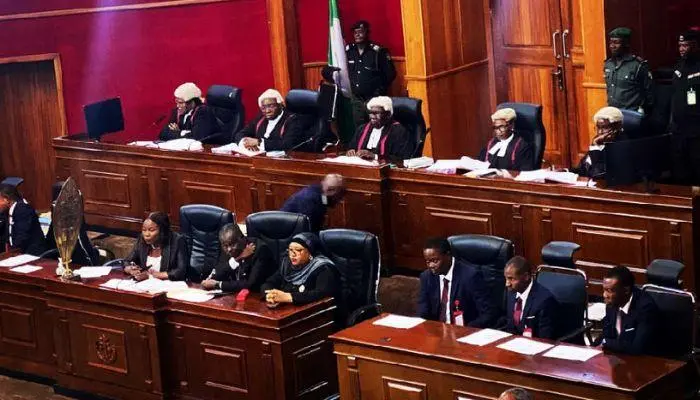
BRINGING the first phase of the ritual of an election petition tribunal to a close, yesterday, what became very clear from the judgment delivered by the five-man Presidential Election Petition Tribunal, PEPT, led by Haruna Tsammani, JCA (Justice of the Court of Appeal), was that a misplaced expectation that a public officer’s word would be his bond has no place in proving whether an election petition would fly or not based on the provisions of the law.
This is in the instant case of the upload of results from polling units in real-time, online as promised by INEC Chairman, Professor Mahmood Yakubu.
What the PEPT also laid to rest, yesterday, was that in proving an election petition, the petitioner must not only provide all the documents to support the petition, there must also be eye-witnesses, who must come before the tribunal to prove the infractions without doubt – no matter how many they may be.
Tsammani made it clear that in an election held in 176,866 polling units in 774 LGAs of Nigeria, petitioners must be specific about areas of electoral misconduct. There are 153 sections in the Electoral Act 2022 as amended. Relying on just a handful of sections as a basis for the nullification of an election would not and did not meet the threshold of substantial non-compliance. There were other issues.
The second phase of the ritual happens at the Supreme Court of Nigeria – if the petitioners feel the need to continue their cases.
Whether the ritual of yesterday was hollow or full would remain a matter of discussion by all those involved in the litigation.
What stood out, however, were the points of law as interpreted by the Lordships.
On almost all counts of the petition, the justices ruled in favour of the respondents – the Independent National Electoral Commission, INEC, the All Progressives Congress, APC, President Bola Ahmed Tinubu and his running mate, Vice President Kashim Shettima.
The tribunal flung, through the window, the petition of the Allied Peoples Movement, APM, seeking to disqualify the APC ticket because of what it perceived as a double nomination of Shettima.
The tribunal described as baseless the drug deal forfeiture involving Tinubu. It also trashed the EU’s report on the 2023 poll tendered by Peter Obi of the Labour Party, LP. From issues of money laundering to improper nomination, non-qualification to contest, compulsory 25% votes in Abuja, rigging (in all forms) and other perceived infractions by the petitioners, the PEPT insisted that proving election petitions should never be a voyage in sheer expectation and hope, but in proving, beyond reasonable doubts, and in a cogent and verifiable manner, that the disputed election did not substantially comply with provisions of the law.
That is where the devil lurks.
It must be understood by all that petitioners must be ready to prove to the tribunal that the election in dispute did not substantially comply with the provisions of the law.
That is not all. Such non-compliance in a substantial manner must also be proved to possess the potential to alter, substantially, the eventual outcome of the election.
The JCAs relied largely on precedents of judgments delivered by the Supreme Court to throw out almost all the grounds of petition by the petitioners.
While some supporters of the LP and Peoples Democratic Party, PDP, hoped that the 25% votes in Abuja or the non-upload of results real-time online would clinch it for them, what stood out was the painstaking explanation by Justice Tsammani on the issue of upload, its place in law and whether or not INEC was bound by law to transmit the results electronically, realtime from polling units across the country.
Perhaps, had the National Chairman of INEC, Professor Mahmood Yakubu, not over-promised and under-delivered on the inherent magic of the “Bimodal Voter Accreditation System (BVAS) for both voter accreditation and e-transmission of results for collation and the INEC Result Viewing (IReV) portal”, the level of anxiety in the polity would have enjoyed the benefit of being mellow.
If this was a marketing gimmick employed by Yakubu to entice the voting public to have a buy-in in the 2023 general elections, it worked because it was based on his promise of an inclusive and transparent process that galvanised the youths, who understand the power of technology, to massively participate.
Even before a global audience at Chatham House, on Tuesday, January 17, 2023, Yakubu boasted about the near inviolability of BVAS and IReV.
Said Yakubu: “To avoid the usual challenges with the application of new election technologies, the Commission introduced and tested our innovations for the election early enough. There are three critical components namely, the INEC Voter Enrollment Device (IVED) for improved registration of voters, the Bimodal Voter Accreditation System (BVAS) for both voter accreditation and e-transmission of results for collation and the INEC Result Viewing (IReV) portal to offer the public access to view Polling Unit results. For the BVAS and IReV, we initially deployed it on a pilot basis in several bye-elections and off-cycle governorship elections. The IReV was used in the governorship elections in Edo State (September 2020) and Ondo State (October 2020). A combination of both BVAS and IReV was used in Anambra State (November 2021), Ekiti State (June 2022) and Osun State (July 2022). The BVAS was also used in the Area Council elections in the Federal Capital Territory (FCT) in February 2022. Deploying this technology in these major elections afforded the Nigerian public and the Commission opportunities to get acquainted with the device and to review its performance to enhance it towards the general election. For the Commission, several lessons have been learnt from these deployments and we believe that we are ready to deploy these technologies for the general election.”
It did not end there. Again, following a painstaking investigation by Vanguard, a story was published on Monday, November 21, 2022, titled ‘How politicians still threaten credible polls – INEC Source’, Professor Yakubu came out to discredit the story. Relying on IReV Portal printouts from the Anambra governorship elections of 2021, the exclusive report warned INEC of the potential for doubt should the Commission not transmit results to IReV, in real-time.
In trying to wave the report aside, Professor Yakubu told Nigerians: “On this note, let me seize this opportunity to respond to a story emanating from a section of the media that the commission has decided to jettison the uploading of polling unit results in real time on Election Day. It should be disregarded as fake news. The commission will upload polling unit-level results and citizens will have access to these results in real-time as they upload from polling units. This innovation was introduced by the commission and the commission cannot turn around and undermine itself. This technology has come to stay, we will upload polling unit results and citizens will have the right to view these results. After all, we are serving the citizens. How can we deny citizens access to the results of the process conducted by them at the polling unit? I want to reassure you that the 2023 election is going to be our best election and we are committed to ensuring that votes cast by Nigerians will determine the outcome of elections, nothing more, nothing less.”
Unfortunately, Yakubu’s INEC succeeded in uploading only the House of Representatives and Senate elections, while presidential election results’ upload was said to have suffered a glitch. Mind you, the elections held on the same day and at the same time. It is this disappointment on the part of a section of the voting public, more than the 25% votes expected to be delivered in the FCT for any eventual winner, that cast a pall on the credibility of the 2023 presidential election.
As proceedings were winding down, Justice Tsammani’s reference to the preamble of the 1999 Constitution which says in part that “We the people of Nigeria,…” drew chuckles from lawyers in the court, because it is a known fact that the long out-gone military administration of General Abdulsalami Abubakar handed down the 1999 constitution.
At the end of the day, the grounds for the petitions were described by the lordships as vexatious, misconceived, incompetent, unmeritorious and, therefore, dismissed. What this means is that petitioners must be diligent, rigorous and thorough in presenting their cases at election petition tribunals.
However, without prejudice to the fine wordings of the judgment delivered yesterday, politicians are likely to continue along the same path of electoral malpractices and brigandage to win at all and any cost while taunting the losers to ‘go to court’.
Disclaimer
Comments expressed here do not reflect the opinions of Vanguard newspapers or any employee thereof.