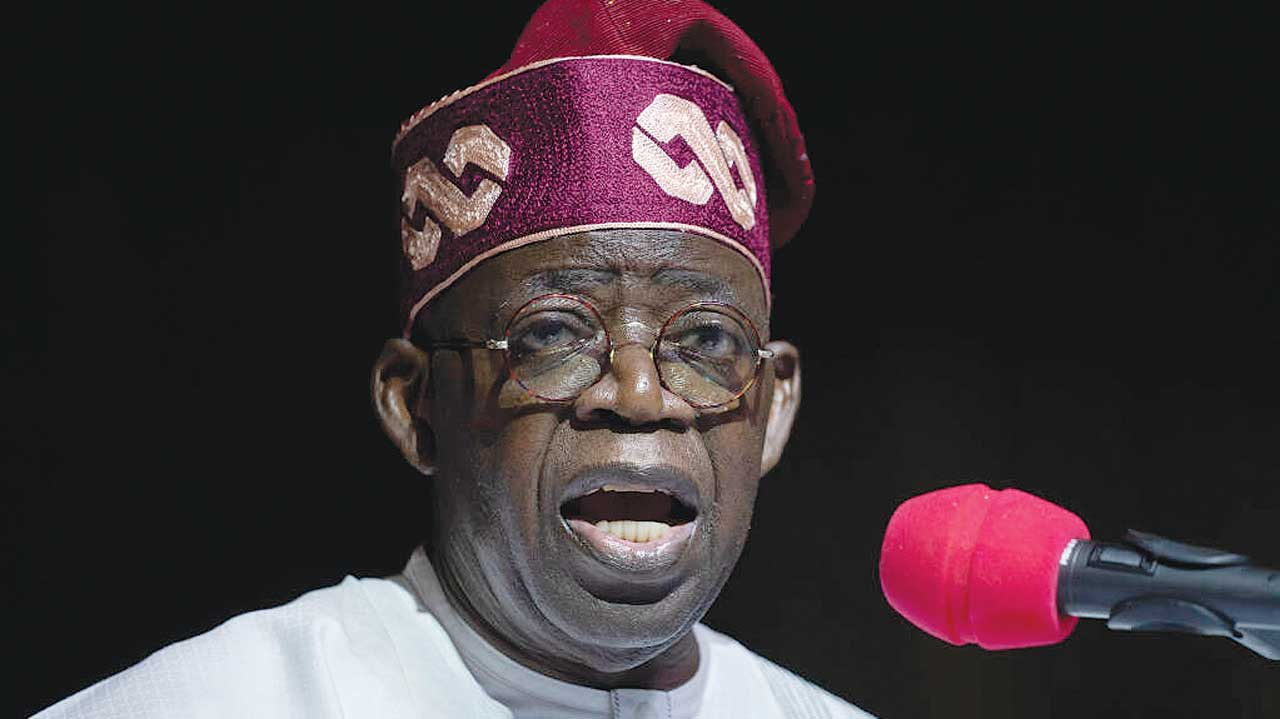
Tinubu
Now that we found love, what are we gonna do with it?– Heavy D and the Boyz
It takes a lot of guts to transmute from candidate Tinubu to President Tinubu, yet this has happened, and this possibility provides some huge lessons for any discerning mind.
To learn from Candidate Tinubu is to identify your turn or create your turn, insist on your turn, and resolve that when it does and if it ever comes, you swoop on it and maximize the opportunity. There is nothing wrong with that. Indeed, it takes a lot of courage and determination to appropriate the right to the presidency of Nigeria at the time and in the manner candidate Tinubu did. It is easy to condemn the approach as arrogant and lacking in decency.
However, we can extract some moral lessons thrown up by the ultimate victory of President Bola Tinubu at the 2023
presidential election. At the beginning, it seemed so far-fetched yet he remained self-assured and undaunted by the forces and antics which somehow beclouded any chance of his victory.
Convinced that someone or a particular region of the country had exhausted their turn to rule the country, Candidate Tinubu raised the tempo of political discourse in Nigeria to a high-pitch crescendo of demonizing those he felt had inordinately held onto political power with no thought of relinquishing power to anyone outside their geopolitical radar on a platter of gold. This main thrust of his campaign (Emi lokan) resonated perfectly with the general feeling of a majority of the Nigerian citizenry who felt that power must be equally and fairly allocated and timed in a manner that engenders a sense of belonging to every citizen or geopolitical region. This worked.
In effect, Candidate Tinubu challenged the much-vaunted but less-observed universal notion of nationalism and patriotism and equated his personal interest with that of the nation at large. The ideal of Nigerian nationalism was thereby torn apart for the more receptive concept of “turn by turn”; that is, the major political actors taking their turn to rule the nation, to reflect the federal character or rotational power sharing/allocation policy.
If candidate Tinubu could ride on the slogan, “Emi Lokan” (it is my turn) to evoke the deep-rooted sentiment of portraying himself as a victim or someone in danger of being denied his rightful place in the political scheme of things, it stands to reason that his strategy worked with Nigeria and that the strategy was acceptable to many who supported him. Having won the presidential election and transmuted from candidate Tinubu to President Tinubu based on this skewed but incisive slogan, one can then understand or appreciate the magnitude of crack inflicted on the very core of Nigerian nationalism.
Very clearly, the “turn” that candidate Tinubu insisted on and succeeded in taking possession of, had no altruistic nationalist flavour at all. It was personal or, at best,
sectional.
Having won the presidential election on the basis of this mantra or slogan,no one should express any surprise that the composition of his government and his policy framework are likely to reflect whose turn it is. We must not forget that Buhari’s turn had come and is now gone. Jonathan’s turn had since gone, Atiku’s turn is yet to come, Obi’s turn may soon come. The Nigerian state (and the Nigerian nationalism) has become balkanized and privatized, it would appear. This could be very worrisome.
It should equally not come as a surprise to anyone if the democratic dividends accruing from this government is made to invariably slant in favour of the geopolitical region or ethnic or other interests represented by President Tinubu.
That’s the clear picture of the emerging or evolving Nigerian nationalism; you first must identify, sensitize and mobilize your micro unit of relative nationalism to attain the larger ideal of Nigerian nationalism. Buhari did it, and his predecessors in office
had done likewise. It is therefore understandable and justifiable; and I can therefore understand, and I now see nothing wrong with President Tinubu re-echoing that strident mantra of self-assertion (Emi lokan) in the mould of “it is my people’s turn” in the slant of his appointments thus far. And who are his people? Don’t be deceived to provide a simplistic answer and conclude that “President Tinubu’s people” are “the Yoruba people”. There is more to it. It is rather an aggregation of all those who share a common philosophy, psychology, ethnicity, idiosyncrasy, and geography with him.
Period! And he is not alone in this posturing.
This has become our skewed national standard, which had since been normalized and institutionalized by each successive
government with the tacit consent of an unawakened citizenry. My interest first. My people first. My region first. My religion first. This represents the sociopolitical state or statelessness of the Nigerian nation. Candidate Tinubu did not bring this about. He
simply built on it the same way Donald Trump built on “America first” during the 2016 presidential election campaigns in the US.
And now, President Tinubu has merely declared or given a louder voice to the latent but dominant feeling in most Nigerians that each person or religion or region should take their turn in partaking of and not baking the national cake. The Nigerian nationalism or patriotism is now our own unique creation, completely devoid of essential ingredients of nationhood. It has become fashionable and it is now advisable to just know when it is your own turn, go for it, fight for it, capture it; present it as our Nigerian brand of nationalism. Kudos to candidate Tinubu, (now President Tinubu) who should be acknowledged as a man of rare courage and personal conviction, endowed with the uncanny ability of knowing what he wants and
knowing when to go for it and how to get it. Now that he has found and grabbed his
turn (power), what is he gonna do with it? Only time will tell.
Okon N. Efut, SAN
Abuja.
Disclaimer
Comments expressed here do not reflect the opinions of Vanguard newspapers or any employee thereof.