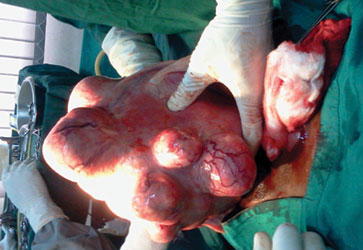
Fibroid
By Dr. DAPO SOYINKA
Leiomyomas as they are medically known and ‘fibroids’ as they are erroneously, but commonly called, are the commonest non-cancerous tumour of the womb. Statistics have shown that about 3 or 4 out of every 10 black women have ‘fibroids’. My clinical experience somewhat correlates with this. Very few of today’s women really, are unaware of ‘fibroids’, at least from a superficial point of view.
But I’m sure you are wondering now why this condition is so common, and debilitatingly so. I’m sure readers are eager to know what the root cause is.
I have in my own practice, seen several women writhing in severe and burdensome menstrual pain; some have bled from a heavy and prolonged monthly flow, even to the point of collapse or needing blood transfusion. A few other unlucky ones have repeatedly lost pregnancies due to the heavy presence of ‘fibroids’ within the womb. We are also beginning to see subtle cases of delay in conception, with no other attributable cause, other than suspiciously located fibroids.
Fibroids are masses arising from the smooth muscles within the architecture of the womb. They could be in different locations; they come in different sizes ranging from a peanut seedling up to several times the size of an average adult fist. It could be one single solitary mass or worse still, occur in multiples.

Fibroid tumor
The cause of ‘fibroids’ is unknown. However, research is really in support of some growth factors in some women that seems to promote its growth when there is a favourable hormonal mileau and the presence of a genetic predisposition studies have shown that the gene in the fibroid mass is quite different from the ones in other smooth muscle cells of the womb.
Hormonal environment, on the other hand, is rarely favourable before the age of 18 years and after the age of menopause (approximately 51 years in most black African countries).
The implication of this is that for a number of women in the reproductive age group (19 years to 45 years), new fibroid seedlings are probably growing on daily basis.
Perhaps you are wondering if you’ve got ‘fibroids’. You will have to see your gynecologist. The commonest complaints are heavy menstrual cramps, increasing swelling of amongst others, the lower tummy or severe menstrual cramps. However, these complaints are not exclusive to ‘fibroids’. A simple pelvic examination and ultrasound scanning by your ‘Gynae’ will confirm the diagnosis. You can also know the number, the size and the location of the ‘fibroids’ in the womb.
Although arriving at a diagnosis is not often the problem, the controversies lie with what to do about them. Majority of ‘fibroids’ are very innocent and require no intervention in the immediate. If they are not causing any significant complaint, it may be counterproductive to attempt to remove them by operation. For the vast majority, your ‘Gynae’ will just follow up on the fibroids by doing check ups every 6 months. However, irrespective of the size of a fibroid, if it is causing embarrassing symptoms or affecting the quality of a woman’s life, it should be treated.
If the fibroids are quite large and many, your ‘Gynae’ may have to cut your tummy open to remove them, and this may be an advantage please. If they are less big and about three or four pieces this can be removed without cutting your tummy open. This is known as laparoscopic or pin hole surgery. If the fibroid are located mainly inside the cavity of the womb, they can be removed from in between the legs without having to go through the tummy approach. This however must be done by a skilled endoscopic surgeon. Surgery is quite safe, if done with the best standard practice, although it is not totally risk-free. It affords the most relieving (temporary) and/or permanent cure.
For women who have completed their families both the fibroid and the entire womb and appendages can be removed by open or pin hole surgery. The latter option though available in Nigeria, is not really cheap.
For women with an aversion for surgery, the good news is with the emergency of selective vascular embolization. The blood pipes feeding the fibroid masses can be isolated and blocked, by injecting some medical substances, until it shrinks in its location.
However, there exists a theoretical fear of its possible effect on the woman’s future fertility. This procedure is therefore advisable for women above 40 years or who have completed their families.
Drugs and medications do not remove ‘fibroids’.
They may alleviate the symptoms such as reduce menstrual flow and abort menstrual cramps. Surgery remains the mainstay of management. Drugs can be used as an adjuvant to surgery. It can at best shrink a very large fibroid mass to about a quarter or a third of its original size, and only at the expense of the woman’s own hormones. The good ones are also slightly expensive too.
Fibroid operation does not preclude the chance of future conception if meticulously done and with optimal standards and precaution taken. For younger women, ensure your tubes are checked before and after the surgery. A post-operative scan can also be reassuring.
Since fibroids are hormone dependent tumor and gene mediated, the future of treatment could be a gene therapy based approach for ablation of the fibroids. This will render inactive the hormonal signal of the receptors inside the fibroid cells. The localized nature of this condition and its easy accessibility using different imaging techniques makes this an attractive option. Clinical trials are currently ongoing.
If you discover you have fibroid avoid self medication, avoid insertion of unknown ‘cure substances’ in between your legs (potentially dangerous). Get a proper evaluation and seek a second opinion regarding the best mode of treatment if still in confusion.
Disclaimer
Comments expressed here do not reflect the opinions of Vanguard newspapers or any employee thereof.