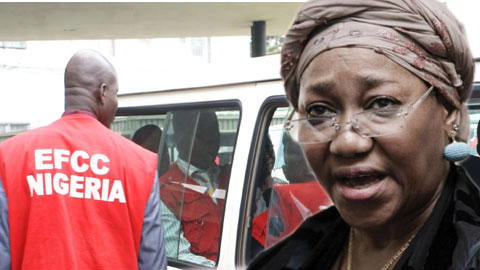
Farida Waziri, former Chairperson of the Economic and Financial Crimes Commisssion.
BY CLIFFORD NDUJIHE, ABDULWAHAB ABDULLAH, PETER DURU & BATHOLOMEW MADUKWE
TWENTY- FOUR hours after Mrs Farida Waziri’s unceremonious removal as the chairperson of the Economic and Financial Crimes Commission, EFCC, by President Goodluck Jonathan, the polity was awash, yesterday, with debates on whether or not her exit would boost the anti-graft war.
Most persons who spoke to Vanguard averred that instead of bolstering the anti-corruption crusade, the way she was sacked could hamper the efforts.
Indeed, the Human Rights Watch, HRW, said in a statement that Waziri’s removal would not improve the fight against corruption.

Farida Waziri, former Chairperson of the Economic and Financial Crimes Commisssion.
While former National Publicity Secretary of the National Democratic Coalition, NADECO, Mr Ayo Opadokun, said Waziri had been made a sacrificial lamb; former Lagos State Commissioner of Police, Alhaji Abubakar Tsav, said Waziri performed well as EFCC boss and that her removal was political.
Other personalities, who spoke on the issue yesterday include Chairman of the Congress for Progressive Change, CPC, Prince Tony Momoh; legal icon, Robert Clarke, SAN; former chairman NBA Ikeja Branch, Dave Ajetunmobi; President, Itsekiri Peace and Unity Foundation Trust, Mrs Roli Inoniyegha; and public analyst, Mohammed Arubayi.
Firing Waziri won’t fix EFCC – HRW
According HRW, the sudden dismissal of Nigeria’s controversial anti-corruption chairman would not fix the troubled EFCC she led unless the government carry out broad institutional reforms.
Rather than sacking the EFCC boss, it noted that the commission was facing broader institutional failures such as executive interference and judiciary inefficiency, which it contended must be addressed, if the commission was to improve its anti-corruption record.
It said: “The EFCC’s mandate is to fight corruption that the political system actually rewards, and to accomplish that by working through institutions that are either broken or compromised.”
Daniel Bekele, Africa director at Human Rights Watch. “That’s an almost impossible job no matter who is in charge.”
It urged President Jonathan to present legislative amendments granting tenure security to the commission chairman because “the institution can never be truly independent if the president can dismiss its chairman at will. The government should also bolster Nigeria’s other key anti-corruption institutions, the Independent Corrupt Practices and Other Related Offences Commission and the Code of Conduct Bureau. Nigeria’s weak and overburdened judiciary has also been an obstacle to effective prosecutions. Most of the corruption cases against high-level political figures have been stalled in the courts for years, with their trials not even begun.”
The government should build on this promising initiative by beginning the long-term process of repairing the battered federal court system, reforming federal criminal procedure, and examining ways consistent with due process rights to establish special courts or designating specific judges to hear only corruption cases, Human Rights Watch said.
Her removal was political – Tsav
Noting that Waziri’s removal was long forseen, Tsav, in an exclusive telephone conversation with Vanguard from Mecca, said her sack was a function of a chain of sustained and sponsored attacks by cynics for alleged and unproven abuse of office leveled against her.
He said the former EFCC boss discharged her responsibilities with all diligence, adding that posterity would definitely judge and assess her achievements as the chairman of the Commission.
“She was appointed by the late President Yar’Adua and her removal by the Goodluck Ebele Jonathan’s Government was long foreseen. Mrs. Waziri has done her best in the fight against corruption, earning star convictions and it is only posterity that can judge and assess her achievements as the chairman of EFCC,” he said.
Tsav identified selfish interest of the high and mighty in the contemporary Nigerian society as constituting a major stumbling block in the fight against corruption and criminality the nation.
“In Nigeria, our personal and selfish interests seem to override national interest. How can we succeed as a nation? I am aware that she has been under sustained attack by Sahara Reporters and other cynics for alleged and unproven abuse of office. Some accuse her of shielding George Akume, her kinsman. She must have also stepped on big toes by her recent arraignment of some big fishes. If the war against corruption must be won and sustained in Nigeria, there must be continuity and the political will to tame the monster,” Tsav said.
The govt is playing to the gallery – Opadokun
On his part, Opadokun said that President Jonathan yielded to pressures from Western powers and non-well-meaning politicians in sacking Waziri. He averred that without political will, empowering of the EFCC and amendment of the EFCC Act to make the commission independent and difficult for the President to remove the chairman without two-third majority approval of the Senate, the anti-graft crusade would not yield dividends.
His words: “I don’t see the removal of Waziri as an evidence of the fight against corruption. Among other pressures, President Jonathan yielded to pressures to Western powers, which see the fight against corruption as having waned. He wants to be a good boy. There are also pressures from non-well-meaning politically exposed persons, who skeletons in their cupboards and cannot stand the rigours of being adequately investigated and prosecuted. No anti-graft crusade can go on without political will. They are playing to the gallery and deceptive in this kind of sack.
“If President Jonathan can exploit the EFCC 2004 Act to summarily dismiss Waziri, it shows that any person occupying that office will be looking at his back, whether or not he has pleased the President, those in government or party in power. The sack of Waziri will not improve the anti-graft war unless there is political will and these three things are done:
“The EFCC Act should be reviewed to the extent that before the chairman is sacked it has to be approved by two-third majority of the Senate. The President is human and at times can play to the gallery. He should not be given the opportunity to summarily dismiss the EFCC chairman. Government must develop sufficient political will to empower the EFCC and provide the necessary support to make the EFCC live above board.
“Waziri was a sacrificial lamb. I am not making a case for her because of how she came to office. She came after late President Umaru Yar’Adua’s election where a clique of evil characters were the alternative government. They subverted the work Ribadu was doing and brought Waziri to cover their tracks. Perhaps, it is nemesis that is catching up with her as well. However, I am not under any illusion that anyone that anyone stepping into her shoes will not be subjected to this level of political conundrum.”
Problem with the institution
Also speaking, Mrs Inoniyegha condemned Waziri’s sack, noting that the problem was not with her but the institution.
She said: “The sack of Waziri by president Jonathan is not a right step in the right direction. I have listened to several of Waziri’s interviews, she has got all that it takes to be there. And whoever that is stepping into her shoes will still face the same thing. For instance, look at PDP’s preliminaries taking place in Bayelsa State, with a court injunction – they ignored because there is no respect for the rule of law. Let them bring whoever they want to bring to step into Waziri’s shoes, they are just making mockery of us.”
Relatedly, Dave Ajetunmobi said: “If the constitution states how the EFCC Chairman can be removed, and Mrs Waziri was just removed without reference to the law that created the EFCC, her removal becomes null and void. It is necessary that before you can remove her, the president should have followed the laid constitutions. Though there can be reasons for her removal but the president is supposed to take his time to follow due process. Though she was not properly appointed into the office, that shows why the independence of the EFCC must be strictly adhered to.”
Mohammed Arubayi also kicked against her removal, saying: “Nigerians have the duty to complain, if they have an anti-corruption agency that is attached to the apron of the president, where the president can just wake up and say ‘I don’t like your office.’ The independence of the anti-corruption agencies is very important.
Nigerians have been saying under these commissions, perceived enemies of the president are being persecuted. So, technically, it is Mr. President that has shot himself in the foot, because; this just confirmed that the president is the one controlling the EFCC. If EFCC is inactive, it is Jonathan that is not active. The National Assembly has not done anything in this area, the anti-corruption agencies should be made independent without any interference and control whatsoever.”
Tony Momoh speaks
However, Tony Momoh said the questions that should be asked and answered include whether or not the person who removed her had the right; whether or not Waziri was doing her work and was fired because of that; and whether or not she abused her office, did things that led to petitions being written against her for which the President acted upon.
On whether Waziri’s removal would hurt the anti-corruption efforts, he said: “What has she done about anti-corruption crusade that is memorable. Ibrahim Lamorde has been the big brain even when Ribadu was there. He was the man behind Ribadu. They made him to act once. If waziri is removed, let him assume the post.”
Robert Clarke concurred, said: “Any statutory office in Nigeria right from the office of the president to the office of the Governor, President can be removed at anytime, there is a provision in the constitution, the governor can be removed, if he is impeached, the minister can be removed anytime by Mr. President.
The president of the Senate can be removed anytime by vote of no confidence. And Waziri as EFCC chairman under Section 3 of the EFCC Act can be removed by Mr. President. It is within his own discretion and it has no adverse effect.”
Disclaimer
Comments expressed here do not reflect the opinions of Vanguard newspapers or any employee thereof.