By Osa Mbonu-Amadi, Arts Editor
There couldn’t have been a better forum for a professor to share a lesson he learned from another professor on how to write and communicate in simple words, than in a symposium organised by other professors and doctors to honour him.
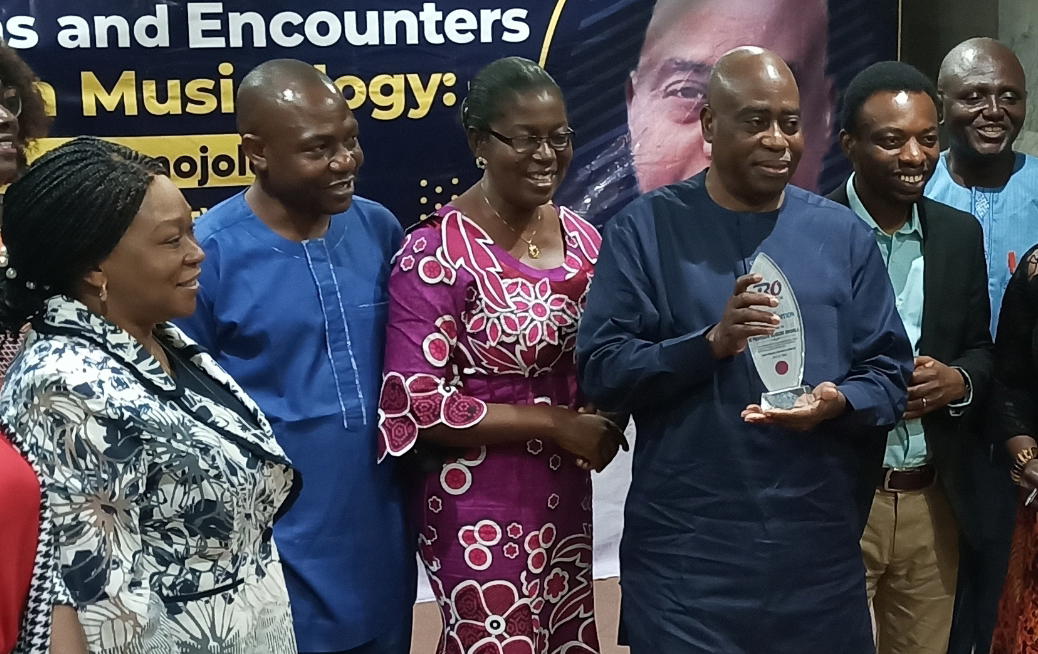
That was exactly what Prof. Bode Omojola, the Hammond-Douglass Five College Professor of Music at Mount Holyoke College, Massachusetts, did last weekend at the MUSON Centre, Onikan, Lagos, where his former students who are now professors and doctors organised a symposium in his honour. Yet, sharing that lesson on simple writing did not deter jaw-breaking words from flying up and down at the event.
Prof. Omojola was commenting on the keynote address delivered at the symposium by Prof. George Worlasi Kwasi Dor. Omojola said: “One of the many things I heard (in Dor’s keynote address) was the advocacy for an inclusive postmodern ethnographic approach, admitting of multiple perspectives – these are my own words – in which local actors shape the narrative away from colonialist discourses. Thank you so much for that inspiring keynote address.”
Prof. Bode Omojola also commented on Prof. Kofi Agawu’s opening remarks. “Prof. Agawu,” he said, “was talking about those years of publications. I would say that all that landmarks have shaped my career.
“I went to (the University of Nigeria) Nsukka, the first music department in Nigeria and one of the biggest in Africa. I was trained by many brilliant British-American pianists and composers, and I had that solid grounding in Western music. Nsukka was great; it is still great. You go there and you have all that you needed to grow as a musician. And then I went to Ibadan. I was one of the first set of people to do the M.A in Ibadan, and I was taught by Prof. Sam Akpabot. He taught me how to write.”
“You know, you are an M.A student, and you have an essay (to write) and you want to impress. (After writing the essay), I would take it to Akpabot and Akpabot would say, ‘are you trying to impress me? Write as if your grandmother who understands English is your audience.’ The profundity of your scholarship is not in verbosity. It is not how big the words are. It’s how clear the words are. And I don’t know whether you’ve been noticing Prof. Agawu. There is nothing he writes that you don’t understand.”
As it often happens, Omojola, at one point, forgot what Prof. Akpabot taught him. “Then I went to Leicester in England for my Ph.D. This time I was a doctoral student. So, I forgot Akpabot’s advice. They gave me something to write and I wrote it. Then my professor said, ‘what are you trying to say here, Bode?’ I told him what I was trying to say. He used a pencil to write what I said. Then he said, ‘keep the other one you wrote…write as if your grandmother is going to read your research.’”
Now, Prof. Omojola advises his former students: “Don’t be verbose. Write clearly. Write logically. Be deep in your thought, but make sure you know how to put it in a way that is accessible to everybody. Your greatness will still be there, just as Kofi Agawu witnessed. He doesn’t write verbose things…”
Prof. Omojola recalled one other thing that happened at Leicester where he did his Ph.D. “Those of you who knew me (know) I was a very good pianist; I think one of the best that Nsukka produced. There was a time I sight-read an entire concert performed by Prof. Laz Ekwueme. Something happened. The person who was to accompany him was not there. So, they called me from the audience and I went on stage. It was only one or two songs I couldn’t play.
“So, I carried that to England. I was playing Chopin and all that. But then, I saw some young English boys and girls who would demolish those pieces (with such amazing tempo or speed). And I said, ‘wow! Okay, maybe I should look for something else to do. There is no point; I can’t beat these people.’ So, I decided to change to African Art music. I think my Ph.D. was probably the first one that was written on African Art music, let me say, in Africa. In those days it wasn’t popular. Nobody wrote about African Art music. But my professors at Leicester were kind enough. (They said), ‘okay, this is different from what we wanted you to do. This is like mid-way. And that was how I wrote my thesis on African Art music. I am happy that everybody is now writing about it. That’s fantastic. That was a life-changing experience for me.”
Earlier in his response to all the speeches made in his honour, Prof. Bode Omojola said, “I appreciate your love, which has kept us going. I am just so grateful.”
He also revealed how the idea of the symposium was conceived and hatched: “About a year ago, Dr. Mrs. Sumbo (Omolara Loko) called me and said that she had something to discuss with me. She said, ‘please don’t say no.’ She told me that she wants to discuss this event with some of our colleagues; that she wanted to organise a symposium.
“I had kind of double-minded with it because many of you know me, I just want to do my things quietly. I discussed it with my wife, Abimbola, and she said ‘you cannot say no. They want to do something special for you.’ So, later I got back to Sumbo and I said that’s fine…. Then occasionally I would get emails from Dr. Loko. They kept everything secret from me. I didn’t know what was going on.
“I wondered how these people would get money, because ASSU was on strike, even when they weren’t on strike, the salary was not enough to take one home. I was wondering how they would do it. Then I got another call from Sumbo that Dr. D.K Olukoya, the General Overseer of MFM had decided to fund it. I was so grateful because I never imagined that he would remember me. When he invited me some 20 years ago to work on his choir – I think they were trying to restructure the choir at MFM – I was in Lagos for like three months. Fortunately, it was during that strike that led to my sack at UNILORIN. If many of you have been wondering how I survived, this was part of it because he paid me handsomely for the job.
“I just want to publicly thank Prof. Olukoya for the things he has been doing. And it’s even beyond him, because he has been doing this kind of thing – helping music programmes across the country. It’s a calling…So thank you so much, Dr Olukoya.”
Prof. Omojola specially acknowledged Dr. Omolara Loko and Dr. Samuel Ajose as the key drivers of the programme. He thanked Prof. George Worlasi Kwasi Dor who delivered the keynote address, Prof. Kofi Agawu, Prof. Stephanie Shonekan, Dr. Kayode Samuel, Dr. Oladele Ayorinde, Dr. Mrs. Doyin Aguoru, Dr. Mrs. Florence Nweke, Dr Kehinde Faniyi, Associate Professor Yomi Bello, Prof. Olusoji Stephen, Prof. Albert Oikelome, Dr. Oluwatoyin Olokodana-James and all his former students who attended the event. He also commended the Lagos State University of Education Choir conducted by Seun Babalola, which preformed live at the symposium. Prof. Omojola also thanked his wife, Mrs. Abimbola Omojola and his children who joined the event virtually.
Omojola is always there for you – Prof Dor
Apart from delivering the keynote address, Prof. George Dor also contributed to the panel discussion. “I am Ghanaian, but I think in Nigeria, you are doing a great job. After South Africa, Nigeria is number two.” He said the future is very bright for Art music in Africa. “I’ve been encouraged by today’s event, because I was part of Prof. Akin Euba’s symposium. We regretted that Prof. Akin Euba was not honoured nationally, because after the symposium he passed….
“So, I just want to encourage you about standards. I can tell you proudly that I have been following the scholarship of several Nigerian ethnomusicologists, and I am impressed. The concept of ecological ethnomusicology was invented by a Nigerian. I will encourage all of you to be united as scholars, as performers and as musicians – stay united, exchange ideas. And I am very positive you will always improve. I have already said you are doing well. But the sky is always your limit. Prof. Omojola is always there for you. If you have some challenges, you should approach him, and I am very positive he will lend a helping hand.”
Prof Omojola is a Perfect Cadence – Dr Kayode Samuel
Dr. Kayode Samuel, Associate Professor of African Musicology, described Prof. Omojola as “a Perfect, Positive, Interrupted Cadence to the African music.” He expressed worry at what he called “bastardisation of the culture of publications.” Instead of promoting knowledge sharing generation and quality scholarship, Dr. Kayode said, “editors solicit manuscripts to be published without paying due attention to the diligence of peer review process.” This practice, he said, is motivated largely by pecuniary gains, whereby younger ones are exploited, because they have to pay to get published. “This is very sad indeed, and I think it should stop.”
Unanswered questions remain – Dr Oladele Ayorinde
According to Dr. Oladele Ayorinde, a musician, scholar and cultural entrepreneur, “the works of Prof. Omojola and other scholars are quite relevant here to start thinking about African musicology and what this means in our own contemporary times.” Commenting on some of the issues Prof. Dor raised in his keynote address, like the chronological analysis of paradigms and encounters in African musicology, Dr. Ayorinde said there are questions that remain unanswered in that analysis: “The Omojolas and the Dors have created the way (through) mentorship, both direct and indirect. We can see that product today. For the new generation of scholars, how do we intend to build on these works?” Ayorinde asked a very complex question that looked every inch like a research question in a Ph.D. thesis: “How could digital technologies, online platforms and trans-national networks for collaborations, facilitate creatives, artistic and scholarly production in African musical studies and tradition?”
Omojola, a scholar of global standard – Prof Stephanie Shonekan
Stephanie Shonekan, Professor of music and Dean of the College of Arts and Humanities at the University of Maryland, who also joined the event virtually, spoke about the character of Prof. Omojola. She said Dr. Omojola is a scholar of global standard, a teacher, an administrator and adviser to students.
He’s highly professional and patient – Dr Olukoya
Represented by Dr. Oluranti, Dr. Olukoya, G.O of MFM and sponsor of the symposium, assumed that Prof. Omojola had forgotten that he (Olukoya) “had invited him over two decades ago to audition the 2,500 MFM Mass Choir. He was highly professional and patient.” Dr. Olukoya said he joins thousands of people who love African music to celebrate Prof. Bode Omojola.
I never saw him angry – Dr Yomi Bello
Dr. Yomi Bello, Associate Professor of music at LASU, whom Prof. Omojola described as one of the 3 musketeers, said: “I want to appreciate everybody here for taking time to be part of today’s symposium organised for our brother and uncle, Prof. Bode Omojola, who is here with us – a great scholar whom some of us have known for over 30 years.” Dr. Bello said one thing that nobody has said about Prof. Omojola, of which everyone needs to learn from him, “is the fact that for all those years, I never saw him annoyed or angry. I don’t know how he has been able to do that…He is always calm.”
Thanks for showing my husband love – Mrs Omojola
Mrs. Abimbola Omojola, wife of Prof. Bode Omojola, who studied music at the Obafemi Awolowo University, Ile-Ife, in her vote of thanks, said: “I thank everyone present today. All I want to do after this amazing honour you have bestowed on my husband is just to thank everyone who had extended the hand of love to my husband. Thank you all.”
Disclaimer
Comments expressed here do not reflect the opinions of Vanguard newspapers or any employee thereof.