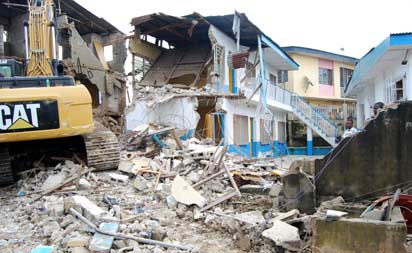
a collapsed building
By Rosemary Onuoha
The enforcement of compulsory insurances as mandated by the Laws of Nigeria has kicked off in Ibadan, Oyo State Capital. For the good of the country and her citizens, experts are of the opinion that the initiative must attain optimum success
“It is almost a month now since our office building collapsed and we have not seen the owner of the building again. He came here the day the building came down after being alerted and that is the last we saw of him. The owner resides abroad but never fails to come home when the rents are due.
“Before the collapse, the owner had notified us that he will be coming the next day to collect the rents, but unfortunately the building came down before the appointed day. We have always complained about the weak nature of the building, but the owner refused to do anything about it. My office pays nothing less than N3 million as annual rent and I can confirm to you that that is the least payment that is paid as rent in that building.”
These were lamentations of an aggrieved tenant of the six story building that collapsed in Maryland recently. And it is lamentations like this that the National Insurance Commission (NAICOM) is making every effort to prevent in its drive to enforce the compulsory insurances encapsulated in the Market Development and Restructuring Initiative (MDRI).
Amongst the five compulsory insurances in enforcement is the Occupier’s Liability and if the owner of the collapsed building in Maryland had bought it before the disaster, his tenants would not have been lamenting.
Section 65 (1) of the Insurance Act, 2003, states thus, “Every public building shall be insured with a registered insurer against the hazards of collapse, fire, earthquakes, storm and flood. ‘Public building’ in this section includes a tenement house, hostel, a building occupied by a tenant, lodger or licensee and any building to which members of the public have ingress and egress for the purpose of obtaining educational medical service or for the purpose of recreation or

a collapsed building
transaction of business.
“The insurance policy under subsection (1) shall cover the legal liabilities of an owner or occupier of premises in respect of loss of or damage to property or bodily injury or death suffered by any user of the premises and third parties.”
According to Mr. Yemi Soladoye, Consultant of NAICOM on MDRI, the owner of the collapsed building violated the provisions of the Occupiers’ Liability Insurance Law even before the collapse.
Chairman of Council of Registered Builders of Nigeria, CORBON, Prof. Akin Akindoyeni stressed that not having any insurance cover is very disadvantageous because when people lose manpower and assets the country losses. But with insurance, Akindoyeni noted that there is replacement, stating “And when you have replacement it is as if you have not lost anything.”
However, Occupiers Liability is just one of the compulsory insurances being enforced by NAICOM. Others are Builder’s Liability Insurance mandated by Sections 64 of the Insurance Act, 2003; Medical Professionals Liability Insurance mandated by Act 35 of 1999 establishing the National Health Insurance Scheme (NHIS); Employers’ Liability Insurance; Group Life Insurance for employees as mandated by the Pension Reform Act, 2004 and the Third Party Motor Insurance mandated by the Motor Third Party Act.
With the apathy and poor perception which insurance is known for in the country, skeptics have continued to wonder how the enforcement of the compulsory insurances is going to be successful at the end of the day.
Akindoyeni enthused that the feat can be achieved and it must be achieved for the sake of the country.
In his words “From my own professional point of view, in Auchi sometime last year, a building collapsed. 12 people were killed and another six were injured very seriously. Nobody was prosecuted, nobody paid any compensation, and nobody was given anything, nothing at all. These people died for nothing. Why?”
“The law of the Federal Republic of Nigeria on insurance says that that building should have been insured. And all those affected if they are injured or killed in any way should be compensated one way or the other. So the compulsory insurances enforcement has to be achieved for the sake of this country.”
While stressing that anybody who does not support the enforcement of compulsory insurances does not like Nigeria, Akindoyeni stated, “Take fire for example, if a market burns most of the people who own shops there will lost everything. You will be sorry to hear that less than 20 per cent of them would have been insured. What they lost, they lost for nothing, and they are back to penury and what a loss to this country.”
Soladoye posited that NAICOM is embarking on this episode of MDRI in nine states in Nigeria between November this year and March next year as they have already drawn their programmes and time table, adding “Thereafter we will have preparations and planning for the 2012 edition from April and we are going to do it in October 2012 and it will be nationwide. Then we would have put in place the structure for each state. So it takes place continuously in all the states of the federation. Definitely it is going to be an annual event.”
Soladoye stated that 15 insurance products are directly and indirectly made compulsory in Nigeria and the insurance industry is taking up with five.
“These five are almost popular and they affect almost everybody that is why we are showcasing them now.”
The MDRI is a medium term plan under which NAICOM is carrying on the first phase of the reforms in the country’s insurance industry. It is premised on four key areas namely; enforcement of compulsory insurance products, sanitisation and modernisation of the insurance agency system, wiping out of fake insurance institutions and introduction of risk-based supervision.
It is expected to continue till 2012 when expectedly, expansion of the industry’s underwriting capacity, market efficiency and consumer protection would have been attained.
Disclaimer
Comments expressed here do not reflect the opinions of Vanguard newspapers or any employee thereof.