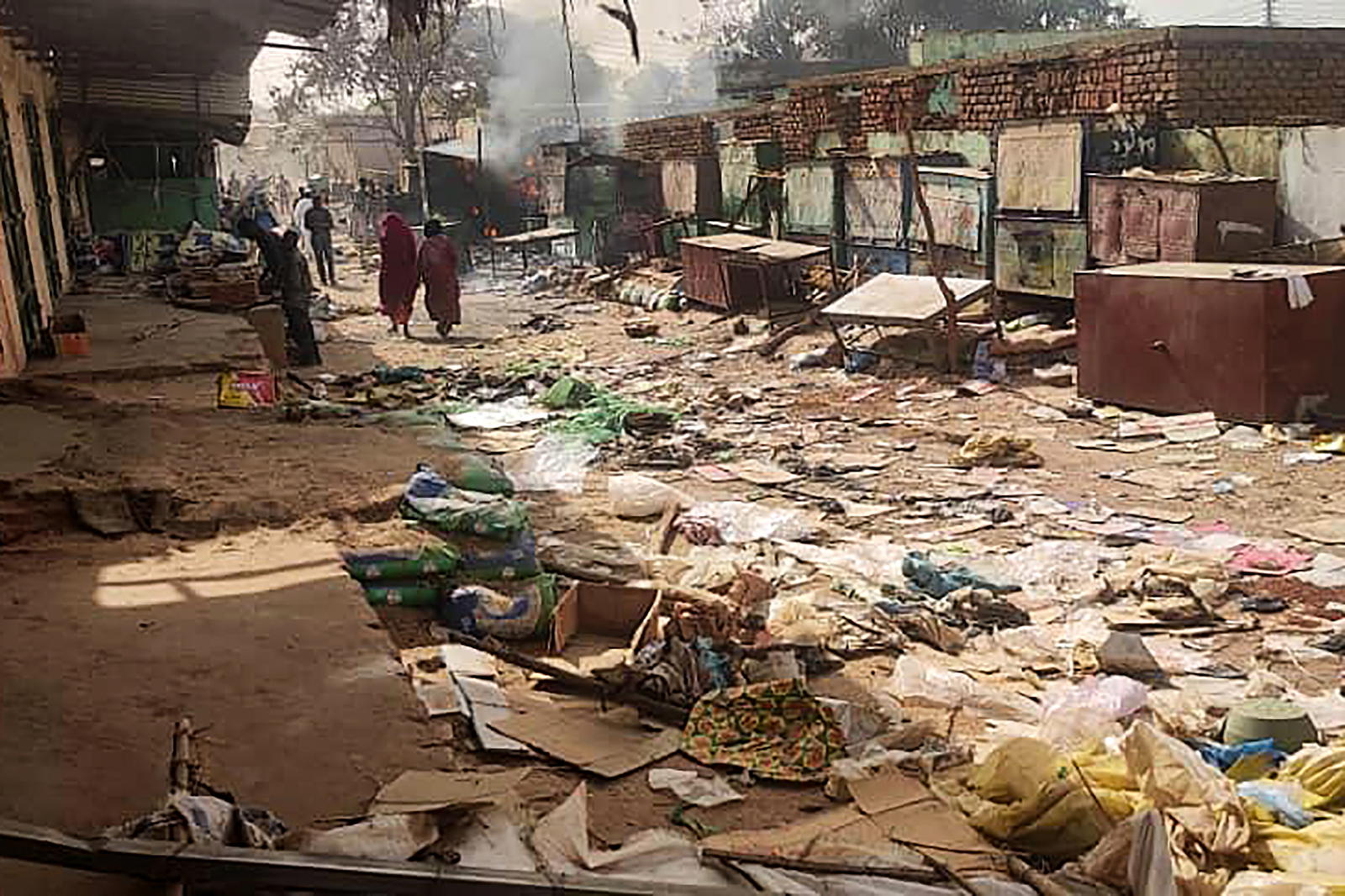
(FILES) People walk among scattered objects in the market of El Geneina, the capital of West Darfur, on April 29, 2023, as fighting continues in Sudan between the forces of two rival generals. – Sudan’s devastating war raged on into a third month on June 15, 2023, as the reported death toll topped 2,000 and after a state governor was killed in the remote Darfur region. (Photo by – / AFP)
The Commandant National Defence College (NDC), Rear Adm. Murtala Bashir, says the ongoing crisis in Sudan may aggravate the already dire security situation in the continent if not properly handled by African leaders.
Bashir said this at a One-Day Roundtable on Sudan Crisis organised by the Center for Strategic Research and Studies of National Defence College on Monday in Abuja.
The theme of the roundtable is “Sudan Crisis: Implications for National and Regional Security”.
The commandant said that Sudan had witnessed a lot of crises such as the two civil wars between the then central government and the southern regions and the ongoing crisis in the western region of the country.
He said the crisis had so far claimed the lives of about 200,000 people, in addition to the millions of people that had been displaced and taking refuge in neighboring countries.
According to him, there has been massive destruction of infrastructure and facilities in the country as well as the ongoing crisis that has claimed so many lives and further displacement of people in the country.
“We should realise that we are yet to get over the shock and the effects of the crisis in Libya.
“So with this recent development in Sudan, it is definitely going to aggravate an already dire situation not only in the sub-region but the continent and probably outside the continent.
“That is why as the apex military institution in the country, we felt it is necessary for us to organise this roundtable by inviting very esteemed resource persons with the requisite knowledge, experience, and exposure so that we can come and brainstorm, interact and see how we can propose strategies for Nigeria, the African continent and maybe international organisations.
“We want to see how this conflict could be resolved as quickly as possible.
“Already some countries and organisations, countries like Saudi Arabia, United States and some countries in Africa have intervened, but we felt as a think-tank of the country and for the armed forces of Nigeria, we need to organise this roundtable,” he said.
Bashir said the resource persons would have an in-depth analysis and interrogates the crisis in Sudan and generates practical and enduring strategies that would hopefully help to put an end to the crisis.
He said the college would continue to see how it could develop strategies that would help to address security issues in the country, the continent, and globally.
He promised to ensure that the findings were articulated and forwarded to the appropriate security authorities for action.
While giving the background to the Sudan crisis, Dr. Victor Akran, of the Department of History and War Studies, Nigerian Defence Academy (NDA), said that Sudan had over the years witnessed a series of conflicts since the colonial era.
Akran said that there was the perspective of the European powers’ involvement in the exploitation of Sudanese and their resources as far back as 1821 and the Egyptian control.
He said the purpose of their involvement was to procure slaves for slave labour and extract the natural resources of Sudan.
He said that the British conquest of Egypt opened the way for European nations’ penetration into Sudan, adding that the country had continued to face crisis since during and after independence.
According to him, how the current crisis is going to end depends greatly on the involvement of the African leaders.
“Of course, Africa has experienced several of this type of crisis but the closest to Nigeria was in Libya.
“Africa refused to act in time, and the Libyan crisis has become what we know it and today, Nigeria is at the receiving end,” he said.
Disclaimer
Comments expressed here do not reflect the opinions of Vanguard newspapers or any employee thereof.