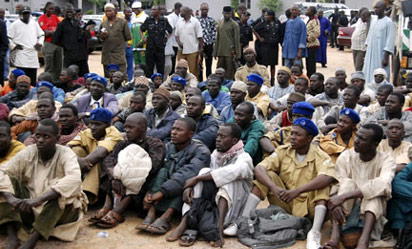
Suspected Boko Haram members
By Jide Ajani
It was brazen yet effective. In less than 24hours, over 150 people had been killed.
A spokesman for the BOKO HARAM, using the name Abul_Qaqa, who spoke hours after witnesses reported “scenes of carnage” vowed that “more attacks are on the way.
“We will continue attacking federal government formations”, he threatened, “until security forces stop their excesses on our members and vulnerable civilians,” Abul_Qaqa said in an interview with newsmen.
Yet, there appeared to have been sufficient intelligence which suggested that the Sallah weekend would be bloody as members of the Ahlan Sunnah Lid Da’waati wal Jihad Yaanaa (brothers), also known as the Boko Haram sect would strike. Though the intelligence provided hinted at a strike by the sect, it was not target specific.

File photo: Suspected Boko Haram members after their arrest.
So, what happened?
A source informed Sunday Vanguard that had “the so called intelligence provided been target specific, officers and men of the police force would have prepared for an effective response. And even the way and manner the sect members struck in Damaturu, they were able to do so because they knew the geography, topography and everything about the state”.
Information available to Sunday Vanguard points in the direction of not only intelligence failure but a gap in operational co-ordination as being responsible for the seeming success recorded by members of the sect. In fact, the vengeance of not being able to carry out their strike in Borno State was what was visited on Damaturu, the Yobe State capital.
For the members of the sect, their attachment to Yobe State dates back to sometime between 2004 and 2007.
Investigations by Sunday Vanguard within the intelligence community revealed that members of the group are very familiar with Yobe State. The group had set up a base in Kanamma, Yobe State, from where the then seeming rag-tag followers of the brotherhood operated. The camp was aptly named Afghanistan. The man in charge at that time was Mohammed Ali – Mohammed Yusuf, founder of the sect had traveled abroad for treatment.
It was from that camp that they were first dislodged. Acting on a tip off, the security agencies invaded the camp and flushed out the members. But they only scattered; the group refused to disband. In deed, it waxed stronger by attracting more members. Before Yusuf’s return, the group moved from the camp and headed northwards, towards Maiduguri, the capital of Borno State, and set up a new camp.
Although Sunday Vanguard could not establish the exact year, there was evidence, according to security sources, to suggest that the group sent some eight persons to Algeria in North Africa to go and learn how to make Improvised Explosive Device, IEDs, within thaty same period of three years.
From all indications, those they sent out learnt well. They perfected the art of making IEDs. At least, the evidence of that is the spate of bombings that the group has caused to happen in just about 11 months, starting from December last year.
Therefore, when the sect decided to re_group and launch, it was with a vengeance.
Firstly, the group members invaded the prison in Bauchi and set free its members.
For regaining freedom, they pledged eternal loyalty to the group.

President Jonathan
According to an agent of America’s Federal Bureau of Investigation, FBI, Jennifer Dent, who is the US Embassy’s legal attaché, the Police and Civil Society, (at a Hubert Humphrey forum in Lagos) “We have been hearing of Boko Haram but people had not realized that there were others in the continent”.
She said her government and the Nigerian authorities were working together in the area of intelligence gathering and effective response. With regards to the October 1, 2010, bombings, she said “we brought in bomb technicians to help your government. Throughout the entire elections we had experts coming in and out”.
In fact using the June 16 bombing of the Police Force headquarters as an example of how security consciousness could save lives, she said “I was actually at the police headquarters in June.
I was at the IG’s office and we were very lucky that a very observant law enforcement officer noticed that a car followed the IG’s motorcade into the building and only because he noticed and forced him to divert to the visitors’ parking area, the bomb would have gone off in front of the headquarters and there would have been a lot more serious loss of lives”.
Therefore, the question to ask is: To what use have the police put the collaborative efforts? Why couldn’t the carnage in Damaturu be averted?
Sunday Vanguard was told that there are fresh concerns that there may indeed be fifth columnists within the system which makes it appear as though the Boko Haram operatives are sometimes a step ahead of the game.
When Sunday Vanguard asked a top intelligence person last Friday about the possibility of fifth columnists within the system, his sharp response was: “What do you think and why do you think they do some of those things they do the way they do them”?
The source reminded Sunday Vanguard of the United Nation’s House bombing earlier, explaining that fortification of strategic buildings were done only for the terrorists to have a last minute change of plans and headed for the UN House.
The source said that the carnage in Yobe was a result of similar thinking.
According to a source, a truck carrying the Boko Haram sect members and their explosives was sighted early last Friday 4th November, close to the Gombe/Yobe border, obviously making its way to Maiduguri . But once it became obvious to the bombers that their mission may have been unearthed, they made a detour to Yobe State.
On entering Yobe state, security agencies including Mobile Police personnel and other security operatives opened fire on the truck and injured some of the sect members inside it. The truck was said to have continued its movement with the occupants shooting sporadically along the road at any Police checkpoint or security personnel they met on the road until it got to the city center.
At the city center, they commenced throwing of bombs at any notable government structure and churches they met on the way before the truck was said to have gone up in explosion following a counter attack from security agencies that had become effectively mobilized.
“The attack on churches in particular was said to have been a pre_meditated attempt by the sect members to instigate a religious uprising and reprisal attacks between Christians and Moslems in the North East but security agencies have taken measures to prevent such”, the source said.
But even as Nigeria was still grappling with the effects of that, the American government issued a terror alert warning people of terror plans targeting three luxury hotels in Abuja. The embassy warned its citizens to avoid the Nicon Luxury, Transcorp Hilton, and Sheraton hotels in Abuja, the three luxury hotels frequented by foreigners in Abuja, which the embassy said may be the next target of the deadly Islamist sect.
But Issa Aremu, Vice President of the Nigeria Labour Congress, NLC, took a swipe at the embassy for attempting to exacerbate an already terrible situation in the country.
According to Aremu, such a terror alert was completely unhelpful, scary and unacceptable to all Nigerians, emphasising that any further scare about Nigeria’s security challenge is one scare too addictive and too unhelpful.
“What will be refreshingly new and healing for Nigerians (and particularly from the friends of Nigeria including America) are creative constructive suggestions and ideas on how to put an end to the security challenges. The America’s warning statement is certainly not refreshing to Nigerians.
On the contrary, it complicates the security challenges for a country striving to cope with the challenges of development. In an attempt to selfishly safeguard her own citizens, America’s scary statement creates unnecessary tension for 150 million citizens of Nigeria. In 2005 a dubious intelligence report from Washington predicted the collapse of Nigerian project in 2015. We hope USA is not working to prove an acid test.
“America enjoyed instant global sympathy and solidarity of the world after the criminal Sept. 11 2001 attack. America should constructively extend same solidarity and sympathy to other countries under terror and this cannot be done through red_herring that demobilizes the nation and demobilizes 150 million people”, he said.
Making the case for good governance, Aremu further said “the promise of independence is that the sovereignty and independence of the country must be respected. The meddlesomeness of America in the affairs of Nigeria is increasingly too open and brazen.
The solution is good governance and Nigeria’s leaders at all levels must be on duty to provide good governance. Certainly with development and good governance truly independent Nigeria can be re-invented”.
The National Security Adviser, General Owoye Andrew Azazi, also accused America of fanning unnecessary tension in the country by issuing a warning to its citizens resident in the country to avoid three high profile hotels in the federal capital territory because of fears of terrorist attacks. Soldiers were immediately deployed to take over security of almost all high profile hotels in Abuja.
The NSA had disclosed in a statement in Abuja, Monday, that his office was on top of the security situation in the country, insisting that the threat by Boko Haram to bomb three luxury hotels in Abuja was not new. Similarly, President Goodluck Jonathan pledged that all new projects on security beef up in the country would be completed very soon,
Interestingly, it was the confetti of opposition views abiout the unintended consequences of America’s terror alert that forced it to ease same. But even after that, Boko Haram kept striking on a daily basis.
Disclaimer
Comments expressed here do not reflect the opinions of Vanguard newspapers or any employee thereof.