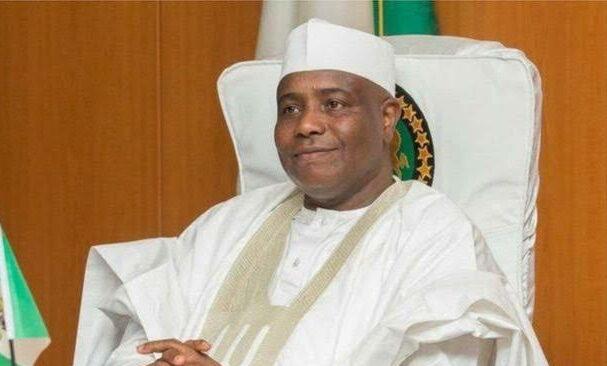
Tambuwal
By Abubakar Yusuf
In a nation where past public officeholders are often criticised for the negative legacies that their reign birthed, Governor Aminu Tambuwal of Sokoto State is certain to leave his constituents with positive offspring, many of which should be credited to his conscious governance that ran between May 29, 2015, and set to terminate on May 29, 2023.
Lending validity to this is the radical transformation that the state’s education sector enjoyed through his excellent leadership style. As soon as he took office, Tambuwal proclaimed a state of emergency in the education sector, promising to completely turn around the sector’s fortunes in four years. In retrospect, Tambuwal has performed better than anticipated.
Tambuwal believes that education is the cornerstone of all growth, which is why he allocated the largest portion of the administration’s annual budget to it upon taking office. Given the widespread perception that Sokoto State’s educational system is underdeveloped, this admirable action was taken to mobilise support for education and ensure that it reflects the interests and aspirations of the populace.
The state has seen a phenomenal rise in the number of students enrolled in basic, secondary and higher levels of education, all thanks to that intentional approach. In a short period of time, Tambuwal completely restored and built new school buildings at all levels. In order to guarantee progress in the state, he stated, it is essential to guarantee everyone’s access to education.
For instance, in 2020, during a condolence visit from the Committee of the Pro-Chancellors of Nigerian States’ Universities (CPCNSU), Tambuwal addressed the group, saying: “This is our collective responsibility to see that our younger ones are educated, particularly those children that are out of school. We, as leaders, should provide them with basic education by creating the enabling environment and making provisions for necessary infrastructure, learning materials and personnel for the education of our younger ones.”
The governor has already sent a “Right to Education Bill” to the State House of Assembly, putting his words into effect. All children in Sokoto State between the ages of 6 and 18 are now required to receive free and compulsory education as a result of a bill that was approved by the legislature and signed by the governor. With the support of all significant educational stakeholders, the governor initiated an enrollment drive campaign to ensure the full and efficient implementation of the “Child Right Law.”
The initiative aims to alter the unfavourable perception of Sokoto State in the area of western education by getting all out-of-school children in the state back in the classroom. Happily, according to data made public by UNICEF, Tambuwal’s administration has successfully enrolled 75,200,000 out-of-school children in school by the year 2020. Governor Tambuwal formed the State Consultative Committee on Education, which is headed by Muhammad Sa’ad Abubakar, the Sultan of Sokoto, in order to support the education sector even further. The committee, whose power comes from the administration initiated education tax, was successful in building and renovating several formal and informal elementary and secondary schools as well as providing them with modern amenities throughout Sokoto State.
Other noteworthy educational initiatives carried out by the administration include the opening of the Government Girls Arabic Junior Secondary School in Sanyinna in Tambuwal local government, the Command Boys Secondary School in Shagari local government, the renovation of Gamji Girls College in Rabah local government, the expansion and renovation of the Government Day Secondary School in Tambuwal, as well as similar initiatives in Kilgori of the Yabo local government and another one at Kofar Rini ar.
The administration decided to take the bull by the horns in order to further revitalise the education sector and started and finished building the Government Science Academy, Kasarawa in the Wamakko local government.
In actuality, Tambuwal’s administration gave priority to education. No higher education institution or school was untouched by his admirable initiatives. A good deal of the administration’s kind deeds intended to advance education to greatness have gone to organisations like the Sokoto State University, Sokoto State College of Nursing Sciences, College of Midwifery Tambuwal, Umaru Ali Shinkafi Polytechnic, Sokoto, College of Legal and Islamic Studies, Wamakko, College of Agriculture and Animal Science in Wurno, as well as the recently founded Sokoto State University of Education.
A closer examination of the Ministry of Science and Technology would reveal that on several fronts, the Tambuwal government has distinguished itself in ways that only a select few can claim. The Information and Communications Technology (ICT) structures have improved as a result of the ministry’s administration’s efforts. To ensure the best results in service delivery, he provided the ICT Directorate’s office with cutting-edge facilities. The Sokoto state received the e-government best state award from the National Information and Technology Development Agency (NITDA) in recognition of the state’s significant advancements in ICT, made possible by the backing of governor Tambuwal.
Even as his tenure is about to come to an end, Tambuwal reaffirmed his commitment to the education sector by turning the almajiri system of education into a model system and launching the Almajiri Nizzamiyah Education Model (ALNIZAMO) while approving two bills.
He said: “The system we are presently implementing is the one that is more acceptable in the world. This system will enhance the living standard of our children and improve their educational capacity toward a greater society.”
The state government’s efforts in increasing the enrolment to schools, especially the girl-child, in 2020, earned UNICEF’s recognition.
There was also USAID award to Sokoto State in recognition of its partnership in promoting Early Grade Reading (EGR) in Nigeria in 2021.
*Yusuf writes from Sokoto
Disclaimer
Comments expressed here do not reflect the opinions of Vanguard newspapers or any employee thereof.