By SUFUYAN OJEIFO
Olusegun Aremu Okikiolakan Obasanjo, a retired Army General and former Head of State of the Federal Republic of Nigeria, had won the February 27, 1999, presidential poll on the platform of the Peoples Democratic Party, PDP, at the expense of a former Minister of Finance and ex-Secretary to the Government of the Federation, SGF, Chief Olu Falae, who ran on a joint Alliance for Democracy-All Peoples Party, AD-APP, ticket to become the democratically-elected president of Nigeria. As soon as Obasanjo won the poll, he took charge of the levers of power, influencing and determining the direction of the emergent government and the concomitant politicking that would define the shape and texture of governance.
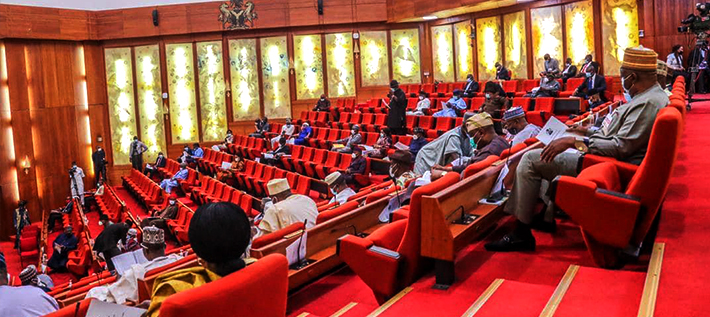
Obasanjo had a clear idea of what he wanted. He predetermined the outcomes of the contests for the positions of presiding officers of the National Assembly because he was interested in who became the Senate President and the Speaker of the House of Representatives. The choice of the Senate President was particularly much more engaging than that of the speaker. Dr Chuba Okadigbo had emerged the natural choice of senators-elect of the ruling PDP for the position of Senate president. In fact, in the pre-consultative meetings ahead of the inauguration of the National Assembly on June 3, 1999, the flamboyant politician from Oyi in Anambra State had been endorsed at the historic Agura Hotels, Abuja, meeting by the 66 senators-elect of the PDP as their candidate for the Senate presidency.
Okadigbo looked good to clinch the seat. But Obasanjo had a different plan which he was determined to push through. He wanted a candidate who was not as independent-minded as Okadigbo; and, against the run of play, he propped up Evan(s) Enwerem , aka “mature”, from Imo State as his pick for the position. The retired General threw everything into the mix because the emergence of Enwerem instead of Okadigbo mattered more to him than any other consideration. The number three position in the country was a big deal and whoever stepped in must be loyal and subservient to him. Obasanjo moved into the camp of the opposition AD-APP senators and effectively cornered all 43 senators-elect. That was the first strategic step he took and thereafter moved into the PDP caucus in the Senate to deplete their numbers.
By the time the dust of the hotly contested race settled on June 3, 1999 on the floor of the Senate, the tide had turned against Okadigbo who had appeared surefooted that he was going to emerge as the Senate president. Obasanjo had deployed intimidating presidential powers of patronage in the Senate to reverse the pre-election calculations and configuration in favour of Enwerem who received 66 votes (43 votes from the AD-APP caucus and 23 from the 66-member PDP caucus, whose endorsement Okadigbo had secured before the inauguration of the Senate) on the floor of the Senate as against Okadigbo’s 43 votes to emerge as the Senate president.
The emergence of Enwerem unsettled not only the Senate but also the Fourth National Assembly because Obasanjo had replicated the same stunt that he pulled in the Senate in the House of Representatives where he had successfully pushed through the candidature of Salisu Buhari as Speaker. Obasanjo ensured that the Senate president and the Speaker were his men although both Enwerem and Buhari lost their seats some months later due to perjury. While the losses caused a permanent seismic shift in the House of Representatives where an independent-minded Ghali Umar Na’Abba emerged as Buhari’s successor and successfully finished his course, it was a game of the musical chair in the Senate as three Senate presidents were turned over between 1999 and 2003, namely Enwerem, Okadigbo who succeeded him (Enwerem) and Anyim Pius Anyim who succeeded Okadigbo when he (Okadigbo) was removed by a coalition of opposition senators funded by Obasanjo’s presidency.
I recall that Anyim who succeeded Okadigbo had enjoyed the backing of senators with strong link with the Presidency, but at a certain intersection after stepping in the saddle, he freed himself from the apron string of the superintendent of executive power in Aso Rock to define his eon and trajectory. Although, I cannot specifically implicate the point of departure in the romance between Obasanjo’s presidency and Anyim’s Senate presidency, one thing that remains a fact of history was that due to the strain in relationship, Anyim (an Ebonyi State senator) decided not to seek re-election to the Senate. He bowed out with the fourth Senate. Obasanjo had thus moved into the fifth National Assembly to influence the emergence of Adolphus Wabara as Senate President, who unfortunately lost his seat to some high-octane conspiracy by some South-East senators who were in bed with Obasanjo over the plot for possible tenure extension (Third Term agenda for Obasanjo). Wabara was reasonably suspected to be interested in running for the presidency of Nigeria after his Senate presidency. He was implicated in a N50-million-bribe-for-budget scandal for which Obasanjo, as president, made a national broadcast aired live on some television and radio stations.
But unfortunately for Obasanjo, the man who succeeded Wabara, Senator Ken Nnamani, was an independent-minded character who espoused and expounded the imperativeness of legislative due process in the conduct of Senate business, especially the Senate consideration of the proposed bill for tenure elongation under the Obasanjo presidency. Nnamani presided over the death of the proposed tenure elongation which Obasanjo was looking forward to profiting from. Nnamani, like Anyim in 2003, decided not to seek re-election in 2007 because Obasanjo, who was smarting from the death of the Third Term agenda, was not going to allow him to return.
In the House of Representatives, Obasanjo had in place Aminu Masari (the incumbent Katsina State governor) as Speaker from 2003 to 2007. In 2007, as Obasanjo was egressing Aso Rock, he had facilitated the emergence of David Mark as Senate president and Patricia Etteh as Speaker. Whereas, Mark, a retired army general, was able to secure his Senate presidency for two terms with the magnitude of his legislative legerdemain, Etteh lost her speakership less than a year into office and was succeeded by Dimeji Bankole.
I have provided the historical context supra in the race to the Senate presidency (and speakership) to situate and explicate the huge influence that presidents who are interested in those who partner them as Senate president(s) and speaker(s) can deploy in the legislature to tilt the balance of leaderships in their favour. The late President Umaru Yar’Adua, initially in the shadows of Obasanjo, inherited those Obasanjo facilitated their emergence; President Goodluck Jonathan maintained the status quo in the Senate with David Mark in 2011. He could not weigh in to reinforce support for the PDP anointed candidate, Mulikat Adeola, to emerge as speaker. She was defeated by Aminu Waziri Tambuwal in a grand conspiratorial alliance that fed on the support of opposition members in the House.
Fast-forward to 2023. President-elect, Bola Ahmed Tinubu matters in the ongoing scramble for the National Assembly presiding officers’ positions. Precedents of presidential interest in the fostering of synergy with trusted loyalists or party faithful abound in historical contexts.
Ojeifo, a journalist and publisher, wrote from Abuja via: [email protected]
Disclaimer
Comments expressed here do not reflect the opinions of Vanguard newspapers or any employee thereof.