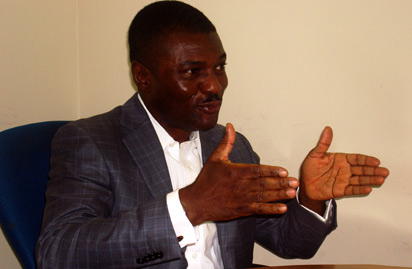
DG/CEO, NESG, Frank Nweke Jr.
By Achilleus-Chud Uchegbu
The first edition of the Nigerian Economic Summit (NES) was held in 1993. It took place in February of that year and was convened by then Head of Interim Government, Chief Ernest Shonekan. As Head of Government, Shonekan mooted the idea of an economic summit as a platform for private sector advocacy and intervention in governance.
It was his belief that one of the essentials to resolving Nigeria’s economic problems was the creation of a forum which would enable key players in the private sector to dialogue with top government officials. His idea, which was put into place in anticipation of a successful transition to democratic governance, was facilitated by a core group from the public and private sectors.
Since 1999, the Summit has held every year till date. It has consistently advocated changes in government and has helped government develop policies that had been implemented to drive the economy.
For instance, on deregulation/sector reform, NESt was unequivocal in its focus on deregulation of the economy so as to rescue it from suffocation and free private resources itching to flow into potential areas of profitable investment in the economy. Summit advocacy led to positive responses in the following sectors, among others:
• Aviation sector which has seen the growth of private airlines in the country. But for private investment, the sector would have collapsed.
• Financial sector which has been largely opened up including the rendition of the role of the CBN in retail banking.
• Communication sector which has seen an explosion in courier services and telecommunications.
• Power sector reforms now permit investment by independent power producers and the unbundling of PHCN.
• Oil and gas sector reforms which are still ongoing although there is still a long way to go.

DG/CEO, NESG, Frank Nweke Jr.
• Agriculture sector which reforms have led to a reduction in fertilizer subsidies, government withdrawal from direct production and elimination of commodity marketing boards.
• Education sector deregulation which has seen the growth of private tertiary institutions, secondary and first grade primary schools.
Another area of intervention by the Summit, which has yielded fruits, is on the issue of long term vision for the country. This gave birth to Vision 20:2020 and Mass Participation. NES was able to market the need for a long-term vision for the country. In doing this, the Summit took cue from the Malaysian experience where long term vision and planning has proven a success.
The acceptance of the idea led to the establishment of the Vision 20:2020 committee which spent nine months producing its proposals. The committee had representations from a cross section of Nigerians as well as other stakeholders. Although subsequent changes in administration affected implementation of the Vision, its recommendations still have much to offer.
Investing in infrastructure has also been one other area of serious concern to NES. On this, the Summit advocated economic liberalization and increased competition that paved the way for the explosion of the telecommunications industry.
The advent of the global system for mobile telecommunication greatly increased the country’s teledensity and is still flowing. It also created employment, attracted substantial inflow of investment and revolutionized the telecommunications industry. It is an achievement, and an evidence of the good ends of deregulation that can be replicated in other sectors.
Another that bogged investors is the cost of doing business in Nigeria. This was, also for the Summit, an issue of serious concern. High business costs are hampering export development and expansion of businesses while also constraining the growth of employment. NES advocated change and also made several recommendations aimed at reducing the cost of doing business in the country. The recommendations include:
• Improvement in infrastructure such as electricity supply, roads, port facilities, water supply, etc.
• Reduction in corporate tax.
• 25% five-year rebate on import duty.
• Reduction in capital gains tax.
• Repeal/amendment of anti-corruption laws
• Abolition of excise duty
• Abolition of export inspection fees, etc.
The Summit had also, in the series, taken a critical look at Nigeria’s Investment Climate and made recommendations that would encourage investors and position the country as a destination for investment. Some of the recommendations are:
• Repeal of the Nigerian Enterprises Promotion Decree (the indigenization law) which restricted foreign investments in Nigeria.
• The enactment of the Nigerian Enterprises Promotion Act, 1995 which removed the restriction on foreign investments and provided general framework for facilitating and promoting investments in Nigeria; the repeal of the Exchange Control Act, 1962 and its replacement with the Foreign Exchange Act, 1995 which liberalized foreign exchange controls in Nigeria.
• Attracting private investments by embarking on a comprehensive and credible privatisation programme.
• Pursuit of consistent policies and macro-economic stability.
• Repeal of anti-investment laws.
NES noted that one area of major concern was the public sector, which was in need of urgent reforms. To this end, public sector reforms occupied the thought of the Summit making it to bring the issue to the front burner for national discourse. It thus canvassed reforms of the sector to position it for effective service delivery as a key necessity for private sector led growth and the creation of a market-driven economy.
NES recommended the reduction and, or, elimination of corruption and the enthronement of good governance and transparency; redefinition of the role of government in a market economy, right-sizing of government bureaucracy and the monetization of fringe benefits of public servants. Specifically, the Summit advocated:
• Combating corruption, payment of competitive wages, upgrading of retirement benefits and adoption of transparent procedures for public procurement. This gave birth to the Bureau of Public Procurement (BPP).
• Breaking of NICON/Nigeria-Re monopoly
• Openness in governance
• A credible privatization programme
• Elimination of ad-hoc agencies
• Policy consistency
• Reducing inflation to single digit
• Resolution of the issue of oil producing communities
• Rule of law
• Hitch-free voters registration/elections
The question of privatisation/deregulation programme of government had been addressed at the Summit in the past. This became necessary to reduce waste of public funds on non-performing assets, increase public revenue, improve technology and the management of several public sector enterprises. Persistently, the Summit called on government to demonstrate commitment to achievement of the programme.
Further to this, the Summit called for a review of the policy on contract leasing, recommending instead that it should be applied only to carefully selected enterprises where no other mode of privatisation is appropriate. Consistent with its advocacy, the NES in 1995, asked government to strengthen the Bureau for Public Enterprises (BPE) and, in 1996, urged government to issue an unambiguous policy statement on the privatisation exercise asking that the BPE should remain the sole agency for facilitating the transfer of ownership of all public enterprises to private hands.
NES moved ahead to request for the introduction of Build, Operate and Transfer (BOT) as a strategy for the privatization of roads and railways and also Repair-Operate-Transfer (ROT) for the power sector. Both recommendations were adopted by government.
Sectorally, at the 11th NES, the body sought the recapitalization and consolidation of the insurance sector in aid of growth and strengthening of the financial sector of the economy. Government responded to this with a 1,000% increase in the capital requirement for the establishment of an insurance company in the country.
The 11th NES also recommended the privatisation of the Nigerian Ports Authority for improved performance; privatisation of the PHCN; and reduction in the transaction costs in the capital market. Government saw the need for these and responded with the concessioning of some ports in the country, adopted the recommendation on the PHCN leading to the creation of generation, transmission and distribution companies out of the power compnay and also, caused a 50% reduction in the transaction costs in the capital market.
Before that, the Summit, at its 10th meeting, asked for the acceleration of the enactment of a reform law to revolutionise pension issues in the country and, in the long term, achieve eradication of issues of pension payments and associated risks. This recommendation led to the enactment of the Pension Reform Act of 2004 which was later signed into law by the president, leading to a total overhaul of the pension management system in the country.
As concern mounted over the viability of the aviation sector and safety issues therein, NES took the bold step to make sure the sector was saved from collapse. To this end, the 12th Summit rose with a recommendation to improve the aviation sector through the procurement of navigational and safety aids; and also to create and enforce a statutory minimum operating capital requirement for domestic airlines in the country.
This recommendation was later adopted by government leading to the TRACON (Total Radar Coverage of Nigeria) project, which has now improved international rating of the Nigerian airspace and aviation industry. Government also created a capital base of N500 million for domestic airlines, an improvement from the previous base of N20 million.
Other achievements of the 12th Summit were the recommendation of the adoption of the PPP model for government in the management of infrastructure. Added to this was the recommendation for the enactment of fiscal responsibility law to enforce discipline in fiscal management. The law was passed into law in 2007.
The 13th Summit canvassed the enactment of a law prohibiting discrimination against persons with disabilities; and also, for the amendment of the Land Use Decree. Both recommendations were adopted leading to the enactment in 2009 of a law against discriminating against persons with disabilities while the late President Umaru Yar’Adua, in 2009, initiated a Land Reform Bill to the National Assembly seeking to excise the Land Use Act of 1978 from the constitution.
The strategic intervention, in 2009, in the agriculture sector, with the institution of a N200 billion commercial agriculture credit scheme, was a direct effect of the 14th NES, which saw the idea of establishing an agric credit scheme was being adopted. Generally, NES series has had tremendous impact on the economy such that it has grown to become the single most authoritative platform for canvassing economic change by the private sector.
This has strategically re-positioned the NESG to become the apex private sector think-tank for advocating change in the management of the economy. Certainly, the vision of Chief Shonekan, in setting up the body in 1993, has blossomed to become a strategic intervention in pushing the Nigerian economy through the storm.
Disclaimer
Comments expressed here do not reflect the opinions of Vanguard newspapers or any employee thereof.