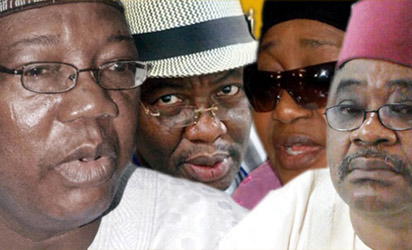
WAZIRI AND HER CATCH: File pictures of EFCC Chairman Farida Waziri (2nd right) and from left, former governors Doma, Daniel and Alao-Akala arrested by EFCC operatives yesterday.
By Kassim Afegbua
One is getting unusually stressed up these days as a result of the very unsavoury news we get about our economy, politics and the future of Nigeria. Everything we do in Nigeria has a corruptive undertone; appointments, fiscal responsibility, allocation of resources, distribution of wealth, and appropriation of responsibilities, patronage, and general lifestyles.
Even the way we dress, talk, smile, laugh, dance, walk, sleep, and eat is loaded with symptoms of corruption. When you see the way people apply desperation to get to public office, you will understand what I am saying. Rather than celebrate our independence from our colonial masters in such hideous manner like we did last month, we should have recruited those praise singers to go on the street in celebration of corruption; that singular cankerworm that is found in every home, well-nourished, well-fed and dancing naked all over the place.
This metaphorical verbiage is a pointer to the ludicrous state we find ourselves in. Imagine this screaming headline: “FG to finance 2012-2015 Budgets from borrowing”. And another clincher: “Auditor-General rejects EFCC audited report”. And yet another one: States are in distress”.
This is Nigeria, sixth largest producer of petroleum in the world. At the investment forum organized to shore up Nigeria’s investment opportunities, I did not hear anyone talk about corruption as a main topic that deserves thorough attention and critical examination.
I heard voices that were telling us what we already know; no one could explain to us how we will get out of our burgeoning domestic debt mess and the plausible routes to take in solving the perplexing unemployment situation. With revelations coming from the several probe panels, we seem at sea explaining where this country is headed. NNPC needs to be “celebrated” for its underhand transactions. Ditto for all other governmental agencies that have become synonymous with corruption.
Despite the efforts of the anti-corruption agencies, the way we still celebrate corruption is a naked reminder that the fight will not win converts.
Just watch your TV and see the pro-corruption crowd that assembled at the courts and other venues where alleged corrupt persons are being tried and you will feel the import of why it is corruption we should be celebrating and not independence.
Where does EFCC go when the society seems to be interested in protecting the corrupt? Just imagine the fuel subsidy removal debate and you will see the strings of corruption. Government has unleashed its apologists on the hapless masses, at every television station, radio station and public forum, you see government fat cats explaining away the rationale for eliminating subsidy.
And the question that comes to mind is: what is the function of government? What purpose is it expected to serve? Who are the beneficiaries of government’s policies and activities? What is the role of “people” in any government? If Nigerians are in agreement that subsidy should stay because of the fear of unknown, why is government heady about its position?
Is it a wrong idea if Nigerians say, please develop the infrastructure first and set a time line for the commencement of the exercise, before you remove the subsidy? What is the basis for the explanation if government cannot fight the menacing unreason of the cartel that has held the country by the jugular? If you cannot eliminate the cartel, what then do you want to eliminate; subsidy?
The fact that government is insisting on removing subsidy is also a product of corruption because justification for the removal is on account of the sharp practices of a nameless cartel that exists within the oil corridor. If government cannot identify the cartel, then why is it still in business? Everywhere, corruption walks in broad day light and we celebrate in agreement that it is a way of life.
Imagine Nigeria road blocks and the news often times that Police kills a driver for N20 naira note. Imagine the check points that have become avenue for raking in revenue for some Policemen. Imagine the amount of money people spend to lobby for positions as if that will be the end time.
Imagine the fraud we hear of every now and then, and after the initial gragra, culprits are left off the hook and made to go home to sin no more. Imagine the search for employment by a fresh graduate and the number of people that will turn up for scheduled interview and later, hand notes and referrals become the order of the day. What the heck are we talking about?
Who is that man that will fight corruption? Is it the man who lobbied to get appointment, spending so much money to bribe his way to power that will fight corruption or the one who disrespected party constitution and bended the rules to favour him, or the one who simply opened up our treasury to launder ostentatious campaign across the country, who will fight corruption?
Corruption is as old as the country. Corruption gained independence in 1960 but I am told that even the amalgamation in 1914 was a product of political corruption. So corruption is as old as the country, whether of 1960 or 1914. Corruption has also gone through several phases by way of constitutional amendment.
Several laws exist in the country pretending to be antidote to corruption but they are never obeyed. Let the ICPC and EFCC advertise for recruitment today, and you will see the different shades of corruption that would overwhelm the exercise.
Notes would be flying from Aso Villa to Village Villas, from Emirs, Obis, Ezes, and Obas to Village Heads, all seeking one favour from the recruiting body or the other. The high level of unemployment and underemployment often worsens the narrative. A simple issue such as paying money into the Federation Account by the NNPC has become a thorny discourse. Renowned Auditing Firms have also become enmeshed in this whole dialogue.
They churn out audited statements giving a clean bill of health to organizations as if those organizations are sane. When queries are being raised, putting to test the integrity of the auditors, you hear all manners of financial jargons to explain away the proclivity. And you wonder aloud, haba Corruption, why are you this powerful?
At the last Commonwealth Heads of Government meeting in Australia, we saw snapshots of President Goodluck Jonathan’s old age romance with his wife of many years, spoon feeding her in show of love to celebrate her birthday. The following day, I read a report which indicated that the President missed out in one of the important sessions of the meeting.
And I exclaimed in my private moment; perhaps the president was carried away by the birthday bash and probably had a hangover that prevented him from attending the occasion that took him out of the country financed by tax payers’ money. I later read the pointless explanation of the Presidential Spokesman, beautiful explanation that refused to convince the picture we saw on the dailies.
That exercise alone is corruption except the President decides to explain to Nigerians how much it costs him to organize the birthday for his wife or if sponsored, how much was spent by the sponsor. Disclosure is a factor you cannot run away from in anti-corruption crusade.
Rather than show Nigerians at home pictures that will gladden their hearts in the face of on-going austerity measures and in the midst of grueling hunger and embarrassing poverty, all they showed us as the outcome of that global forum are pictures of President feeding his wife. Under a democracy, the people deserve to know what their President does and how he conducts the business of government.
He does not own the country like a personal fiefdom. He owes the people explanation at all times on matters that affect the generality of the people. That he is the president does not insulate him from charges of corruption. In fact, his attitude determines the flow of anti-corruption crusade. We are therefore waiting to hear from government publicists how much was spent for the birthday and from whose pockets was the money taken.
From that perspective, we will now see whether the money was budgeted for or whether it is from the statutory estacode that the President is entitled to. But to deny the public to know is to be a confirmed celebrant of corruption.
Lastly, it must be understood that corruption breeds insecurity, and insecurity overheats the system. Under a pressured atmosphere, instability fertilizes apprehension which ultimately leads to revolution. We are not praying for revolution to happen, but those who are presently leading us must wake up to the stark reality that the country is not enjoying the best of times at the moment. Nigerians are grumbling everywhere you turn and to add insult to injury, the thought of removing the oil subsidy is staring us in the face.
When the people unanimously declared that they do not want the removal of subsidy, they are only reminding government that this is a bad idea. Remove the cartel and leave the subsidy, and corruption would have been defeated. Listening to the information minister talk so laboriously about justification for the removal of subsidy only reminds me of human inconsistencies.
Simply because he was appointed by the President does not mean he has to dance to the tune of the President all the time. He draws his salary from the collective till of the people. And when you juxtapose what he reportedly said in 1988 during the IBB regime on the proposed removal of subsidy with what he now believes in today, you will understand that integrity has since gone on holiday in Nigeria. Where are the men of integrity? They no longer exist in this clime.
If Labaran Maku could be jumping all over the place to declare that fuel subsidy removal was long overdue, knowing full well how much untold hardship it would visit on the people, then we have no reason not to celebrate corruption. It is shameful and very disgusting that young minds amongst us could descend to that level of hypocrisy just to protect their jobs and in such a manner that the judgment of history is now harsh on them. God save Nigeria.
Disclaimer
Comments expressed here do not reflect the opinions of Vanguard newspapers or any employee thereof.