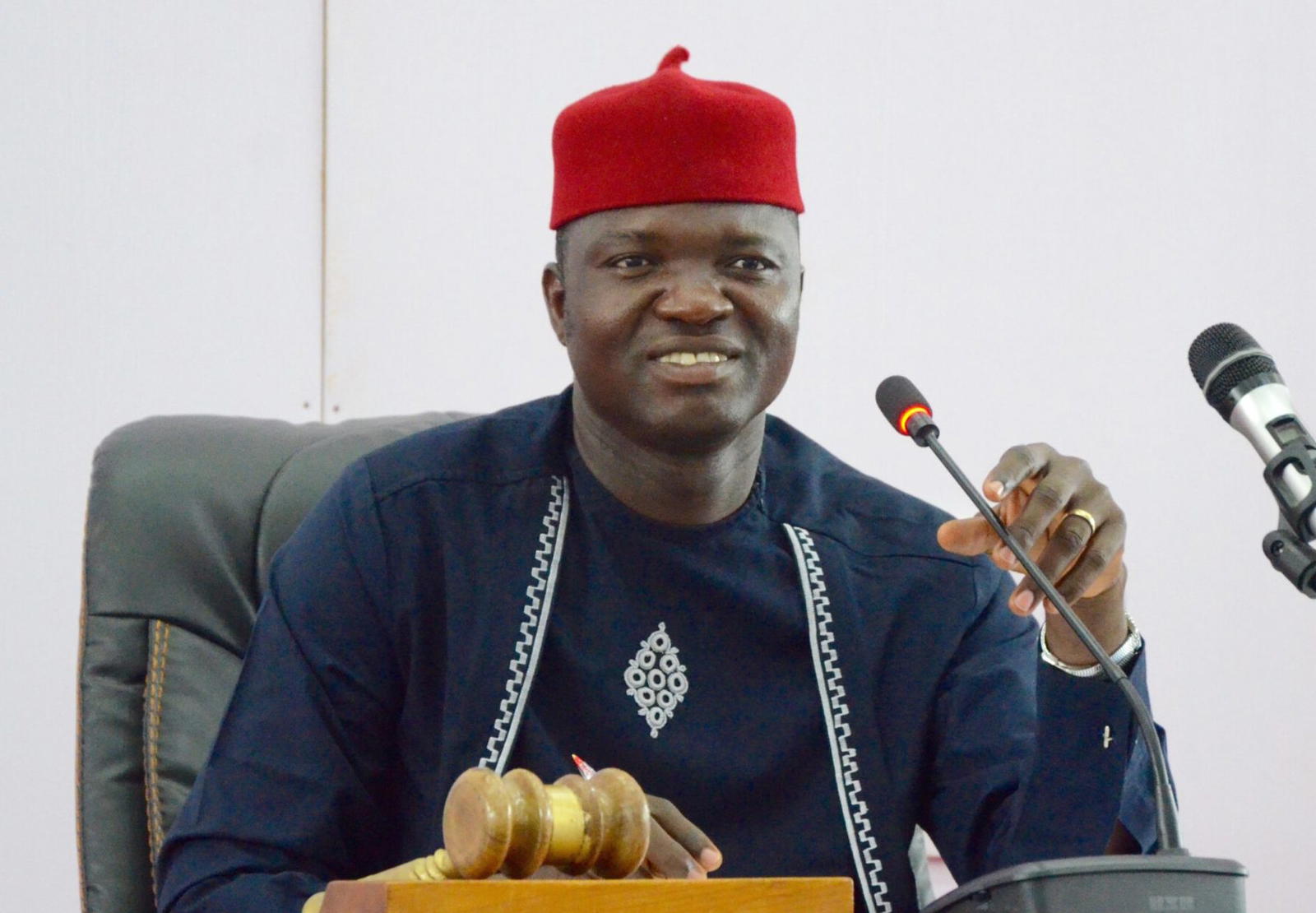
Gov. Francis Nwifuru of Ebonyi State.
By Jonah Nwokpoku
First, let me congratulate Your Excellency on your election as the Governor of Ebonyi State. Your candidacy rode a wave of an unprecedented level of mass acceptance and it is my wish that your government will sustain this popularity throughout its duration.
Your Excellency, permit me to tell you a story. In 2009, a 300-level medical student of Ebonyi State University, Abakaliki jumped onto a commercial motorcycle at his off-campus hostel at Umuchu Street in Ezza Road, heading to the Medical Science Campus at Presco. This was a walking distance of about five minutes, but he was in a hurry because of his MBBS Exam. Barley two minutes into their journey at the popular Presco junction, a commercial bus speeding along the Enugu – Abakaliki Expressway rammed into them. Both the Okada rider and his passenger were crushed to death instantly.
The medical student was an Izzi son named Celestine Mbam – one of the most brilliant minds out of Izzi at the time. His death was a terrible loss and one of the most devastating incidents that left a permanent scar in our hearts up until this day.
However, Celestine’s death was not to be in vain. As the news of his death made it to the local news network that week, the incident compelled the Ebonyi State Government to begin to consider a solution and eventually commenced the construction of a bridge linking the GRA and the Medical Science campus at Presco.
For far too long, the Presco junction had been a death trap, stealing many lives and destroying destinies, but it was not until Celestine’s death did the government consider it necessary to build that connecting bridge and end the carnage.
One could argue that the process leading to the construction of that bridge spurred the construction of many more in several other accident-prone areas, and further unleashed the state’s infrastructure drive spearheaded by the outgoing Governor, His Excellency Engr. David Umahi.
Therefore, his death was not for nothing after all, but perhaps many would not have made any connection between those colourful bridges in Ababkaliki today with the death of a young Izzi medical student in 2009. Perhaps, now that you are a governor, you can do something about that. If naming the Presco bridge after him is too much to ask, a scholarship fund in his memory could be a great place to start.
Your Excellency, my letter is not just to remind you of Celestine’s death. However, it is to illustrate why many Ebonyians, including myself restrained from protesting or overtly criticizing the apparently misplaced priorities when the bridges started going up all over Abakaliki town. Celestine’s story also draws a compelling parallel between the aspirational existence, stoic and resilient spirit of the average Abakaliki man and the State Government’s priorities over the past twenty-seven years.
Permit me to share a few ideas that I believe you could find invaluable as you embark on this journey. Over the past five decades, there have emerged, a reliable formula which developing countries have applied to grow wealthier and improve the lives of their citizens. This formula include investing in education, and healthcare, attracting industries in order to move workers from the field to manufacturing jobs in towns and cities, and prioritizing the export of these goods. Singapore applied this formula to become a city-state and move from a third to a first world. Taiwan and South Korea also used similar formulas and China used them to lift over 800 million people out of poverty.
However, unlike these independent states, Ebonyi faces limitations imposed on its status as a component-federating unit, but can it successfully borrow a leaf from these countries and implement this formula? The answer is yes. The outgoing Governor Engr. David Umahi has laid a strong foundation for infrastructure development and he certainly deserves his flowers, but under your stewardship, the state must now look at that formula and steer the state from an undue focus on physical infrastructure.
There is no gainsaying the fact that the outgoing government has developed some major physical infrastructure needed by the State to anchor its rapid economic development. For instance, the Cargo airport could come in handy for the evacuation of agro-produce to export destinations, while the ring road remains an invaluable economic asset for the evacuation of agro-produce from the farms.
Consequently, your attention may now shift to constructing more connecting rural roads linking major agrarian communities to Abakaliki town. Some other major connecting roads that also deserve your urgent attention include some roads that connect the State with neighbouring states such as Benue, Cross River, and Akwa Ibom. These might require a partnership with the States and the federal government but it is a worthy venture as it could unleash unprecedented economic opportunities through access to agricultural commodities produced in the state.
Meanwhile, it is my humble opinion that investing in education should form the core priority of your government. There is no cogent argument for the entire physical infrastructure if the people are not educated, as the capacity for full utilization lies squarely in the education of the people. The State has not done so well in education over the past eight years. The latest National Bureau of Statistics, NBS’s Multidimensional Poverty Index, rated the State high in poverty, and some of the indices that contributed to our abysmal rating are in “years of schooling and school attendance”.
You may agree with me that over the past eight years, school enrolment has dropped significantly at all levels. The public school system has all but collapsed. Private primary and secondary schools are now springing up in many villages at an unprecedented level, with steep costs of enrolment – a major source of discouragement to parents. And no thanks to the lack of support structure for transitioning into the labour market, graduate unemployment has now worsened, with many questioning the meaning of higher education.
The result is the thousands of Ebonyi people, young and old, that litter the streets of Nigerian cities hewing life out of stone. In the slums of Lagos, Benin, Kano, Abuja, etc. our people are not in short supply as road hawkers, domestic workers, sharecroppers, etc., searching for life’s happiness, no matter how modest, in the oddest of jobs one can find. Sadly, this is not a problem that more roads, bridges, and streetlights can solve, but education can.
Prioritizing education should start with a new drive for school enrolment at the basic and secondary school levels while recruiting more qualified teachers, training, and incentivizing existing ones to show up every day. To achieve this, you may consider collaborating with the church – an already established leader in education in the state. Getting it right with this foundation is what the State needs to reap the investments already made in bridging the infrastructure gap.
More so, many of our graduates are really struggling to transition into the marketplace after leaving school, even with incredibly outstanding grades. Your government may want to create a structure that allows opportunities for fresh graduates to go through an internship programme that then prepares them to transition into the marketplace and join the local/global workforce. I also believe that the State can aim for greater capacity by instituting an overseas scholarship for graduate education with predetermined terms for all beneficiaries. I am proposing a minimum of 1,000 overseas post-graduate scholarships annually.
Technology is the new game in town now and young people across Nigeria are leading the pack in Africa. Ebonyi youths must not be left behind. Your government can set a policy agenda that encourages skills acquisition, especially in software development and other information technology-related skills. There are existing IT/software development schools that the State can collaborate with to achieve this in a very cost-effective manner.
Lastly, it is not impossible to reverse the poverty trend and education backwardness within the next 4 – 8 years under your stewardship if education is the hallmark of your administration. Ebonyi is a relatively small state. With a population of around 3.5 million and a GDP of $2.9 billion, it is possible to take advantage of the immense economic potential of the state, especially in agriculture, and turn things around within the shortest time possible.
Today, Ebonyi ranks 34th on Human Development Index, and only ahead of Gombe and Yobe in terms of GDP. This is unacceptable. We should comfortably rub shoulders with our neighbours in the Southeast region since our people are no longer bottled up in Abakaliki.
Abakaliki used to be an economic powerhouse in the pre-colonial eastern region boasting abundant agricultural output in rice, yam, potatoes, maize, beans, and cassava and natural resources such as Lead and Salt. I believe that it has the potential to regain this status in the region and its pride of place in Nigeria.
Your Excellency, our hopes are high and expectations unbridled. But I have no doubt in my mind that yours will be a successful mandate. Congratulations, again.
*Jonah Nwokpoku, an author and a PR Executive writes from Lagos.
Disclaimer
Comments expressed here do not reflect the opinions of Vanguard newspapers or any employee thereof.