By Elizabeth Osayande
When you mention the name, Oluwatumise Oladapo-Kuku, what comes to mind is the sagacious, and witty presenter with a sonorous voice on Lagos Traffic Radio 96.1 FM.
However, what many do not know is that Tumise as she is fondly called fights a battle to Be, as she navigates the throes of living with bipolar affective disorder.
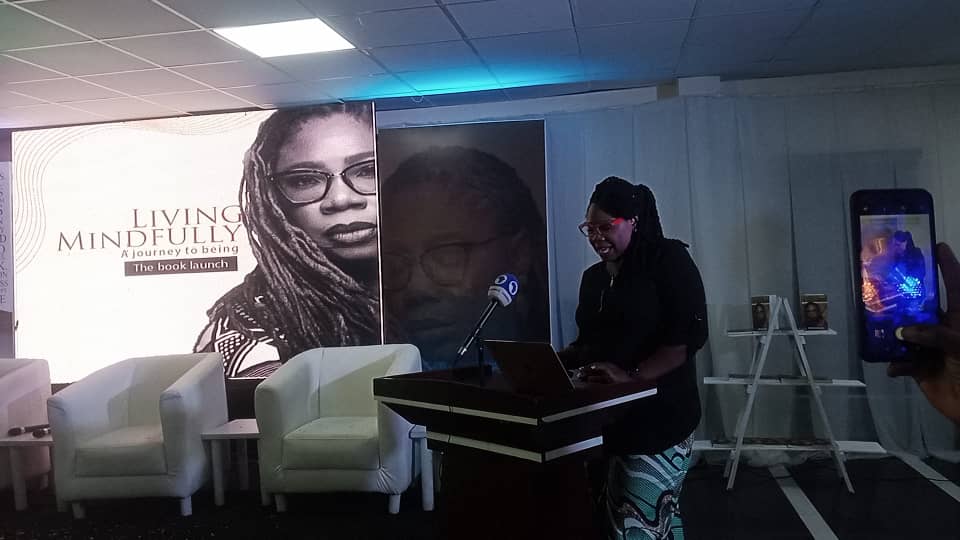
In this interview at the recent launch of her book: ” Living Mindfully: A Journey to Being, where she says, the book was mainly to raise more conversation on mental health, and give people living with it a safe haven to express themselves.
Who is Oluwatumise Oladapo-Kuku?
I am Oluwatumise Oladapo Kuku.
Can you tell us about the book?
The book is a mini memo. What I just did with the book is to drop on some experiences after I was diagnosed with Bipolar Affective Disorder, and how I have used the mindful tools to navigate that disorder. What I have done with the book is also not necessarily go in-depth into the stories that let led to the diagnosis. But picking up those stories, and making the book conversational enough to help people understand that when you have this kind of thing, it is not the end of the world. It is a fact that everybody does have anxiety at some other point, and everybody does have questions. The book curates some of the form of processes where you can at a situation or an event that might trigger anxiety, and you can use the book to navigate through them.
I am also hoping as a certified mental health coach, people can begin to have conversations. At the end of the book, I direct people to my website to personally get journals, and curate their experiences themselves. People can also talk therapy with me.
How is Bipolar Disorder not being talked about?
That is the reason for the book launch. The purpose of this book lunch was to focus on how much we don’t talk about mental health as there is a stigma. It is also to sow the seed of us to have open conversations, as it is not that deep. For those who might know me, I was in the media industry for over 20 years and except I say it, no one knew that I was battling with this. All they knew was that I was just a performer. All they knew was that I was a presenter. But, I would go home and I am another person. Until, I was battling with insomnia, and it got to a point where I was not sleeping seven days straight. It was those things. Yet, I was also termed a perfect person, I was very understanding of people’s suffering. So, I was just a box of mixed emotions kind of a person. One moment, I am this, another moment I am that. Then it got to 2015, I had a suicidal attempt. I was a completely different person, I was having breakdowns. But when I get to work I am the best. That same year, I got diagnosed and I started visiting the neuron-psychiatric hospital, Yaba. So I said to myself as a media person that I needed to start educating people. When I wrote this book, I was not ready to tell my full story. So, I wrote this small 70 pages, hoping when I am ready, I will write the full story. Today is world bipolar day, and I said to myself, what better way to start the conversation, as you are living with bipolar than today? For people who listen to the radio when they hear that I live with bipolar, it will lift in some way the mystery behind mental health. And they will be able to say it is not that deep.
How did you manage this disorder being a female journalist, wife, and mother?
Bipolar is a spectrum on depression. It used to be called male depression. When I started noticing it as it started with postnatal depression. So, for a woman, it is even worse because you could have postnatal depression. You could also have postnatal blues, and then it goes away after birth. But mine went up from two weeks to three months. We didn’t even notice, as I was a performer, I just wanted to work, and work was validation for me. Again. I never saw myself as female, as I am your classic tomboy. Then, for me being a media, everybody can do anything. I don’t see myself as any gender. Yes, I have two children which made it was quite easy for me.
What is the relevance of this book on marriages?
I have an amazing husband. It is as simple as having support. This might shock you. My first child is 16, and my second child will be 12 in a week. Some people might say it is unethical, but my children know about my condition. My daughter has known since she was 13, and my son since he was nine. Although my husband felt somehow of my telling them. But, it was critical I feel for me to tell them. So that they would know when I had my depressive mood, it was not personal. And in the long run, it paid off. Because they now knew that when I had depressive mode. I remember when my daughter was 13, she wrote placards for me. 13 of them that said: You were loved; God loves you, etc, as that was the first time I was attempting suicide. So, I would read them whenever I go into a depressive move, I would look at these placards, and they are still beside my bed. The support system telling my children paid off.
What is your advice generally?
My advice generally is, if your partner male or female has low moods, don’t shut it down, have a conversation first. Every one of us has reasons to off-charge. It might not be depression but have a conversation first. It is not just easy to be working in the other person’s shoes. But, what is empathy? Empathy is not working in another person’s shoes, I do not like that definition. Empathy is allowing yourself to sit down with another person, and allowing that person to lead. This is because you can never understand the other person’s feelings.
What do you think the government can also help in this regard?
Make the value change to mental health care more accessible, and more dignifying So when I first went to the neuron-psychiatric hospital at Yaba, and I went to the General out-patient-ward. I would be the first person to tell you, I was scared and shitless. I told myself, Tumise, nothing is happening to you, get out of here. Eventually, I got private practice care but just quite expensive. I am grateful to my husband who insisted we go the private practice route. I was at the there Amenity clinic which is a sort of VIP treatment place. It is a little bit more expensive. Make mental health care more dignified and accessible. And treat the Doctors right. For example, I know that the Sleep hospital is shut down.
Disclaimer
Comments expressed here do not reflect the opinions of Vanguard newspapers or any employee thereof.