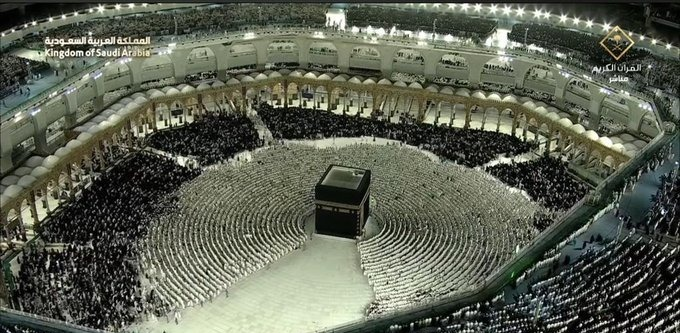
The activities for the last ten day began last night which was the first of the last ten nights in this year’s Ramadan. It shows this Ramadan is drawing to a close. As we embark on seclusion, we need to know the rules so as to avoid what can invalidate it.
We have lots of our brothers and sisters observing Itikaff in various masajid while some are still preparing to take less than ten days of Itikaf.
I`tikaf in the last ten days of Ramadan in the Masjid is one of the most virtuous deeds and an excellent form of obedience. It is one of the most cherished tradition of the Prophet (s.a.w). It is a spiritual retreat. It is a recommended sunnah and not a compulsory act, that can be performed anytime.
A’ishah (r.t.a) said that the Prophet (s.a.w) used to observe I`tikaf during the last ten days of the month of Ramadan and that he continued this practice until his death. After him, his wives regularly carried on this practice of observing I`tikaf. (Reported by Al-Bukhari and Muslim)
It is recommended that every Muslim make at least one I`tikaf in his/her life.
It is mustahab for a person to begin his Itikaft before sunset. Although some scholars say you can enter Itikaf at Fajr, but the popular opinion is after fajr and before sunset.
Men should do I`tikaf in the Masjid so that they can pray in Jama`ah (congregation) and also offer the Friday prayers. Women can also do I`tikaf but she must seek the approval of her husband.
Conditions for Performing Al I’tikaf
1- Making intention
He who performs I’tikaf has to make the intention that he is staying inside the mosque to worship Allah in order to become closer to Him. This is in accordance with the statement of the Prophet (s.a.w) “Indeed, every action shall be judged according to intention.” [ Agreed upon.] In addition to this, he must confide in his wwife and members of the family that he is going on Itikaf and also leaving all the provisions and sustenance for them without any difficulty.
2- That the masjid in which he is performing i’tikaf is a masjid where jama’a (congregation) salah is performed. It is not permissible to perform it except in a masjid; “And do not have relations with them as long as you are in i’tikaf in masjids.” (Baqarah: 187)
This is because i’tikaf in a masjid in which there is no jama’a salah necessitates one to either abandon that salah, when it is obligatory for him to perform it, or to be forced to leave his i’tikaf repeatedly each time jama’a salah is due, which goes against the purpose of i’tikaf. It is valid for women, however, to observe i’tikaf in any masjid whether a masjid in which jama’a salah is held or not, that is provided that her i’tikaf does not lead to any fitna (sedition).
If fitna would result from her performing i’tikaf she must then be forbidden from doing so. It would be better if the masjid in which he performs i’tikaf is one in which Jumu’ah (Friday) salah is held. That, however, is not a condition for observing i’tikaf .
3- Being free from the state of major ritual impurity
It is thus not permissible for a man who has not yet purified himself from Janabah (ritual impurity), or a woman who is undergoing either post-natal or menstrual bleeding, to perform Al I’tikaf. This is because people from these two categories are not allowed to stay in the masjid at any time due to them being impure. Continues tomorrow insha Allah.
Disclaimer
Comments expressed here do not reflect the opinions of Vanguard newspapers or any employee thereof.