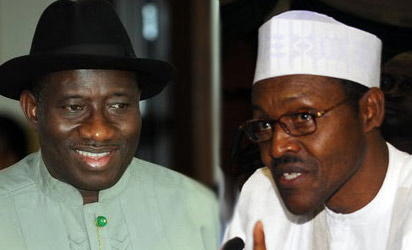
President Goodluck Jonathan and Gen. Muhammadu Buhari (rtd)
Ahead of presidential election petition tribunal judgment which is expected to be delivered November 4 in line with the provision of the electoral act 2010 as amended, penultimate week we began the chronicle of the road to the tribunal by the Congress for progressive change CPC, which is challenging president Goodluck Jonathan victory in the April presidential poll’s. As counsel on both sides are expected to adopt their written addresses today, we continue with the legal fire works that took place at the tribunal.
By Ikechukwu Nnochiri
IT urged Justice Salami to direct INEC Chairman, Jega, to furnish it with the list of all the local contractors that were engaged by electoral body to print ballot papers used for the presidential election, as well as, oblige it with copies of the contract papers executed by the electoral body, as evidence that the said contracts were actually awarded by the commission.
Though the panel accordingly granted the request, however, the CPC returned to court, saying none of the orders were complied with.
Meantime, on August 15, Justice Salami gave President Jonathan till August 29, to respond to a fresh application that was filed by the CPC, asking that Buhari should be declared as the bona-fide winner of the April 16 presidential election.
The CPC had in a motion on notice filed pursuant to paragraphs 18[11] of the 1st schedule of the Electoral Act 2010, as amended, and Section 149 [D] of the Evidence Act, alleged subterranean collaboration between the PDP and the INEC, insisting that it was the grand reason why the electoral body refused to make available to it any of the materials used in the conduct of the poll.
It therefore sought for “an order entering Judgment in favour of the Petitioner in Petition No. CA/A/EPT/PRES/1/2011 under Paragraph 18(11) of the 1st Schedule to the Electoral Act, 2010 as amended and Section 149 of the Evidence Act on the ground that the order for inspection granted by this Honourable Court on the 24th day of May, 2011 is refusal or failure or neglect of the Respondents to comply with the terms contained in the said order.”
This request was still pending when the National Judicial Council, NJC, suspended Justice Salami from office over alleged judicial misconduct.
Sequel to the development, when hearing resumed on the matter on August 29, only four Appeal Court Justices, led by Justice Mohammed Lawal Garuba, sat over the application seeking Buhari’s declaration as president.
While moving the application, counsel to the CPC, Dipo Okpeseyi, SAN, pleaded the court to hold that the refusal of INEC to grant the petitioner access to all the materials used for the presidential election, was an indication that the election was rigged by the PDP.
His application was vehemently opposed by counsel to Jonathan, Dr. Alex Izinyon, SAN, who contended that granting CPC access to voters’ information in the DDC machines, will amount to an infringement on the right of privacy of electorates which he said was made sacrosanct by the constitution of the Federal Republic of Nigeria, adding that what the petitioner requested for would be a breach of section 125 (3) of Electoral Act.

President Goodluck Jonathan and Gen. Muhammadu Buhari (rtd)
Counsel to PDP, Chief J.K Gadzama, SAN, also opposed the application on the premise that Section 25 of the Electoral Act, 2010 as amended and Section 1 and 9 of the Official Secret Act 1990, did not permit INEC to allow any person or authority to have information as to the pattern of voting or who a voter voted for during election.
He insisted that Section 1 of the Official Secret Act made it a criminal offence for the electoral body to divulge such information, adding that any staff of INEC found to have granted such access to a petitioner would be prosecuted.
After listening to their arguments, Justice Garuba in consonance with other members of the panel, reserved ruling on the petitioners motion sine-die (indefinitely).
On September 6, a reconstituted panel at the tribunal, dismissed the application, and went ahead to authorize INEC not to allow the petitioner to take copy of any of the ballot papers used in the conduct of the presidential poll.
Clarifying the previous order made by the ousted PCA, Justice Salami, on May 24, the new panel told CPC that the order was not an express permission for it to “take copies” of any of such electoral materials, noting that it could only be allowed to inspect them.
At the resumed hearing on September 7, the tribunal handed CPC 10 days to prove that the April 16 general election was rigged by the PDP.
The panel while concluding pre-hearing session on the petition, also gave President Jonathan and other respondents in the matter, five days each, to respond to allegations of electoral malpractices levelled against them by the CPC, adding that all the parties would be accorded five minutes each to cross- examine witnesses that may be called against them.
On September 11, CPC went to court with a fresh application, seeking leave to tender software evidence it said would prove that INEC boss, Jega, manipulated the 2011 voters registration exercise in favour of President Jonathan.
CPC said the reason it filed the motion pursuant to paragraph 47 (1) of the 1st Schedule to the Electoral Act 2010 and/or the Court’s inherent jurisdiction, outside the pre-hearing session of the substantive petition, was due to the blatant refusal of the electoral body to grant its forensic experts access to the biometric data base of registered voters in the country.
It told the tribunal that aside Exhibits 1-14, earlier tendered against the April 16 presidential election, it intend to submit a “Blog extracts from Lagos, GTUG, of Femi Taiwo (lead Software Developer) of INEC Open Voters Registration project (The soft ware used by INEC for voters registration).”
The next day, the Acting PCA, Abdullahi Adamu appointed a new presiding Justice, Kumai Bayaang Akaahs who was hitherto serving at the Calabar Division of the appellate court, to take over position left by the suspended PCA, Salami.
It was also the day the CPC opened its substantive case amid drama, as its National Chairman who, Momoh, who was billed to testify as a witness in the matter, was disqualified over a legal blunder that was committed by the lead counsel to the petitioner, Mallam Abubakar Malami, SAN.
CPC chairman, Momoh, who was to testify as the PW- 2 in the matter, was disqualified by the panel, few minutes after the Acting National Secretary of the party, Mr Buba Galadima, who had while testifying as PW-1 conceded that the presidential candidate of the CPC, Muhammadu Buhari, benefited from election rigging.
Galadima who made the assertion while under cross-examination, told the panel that even the states won by the CPC during the presidential poll, suffered the menace of election malpractices. Cross-examining him, counsel to Jonathan, Olanipekun asked; “Mallam Galadima Sir, you said in your statement that election was rigged in the 36 states of the federation including the FCT, are you now telling this court that even in the area your party won, that it was rigged?”
Before Olanipekun could finish the question, the CPC scribe bellowed: “yes election was rigged even in those places! Rigging has different facets but in the general perspective, I will say yes, it was substantially rigged!”
Shortly after the other respondent took turns to cross-examine the CPC scribe on the basis of the said statement which he earlier identified as his own, counsel to the petitioner, Malami, SAN, ushered in the Chairman of the Party, Momoh as his next witness.
Malami specifically told the panel that Momoh, who was number 11 on the original list of witnesses’ tendered ab-initio by the petitioner, would rely on all the depositions he made in pages 17-55 of the witness statement on oath.
In a bid to administer witness oath on the CPC chairman, the court clerk asked him: “Sir, are you a Christian or Muslim?” Momoh: “I am both a Muslim and a Christian when they are not quarreling!”Irked by the answer, a justice on the panel, bellowed: “Mr Momoh it is a serious business we are doing here, please answer the clerk! What do you believe in?”
“I believe in God Almighty”! Momoh retorted.
To save the situation, counsel to the CPC, Malami, decided to delve into the examination-in-Chief, and pleaded the court to take judicial notice of two newspaper publications that he said would prove that the PDP manipulated the INEC with a view to ensuring that President Jonathan won the April 16 election. It was at this point that he realized that there was a mix-up between the witness statement accredited to the CPC scribe, Galadima and that of the Chairman, Momoh.
It dawned on Malami that the witness statement and signature identified by Galadima in pages 17-55 of the proof of evidence, as his own, actually belonged to the chairman of the party, Momoh, while the evidence of the PW-1, was actually contained in pages 8-14 of the petitioners document. Sequel to confusion created by the discovery, the panel stood down the case to enable the petitioner to resolve the discrepancy.
When the court reconvened, fresh legal fireworks commenced following an oral application by the CPC, pleading the panel to in the interest of justice, allow it to swap the testimonies of the two witnesses, a plea that was vehemently opposed by all the respondents.
According to Malami, “my lords, I want to believe that this is not a hide and seek game. The interest of justice should be uppermost. The respondents cannot be prejudiced in anyway if this application is granted. It was only a mix-up and we regret the inconveniences this may cause to the records of my lords, the spirit of justice should be allowed to prevail”, he pleaded.
“My lords, the record of this court cannot be corrected by mere oral application made by the CPC counsel from the bar, he knows what to do, let him come properly by way of an affidavit”, argued counsel to INEC, Awomolo, SAN.
While counsel to President Jonathan, Olanipekun, SAN, contended that it was late in the day for the CPC to make amends on the issue, counsel to the PDP, Gadzama, SAN, added that the court was already functus-officio on the issue, stressing that the only remedy available for the CPC was going on appeal.
“Mallam Galadima and Chief Momoh identified their signatures and statements before adopting them in the open court, it therefore constitutes evidence that cannot be interchanged, and the petitioner has reached a point of no return. This court lacks the jurisdiction to grant this kind of application that has no precedence,” Olanipekun submitted.
In a unanimous decision of all the justices on the panel, the application was refused with the panel noting that such request was a novelty in law.
After then, CPC called 44 witnesses who testified and alleged sundry malpractices against the INEC, PDP, Jonathan, and even security agencies.
Disclaimer
Comments expressed here do not reflect the opinions of Vanguard newspapers or any employee thereof.