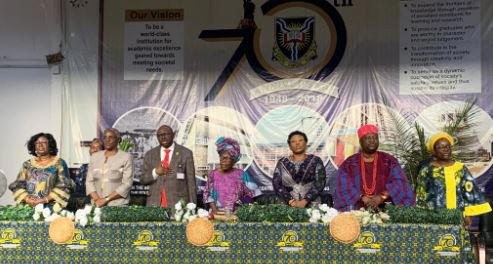
Academics, university administrators and the general public have showered encomiums on erudite African historian, Professor Bolanle Awe for her scholarship and humanity.
This formed the crux of the opening ceremony of the Professor Bolanle Awe at 90 Conference, organized by the University of Texas at Austin, the University of Lagos and the University of Ibadan, held at the Trenchard Hall, University of Ibadan, on Monday. The two-day conference, with the theme: ‘Oral Traditions and Written Histories’, had participants across four continents: Africa, Latin America, North America, and Europe. The conveners of the conference put together to celebrate the 90th birthday of Professor Bolanle Awe were Professor Toyin Falola – University of Texas at Austin, Professor Olufunke Adeboye – University of Lagos, Professor Rasheed Olaniyi – University of Ibadan, and Dr. Sharon Omotoso – University of Ibadan.
Speaking on the motivation for celebrating Professor Awe, the lead convener, Professor Falola stated that: “You have to understand Professor Awe’s scholarship against the background of African Studies after the Second World War. She was one of the pioneers of intellectual battles and epistemological wars. She survived in the trenches! Right from the time when Eurocentric ideological traditions have been centralised as the global source of intellectual inspiration, every other knowledge economy has suffered substantial damage done to them in an attempt to universalise the same bias that initiated the problem. The enormity of this catastrophe on African epistemological foundations, identity and existentialism are not appropriately captured or felt until it was the time when African intellectuals and intelligentsia came to the ground where knowledge production and then distribution were being managed, and they were left with nothing but pebbles to deal with, being exposed and rendered vulnerable as a result. Whereas the success of this outrageous one-size-fits-all and Eurocentric approach would always place them at the base of international relevance as they have refused to produce intellectual content that bears the mark of their mental quality, nor were they efficient in making use of contents created outside the knowledge terrain of the universalists, regardless of how original, the validity of their civilisational ideas, the quality of their intellection, among others, they would remain second fiddle to the West and their woes would be deepened by this reality. One would notice, therefore, that the odds are apparently against the Global South, and it would take a diligent and committed focus to rescue the situation.
“One of the most consistent voices against this institutional rot and decadence was, and still is, Bolanle Awe, whose confidence in charting the course of Afrocentric epistemological inheritance to the knowledge community in the world is illustrated by a series of intellectual productions, engagements, theories and the unending research she undertook which would eventually serve as inspiration to a whole world of Africans in the past and the contemporary time. We often reduce the honour of outliers when we have normalised the efforts they made as basic or conventional standards, not knowing that what it takes to come across as a voice of the people in an unapologetically repressive environment cannot be overemphasised. Confidence, determination, and the zeal to make an impact even at personal cost and consequences are the attributes we undermine when we gloss over what pioneers have done, forgetting along the line that they paid priceless value to ensure that people have access to the level of freedom that they have today. Awe is one such light to African epistemological perspectives offered in the global knowledge economy in contemporary times. Apart from breaking the unwholesome barrier that Africans were a people without civilisation and a people without worthwhile history to reckon with, this intellectual was able to dissect Eurocentric bias by letting us into African history to understand the various items of knowledge and layers of wisdom that is dished out in the African knowledge pool.
“At the time when she was born, Africans still suffered the stigma that they were intellectually inferior to the extent that they were considered subhuman and could not understand the gravity of intellectualism, much less talk of contributing to the debate. More realistically, it was a time when the European-induced African patriarchy was taking the honour of the period, thereby suppressing the voices of female scholars in a desperate attempt to keep the oppressive culture. This again indicates that the position of Awe against this system required confidence and determination. In essence, her efforts to enhance Afrocentric ideas in the knowledge domain were targeted at fighting different battles, all of which were critically important and situationally necessary to redeem African images. On the intellectual front, she corrected the erroneous notions that Africans did not have recordable history, projected by a chain of European generations who even manipulated scientific evidence to substantiate their racist claim. On the other side, she was also creating a passageway for the females to come into the system so that they would correct the wrong values carefully instituted by the Europeans and their African allies after independence. One cannot look at what she has done and have the moral courage to say that she does not deserve whatever honour we have rendered today and every other day.”
Welcoming participants to the conference, the vice chancellor of the University of Ibadan, Professor Kayode Adebowale, in his address, eulogized the sterling scholarly qualities of the honoree. According to him, “ with her focus on women, women’s rights and women’s capacities, Professor Awe led the nation, the continent and the world at large to an altar of enlightenment about the meaning of gender justice, and gender equity. Through her work and those of her mentees, the dignity of women experienced a rebirth. Realising the dearth of resources to research on women, she mobilized people and resources to create the Women Research and Documentation Centre (WORDOC) at the University of Ibadan.
“The world would later realise that there is really nothing like women’s rights or women’s issues in the strict sense of that expression. Anyone fighting for the rights and privileges of women is actually fighting for the rights of humanity at large. It is now generally understood that gender issues are not women’s issues; rather gender justice is about removing all obstacles standing in the way of, and preventing people from, realizing their full potentials as men and women in the society. It is all about emancipation.”
Chairperson on the occasion, wife of former governor of Ekiti State, Erelu Bisi Adeleye-Fayemi told the gathering that “Professor Bolanle Awe is a legend. She is the best of the best. She is an acclaimed scholar, author, teacher, development specialist, administrator, leader and mentor. The list of her achievements is endless, and she has a solid legacy of excellence as evidenced in everything she has been involved in throughout her illustrious career.When Yoruba people use the word ‘Omoluabi’, its loose translation is meant to be ‘A person of honour and character’, yet we are socialized into believing that the translation means ‘A perfect gentleman’, because the word is most often used in describing men who meet the criteria. Professor Bolanle Awe is the quintessential ‘Omoluabi’ whose name, character and conduct has been nothing less than extraordinary.”
In her keynote address, Professor Olabisi Aina commended the efforts of Professor Awe, just as she called for the sustenance and improvement of the legacy of the historian.
While appreciating the organizers and participants, Professor Awe commended them while telling the gathering that she was completely overwhelmed by the show of love, noting that the celebration was also in recognition of other women who have done much more in championing the cause of women.
The conference which had about 144 academic papers is expected to end on Tuesday, February 14, 2023.
Disclaimer
Comments expressed here do not reflect the opinions of Vanguard newspapers or any employee thereof.