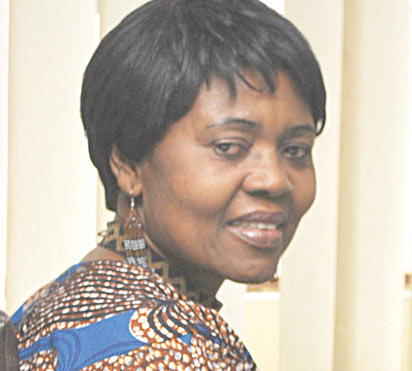
PROF EZEIGBO
Akachi Adimora-Ezeigbo, serial award winning writer, gender scholar and professor of English at the University of Lagos was chairman of the Panel of Judges for the 2011 Nigeria Liquefied Natural Gas,$100,000 Prize for Literature. The Prize , which was announced last week during a world press conference at the Grand Ball Room of Eko Hotel, Lagos was won by Adeleke Adeyemi aka Mai Nasara for his entry; The Missing Clock. In this interview, Ezeigbo spoke to McPhilips Nwachukwu about the whole processes leading to the selection of the winner as well as about other sundry issues.
Excerpt:
You were chairman of the Panel of Judges for the 2011NLNG $100,000 Prize for literature. Can you give us a fair assessment of the whole process?
The process was rigorous.And we had very short time and didn’t get the entries as early as in the past. We got them either end of May or sometime in June. And you know that entries close in March. So, when we got them late, we decided to work very hard. We had a very tight schedule. Also, NLNG also gave us a time frame, which resulted in our having series of meetings.
We did the first shortlist, which was to remove books that should not be there; especially those ones published earlier than 2008 because the publication acceptable were those works published between 2008 and 2011. That was a four year period. So, we had to eliminate those that were not published within that four year period.
And then , we also met to make sure that all the books entered for the prize are children’s literature. We also had to sort out those submissions that do not conform to the requirement for entry. For instance, there were submissions on law and other things that were purely adult literature. We made sure we eliminated all those entries from the list.

Prof Ezeigbo
By the time we had finished pruning, out of the initial 126 entries, we had a little below 50 books left. It was after then that we began proper reading and assessment. After intensive reading and assessment, we again pruned down to 20 and 12 books, which of course was not made known to the public at that point.
It was our short list of six, which we considered to be the best books out of the whole entries that was made public, after which we went back to read again until the time we came out with the final short list of 3 books.
It was after the shortlist of the six that Committee for Relevant Arts(CORA) had its reading programme for the books. And of course , those books received wide reviews and publicity. In fact, NLNG decided to have more publicity for the prize this time than in the past.
So after the short list of six, we came out again with a short list of 3. And that also took back again to read thoroughly again. And after reading, we came to an agreement that Mai Nasara’s The Missing Clock was the best among the three books in terms of criteria for judging children’s literature like relevance, thematic preoccupation, style , language , vocabulary and illustration.
However, among the three shortlist, I think the best illustrated book was Eno’s Story. That book is very well illustrated. But Mai Nasara’s book is also illustrated and in colour. But it has other qualities that far outweigh the advantages that the other entries had.
And the story is told in a very engaging narrative technique; and the language is very appropriate. In his characterization, he was able to get into the consciousness of the child, both in the emotional and psychological aspects of the child’s character. Following this achievements, we concluded that the book should be the winner of the prize.
From the accumulation of entries received, what did the jury identify as the major challenge of writing children’s literature?
One thing that I noticed that was obvious is that many people are writing just to win the prize. If you don’t write to win a prize, you create an enduring work of art. And if you win a prize , fine, but that shouldn’t be the primary concern of a writer. The primary concern of a writer should be to create a work of art that is aesthetically satisfying; a work that will stand the test of time. Writing requires a lot of time and it is not just something you do in a hurry.
The writer needs to write , take time off, and comes back to what he has written and edit himself in other to attain a level of perfection. Some people just write and give to their friends to edit for them. And one’s friend may not really be the good editor one needs for one’s work. The writer needs an editor, who is very detached from the work; and who can engage the work from the point of view of objectivity and professionalism.
Part of the problem with our writing is that we are not painstaking enough. We do not engage writing with the kind of passion and functionalism that it requires. Abroad, many writers write full time and they do nothing else . And therefore, they come to it with a whole lot of dedication.
So, sometime when you see children’s book full of errors, what do you expect. Any book that has errors can not be for children. You can go and look at any of the books published abroad for children. You can hardly see any error in them. The depth of language use is appropriate and the books are culturally relevant. There, they write for children and they write books that are culturally relevant. So, here in Nigeria, if we are writing for children, we should also write books that are culturally relevant.
Interestingly, you mentioned something about interest in the prize money attachment. Being a winner of this prize in the past, do you feel satisfied with the fate of the winners bridged by the prize. Indications reveal that nothing much is heard about these winners and their works after winning?
You see, one really has to empathise with NLNG. It is not their duty to distribute books. This is why there are publishers. I do not think that we should expect them to distribute books that have won prizes even though, they could assist if they like.
These books if they are published by publishers, what the publishers should do would be to capitalise on the winning because it gives him a kind of launching pad to now market the book. It is one of the greatest challenges we have in Nigeria that books are not properly marketed.
Are you now telling me that Okri , who won the Booker Prize or Chimamanda, who won the Orange Prize should have their books distributed by the awarding body ? No. it is their publishing houses that should do that.
Also, this prize year coincides with President Jonathan’s Bring Back the Book Campaign. In what ways do you think that Federal Government could cash in on the NLNG’s effort in driving its own vision?
I think that The Bring Back the Book should be taken seriously. We really need to get Nigerians reading. Each time I travel abroad and see the way people take reading seriously, I marvel.. Even when people are going to work, you see them clutching books that they read while on board and libraries are well patronized. Sometimes, people are very anxious to read the books that you just borrowed and will compel the library staff to ask you to return them soon as you finish reading to enable other anxious readers to borrow.
So, this is a culture where these things are taken seriously. And in spite of the internet, people are still reading. I really think that this Bring Back the Book can help.
Disclaimer
Comments expressed here do not reflect the opinions of Vanguard newspapers or any employee thereof.