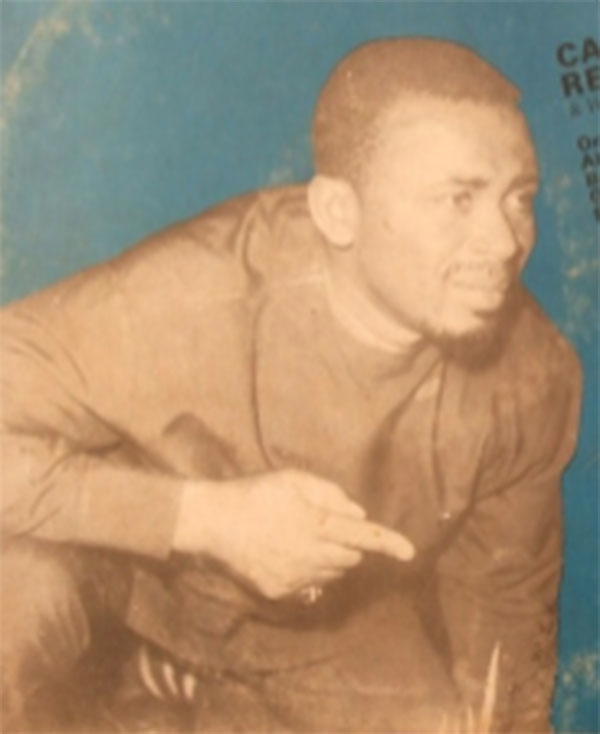
In this expository piece timed to coincide with the date of his tragic death on January 16, 1971, PHILIP JAKPOR takes readers through the intriguing life of highlife musician, the late Cardinal Rex Jim Lawson whose songs continue to be retouched by young musicians yet is largely uncelebrated.
Nigeria’s armed forces remembrance day marked January 16 annually coincides with the commemoration of the death of legendary highlife icon, the late Cardinal Rex Jim Lawson who died in a ghastly crash in Umunede, present day Delta State on January 16, 1971.
Among the musicians that dominated the music scene in Nigeria in the 1960’s, the late Rex Lawson is believed to be the most outstanding.
In his time, his contemporaries could not match the touch he added to highlife– a music genre that morphed from the foxtrot and calypso with Ghanaian rhythms known only among the local African aristocracy in the mid-19th century to dance and guitar bands that all classes of the society could relate to.
Rex Lawson was in his 20s when he took the highlife music scene by storm and virtually became a household name in Nigeria and the West African region. He was an emotional and philosophical singer who displayed mastery in conveying deep meanings through the trumpet, the alto saxophone and his haunting voice. 49 years after his tragic death in a car accident on his way to Warri for a highly-publicised performance, his music still elicits stupefaction and applause among music lovers.
Read Also: Anxiety over Akeredolu’s Health: No cause for alarm – State govt assures
At the time he held sway, many were in awe at his ability to compose and sing in different dialects such as Efik, Kalabari, Izon, Igbo, some Ghanian languages and our own pidgin English. Between 1960 and the troubled months leading to the Nigerian civil war in 1967 his records were released in quick succession and were played back-to-back on radio. He also had several live performances in Radio Lagos studios.
Remakes without credits
Even after his tragic death at the age of 33, almost every generation of Nigerian musicians have retouched or recreated his songs albeit without the due credits. The list is almost endless. His song titled Yellow Sisi was retouched by the late Orlando Owoh. The most popular Lawson single titled Sawale, which won the hearts of fans across the country in the 1960s, seems to be the most remixed.
In 1991 it was remixed by Alex Zito and and the then Port Harcourt sensation Felade. While Alex Zito recreated the song in his Baby Walakalombo, Feladey used the same title as Lawson. Hip hop sensation Flavour N’abania took a cue from them and also remixed the song in his Nwa Baby (Ashawo) in 2011. Larry Gaaga’s Iworiwo, which featured Tuface Idibia is an inversion of Lawson’s classic Love me Adure. Timi Dakolo’s I never know so is also a recreation of Lawson’s Baby Play Me Wayo. Sadly, the due credits to Rex Lawson in these recreations are missing.
His Childhood
Born Erikosima Jim Lawson on 4 March 1938, his father was of the Kalabari ethnic group in present-day Rivers State, while his mother was an Igbo from Owerri.
It is said that his name, pronounced as “Eriko sima”, actually means “do not name this one” because of his father’s conviction that the sickly boy would not live beyond infancy. A pattern of deaths had claimed his first three children. At the time, the young Rex was battling severe smallpox infection. His mother was however determined to see him live. She was said to have sought the assistance of medicine men from outside the Kalabari community for treatment. Finally, her efforts paid off as Rex survived and lived beyond infancy.
Musical trajectory
After his primary school education in Buguma, Rex Lawson is said to have rejected his father’s suggestion and plea that he proceed to high school and perhaps the university. For him, going to school would either slow or ultimately derail his plans to become a great musician. Daba, his elder sister also joined his father to plead with him for a change of heart, but he rebuffed their entreaties.
It is recorded that Daba’s husband, who was a pastor in the church he attended in Buguma, noticed his budding talent, enrolled him in the church band and taught him trumpeting. At that time, the young Rex was also a member of the music band of Christ Army School, Bakana-Kalabari along with the late Sunny Brown who would later become his sidekick and the best trumpeter in the group. Most of the melodious trumpeting in Rex’ songs are believed to have been performed by Brown who in a later interview confessed that while he was good with the trumpet, he could not match Rex’ haunting voice.
From Buguma Rex moved to Port Harcourt and subsequently found a place among the band boys of the popular Lord Eddyson who was then leader and owner of Starlight Melody Orchestra. Rex would later move to Lagos, which was the heart of the Nigerian entertainment life. He was said to have resided in Yaba and played with professional heavyweights such as Sammy Obot, Bobby Benson, Chris Ajilo, and Victor Olaiya.
After his time with Olaiya, he left for Ghana to further improve on what he had learnt from these highlife greats. On his return to Nigeria in the early 1960s, he formed the Mayor’s Band which later became known as the Rivers Men. The band had Sunny Brown and Tony Odilli who played the conga and is the only surviving member of the band, among others. They were an instant success and in high demand. They received invitations to perform across the country, even extending to neighbouring Cameroon and Forte Lamy in Chad.
As his fame grew, so did his teeming fans give him befitting titles. At a point, he was nicknamed Pastor Jim Rex Lawson, then Bishop, before finally taking on the title ‘Cardinal’. In an uncut interview on Voice of America (VOA) recorded for music specialist Leo Sarkisan in August 1965, Tunde Sowande, the Nigerian interviewer, asked Rex how he came about the title Cardinal. His reply was that his fans gave him the nickname because of the way he performed religiously.
At the time, some of his exceptional hits that dominated the airwaves were Angelina pay my money, Baby Play Me Wayo, So Ala Teme, Bere Bote, Ibinabo and Jolly Papa.
Civil war
Before the Nigerian civil war, Lawson had recorded well over 100 songs that were regularly played on radio and night clubs across the country and beyond. During the war proper, he also recorded many hits, some of which could be described as ego massage of the military elite. One of them was Hail Biafra which he sang in praise of Lieutenant Colonel Odimegwu Ojukwu. He is also credited for being the first to play the Biafran national anthem at the proclamation of Biafra’s secession on May 30, 1967.
With the liberation of Rivers from the Biafran captors in 1968, Lawson also composed a heart-rending song Major Boro to mourn the Ijaw nationalist Major Jasper Adaka Boro, who is largely credited for the successful military strategy that liberated present day Rivers State from its Biafran captors, but suddenly died in controversial circumstances. He also sang Gowon Special in praise of the then military head of state, General Yakubu Gowon, when Rivers was firmly in the grip of the federal forces under the control of commander of the Third Marine Commando, Brigadier Benjamin Adekunle nicknamed “the scorpion”. Towards the end of the war, Rex travelled to the United Kingdom where he recorded his last album Rex Lawson in London.
Style and Musical Themes
Known to be very emotional while performing on stage, Rex is celebrated for his contagious sociability, his musical vision, faculty, perseverance and raw individuality. In the typical highlife band, the trumpet often played a leading function in the music. Rex was however an exception and deviated from this path by frequently featuring alto saxophone solos in his songs. In time, he spotted a good hand in the late Sunny Brown who was his alto saxophonist and to whom he conceded the solo in many of his later songs.
Rex Lawson and Fela
Rex Lawson and Fela Anikulapo Kuti were said to have been very good friends who visited each other, ate, and drank together. While Fela was an upcoming star with his Koola Lobitos Band and popular among the younger more radical age bracket, Rex Lawson was the king of Highlife and darling of the middle-aged and older generation. They also lived not too far from each other when Rex Lawson was based in Lagos.
Lawson lived at 283 Herbert McCauley Street Yaba, while Fela lived near the Empire Hotel. Pa Tony Odilli who is now 93 years old, recalls that while the duo were very good friends, the incidents that would have led to a feud between them were the almost regular attempts by fanatical Fela fans to disrupt Rex Lawson’s musical performances even though such actions did not have Fela’s blessing. But he said the duo never allowed that affect their friendship.
Near-death encounter and Soyinka’s intervention
The period immediately after the 15 January 1966 coup through to the start of the Nigerian civil war in 1967 was very precarious. The assassination of Sardauna of Sokoto, Sir Ahmadu Bello and the Prime minister, Tafawa Balewa, were viewed as attempts by soldiers of eastern extraction to dominate the north and other regions.
There was tension all over the country. The situation was near boiling point in the North owing to the failure of the General Aguiyi Ironsi administration to court martial officers implicated in the failed coup and the perceived celebratory posture of people of the eastern extraction living in the region. At the time, musicians were also very cautious of what they sang so as not to be misinterpreted by any of the ethnic nationalities. Rex Lawson was caught in this dilemma also.
In 1965 Rex Lawson and his band made a song from how children mimic a goat bleating. The song was titled Ewu na Ba Kwa (Goat is Crying). A few weeks after the January 1966 coup, the band was invited to Kano to perform, and this song was one of the songs they performed. As the song advanced, the band suddenly noticed commotion in the crowd.
They later learnt that some individuals in the hall made fun of their northern counterparts, mocking them that the bleating goat in the song was Sir Ahmadu Bello howling as he was being killed by Major Chukwuma Nzeogwu, leader of the January 1966 coupists. As news of the alleged derisive song spread in town, mobs started advancing on the club with cudgels, sticks and knives ready to maul the singers. Sensing imminent danger, the manager of the club informed Rex Lawson and the band members to exploit the cover of the night to flee the town.
The group heeded this advice and headed to Zaria. The group was at the point of being lynched save for the intervention of playwright, Professor Wole Soyinka who was on the same route and pleaded for the band members to be released unhurt. The song, however, continued to generate anger in the North and was cited among the reasons why the aggrieved northerners started attacking easterners.
A fisherman
Anger spilled over and there were rumours that a counter-coup was imminent. And it did come on 29 July 1966 when soldiers from the north killed Ironsi in Ibadan. Many soldiers from the east in the west and northern parts of Nigeria were also murdered. But the mayhem was not restricted only to the military, as miscreants jumped on the situation and extended the killings to many innocent citizens of the east living in Kano, Kaduna and elsewhere.
The following months were crisis-filled, bringing a lull to all aspects of life, including social engagements and clubbing. Before the civil war, the highlife industry in Nigeria was dominated by musicians of eastern extraction and natives of the present-day Niger Delta. As suspicion fueled by crisis in government increased, many of the bands disbanded and returned to their hometowns. Expectedly, highlife music took a hit. Rex Lawson fled Lagos for his native Buguma where he retired to fishing – the traditional livelihood of his people.
War broke out on 6 July 1967 with the secession of the eastern region from Nigeria. The secessionists captured many parts of the present-day Niger Delta, including Rivers — a state created by the Yakubu Gowon administration as a contingency plan to break the then eastern region in two.
Chief Lloyd Jim Lawson, younger brother to Rex Lawson who is now in his 70’s, explained the situation:
“When the Biafra war broke out, my brother had to leave Lagos and relocate back home just like many other musicians from the then eastern region which also comprised the present east and most states of the present-day Niger Delta.”
‘Abducted’
Lloyd said that at the time, he was a young man working with the Electricity Corporation of Nigeria (ECN) in Umuahia. On one occasion he had a chance meeting with then Chief of General Staff of the Republic of Biafra, Philip Effiong, who inquired from him about the popular musician. He informed Effiong that Rex had retired to fishing in Buguma since the war was now the pre-occupation of those that hitherto patronized the night clubs. The surprised Effiong felt such raw talent could not be allowed to idle away so he immediately ordered that Lloyd go fetch him and bring him to Umuahia.
“Effiong ordered that I should be provided a vehicle and all that was necessary to bring Rex to Umuahia for rehabilitation,” Lloyd explained.
“As anticipated, when I arrived Buguma, I was told Rex had gone fishing. I had to go down to the river to look for him and when we met, I explained that I had come to take him to Umuahia on the instruction of the number two man to Odumegwu Ojukwu, the Biafra leader. We chatted about this, and he did not object. We returned to the house to prepare for the trip to Umuahia the next day.”
Explaining further, he stated that: “When we finally arrived at the state house in Umuahia, Rex was welcomed and was informed that he was to head the Biafran State Band. He was asked to replace the equally popular musician – Celestine Ukwu, who was heading the band at the time. Celestine was subsequently made head of another band.”
It is believed that it was either in Umuahia or Owerri where they were routinely engaged to entertain the military officers that Rex Lawson composed the controversial song “Hail Biafra” in praise of Ojukwu. But his stay in Umuahia would not be long. For reasons unknown even to Lloyd, one morning, sometime in May 1968, Effiong called him and privately asked that he inform the musician to flee to the newly created Rivers State via the forest. Rex Lawson was at the time performing in Owerri.
“To avoid any suspicion, Effiong told me to wail uncontrollably when I am brought before the Biafran high command to be informed about my brother’s abduction by some persons in Owerri. I did exactly that, rolling on the floor and weeping without any suspicion. Ojukwu was even pleading with me that my brother would be found safely and returned. Effiong was there with him. Later when he met me again privately, he commended me for putting on that convincing show. By then, Rex was safely in Port Harcourt.”
In his account of the evening they fled Owerri, 74-year-old Dawari Somoni Harry, one of the late musician’s team members who used to play conga and maraka, said that they were in Owerri when intelligence got to them that beyond entertaining, they (members of the band) were to be conscripted into the Biafran army to fight. The band had a signal they usually gave each other whenever there was danger.
Harry explained: “After he gave the sign which we understood to mean ‘dispersal’ we left all our musical instruments on stage to avoid suspicion, pretended we were on recess and fled by night through the forest, splitting in different directions. Some of us came back to Rivers, others missed their way in the forest and were never seen after that.”
Harry subsequently quit drumming when he arrived Port Harcourt and got himself enlisted into the Third Marine Commando.
It cannot be ascertained what may have influenced Effiong’s decision to instigate the escape of Rex, but immediately the musician arrived Rivers State there was breaking news on national radio from Kaduna that the federal troops had liberated Rivers from the Biafran troops and Rex also freed from his Biafran captors. Naturally, there was wild jubilation all over the newly created state, particularly Port Harcourt. The federal troops were warmly received in all parts of the state subsequently.
Rex then started playing for the Third Marine Commando Band. It was during this period he composed Gowon Special as tribute to the then Head of State, General Yakubu Gowon. Apart from a government lodge allocated to him by then military administrator of Rivers, Alfred Diepreye-Spiff, his abode in town was 35 Aggrey Road.
Journey to death
Rex was said to have signed a contract to perform live in Warri at a place called Runny Bay on Saturday 16 January 1971. The contract was signed on Friday 15 January. He asked his band members to proceed to Warri ahead of him while he stayed back to sort some issues bordering on a loan he was to obtain from the Rivers State government. His decision to tarry a while was based on information from officials of the state government that a bus which was component of the loan would be delivered to him before the close of work that same Friday.
When the vehicle delivery did not happen that day, he waited till the next day – Saturday 16 January, since in those days Saturday was also a workday. By mid-afternoon when no information on the status of the bus came, he left for the state house to ascertain the true state of things himself. By the time he was convinced that the vehicle would not be released that day, he decided for another vehicle to take him to Warri to meet up with the performance slated for later that night.
It was already around 6pm. His sidekick, the late Sunny Brown who was also supposed to join him on the trip refused to, on the excuse that it was too late to embark on the journey to Warri at that time of the day. But Rex was determined and went on to charter a vehicle for the ill-fated trip.
Chief Lloyd who was with him during the events of his last days explains in detail:
“The contract for the Warri performance was signed on Friday and it coincided with the day he was expecting the vehicle that the Rivers State government promised him. We waited all day and the bus did not come. Since in those days Saturday was also a work day, he decided to wait again, but around 4pm when it was certain that the bus was not forthcoming he opted to charter a vehicle to convey him to Warri to meet up with the performance.”
Continuing, he said: “I recall vividly that when he was loading his bags and other things into the vehicle that Saturday evening, I had this unusual feeling of loneliness. It was unusual because I had never felt that way before. It was like a premonition. I usually travelled with him but that day due to some exigencies I could not.
“One thing I always did during his trips then was not to allow anyone drink, especially the drivers, because the roads were not very good. But since I was not with him, I learnt that on their way they stopped to eat at Gboji Gboji Agbor and the driver had some reasonable quantity of drink.
“Unlike now that we have wide highways, in those days there were only huge trees left and right on the way. When they continued the journey after eating, the drunk driver crashed into a tree. He hit the huge tree on the side that Rex was seated, and the shad of the broken windscreen went straight into his head. He was the only one that died. He was 33 years old at the time. It was a very sad day.
“I learnt his body was taken to the Eku Hospital in Warri where he was confirmed dead on arrival. The next day, the body was repatriated from the Hospital and brought back to Port Harcourt by the Alfred Diete-Spiff administration.”
Lloyd recalls that information about the late musician’s death threw the entire community into mourning when it came.
“At about 5am the morning after his demise, the radio station was even still playing his music when the then military administrator, Alfred Diete Spiff, came with the army to Buguma to break the news to us. I received them on that sad occasion,” he recalled.
His former drummer, Harry, equally related the scene where the accident occurred.
“After leaving the band to join Third Marine Commando, I was stationed near Agbor. The accident that claimed his life occurred at Umutu area near Umunede which was not too far from where I was stationed, so I was among the patrol team that arrived first. They were three in the Volkswagen but he was the only one that died. The vehicle had somersaulted and the splinter that killed him was not more than two inches, but it lodged in his head.”
Though it is customary for the bodies of indigenes of Buguma to be interred in a massive expanse across the river, the military authorities at the time insisted Rex be buried in the town. They even wanted the body to be interred in the town square but the community objected, arguing that it was not customary.
A compromise was finally reached and a final resting place was selected in a conspicuous part of the community. On the site of the original resting place now stands a bronze statue of him holding his trademark trumpet.
His contemporaries remember him
As befitting of a king, after Rex Lawson’s death, his contemporaries were in unanimity that the Nigerian highlife scene had lost an irreplaceable gem. He was well honored by his generation of singers who all paid him tributes.
The roll call of eminent musicians who did tributes to him through their songs included Chief Ebenezer Obey, King Sunny Ade, Victor Uwaifo, Orlando Owoh and Erasmus Jenewari who coincidentally also died in a car crash years later at Obigbo, 30 kilometers from Port Harcourt.
Enduring legacy
Death has not diminished the love that highlife has for Rex Lawson’s music. His songs are still played, recreated, and remixed by younger musicians who were not even born when he lit up Nigeria’s musical landscape.
Though a street is named after him in Borokiri, a suburb of the city of Port Harcourt just south of Old GRA, other recognitions accorded him are the setting up of a Rex Lawson Chair in the music department of the University of Port Harcourt in 2012.
The department also organises a yearly high-life event that brings music lovers from far and near to the institution to share ideas and reflect on the legacy of the late music icon.
Under the current administration of Governor Nyesom Wike, the Rivers State Ultra- Modern Cultural Centre in Port Harcourt was renamed Rex Lawson Cultural Centre. The Ooni of Ife, Adeyeye Enitan Ogunwusi who is also a Rex Lawson fan, was in attendance and did the inauguration on Saturday 2 June 2018.
Meanwhile, the only monument bearing his name in his native Buguma was only erected by his family. In fact, the construction was spearheaded by his eldest son, Felix Jim Lawson.
However, the question begging for an answer is: Are these tit bits enough to honour an icon whose music touched lives across borders, transcended his time and continues to elicit interest?
His son who never met him
49-year-old Osima Jim Lawson is the youngest son of the late musician. Born three months after his father’s demise, he feels successive governments at both federal and state level have not done enough to immortalise the beloved daddy that the older generation talks of, but whom he never set eyes on.
Hear him: “For the hope and consolation that my dad’s music brought to fans from all over the country, we feel he has largely been forgotten. No one talks about him anymore and no one will remember him as time goes on except a concrete legacy project is named after him. The way he has been forgotten is the way his children have equally been neglected. Is there anything wrong if government gives his grandchildren scholarships for example?” he asked rhetorically.
Chief Lloyd’s sentiments are no different. He wants a national radio programme that would periodically celebrate the beloved highlife icon so that the younger generation can know and appreciate him. Like the younger Lawson, he feels Nigeria does not have to summarily write off another all-time great when we can collectively keep his memory alive to inspire many generations to come.
(Jakpor is Director of Programmes, Corporate Accountability and Public Participation Africa, CAPPA )
Disclaimer
Comments expressed here do not reflect the opinions of Vanguard newspapers or any employee thereof.