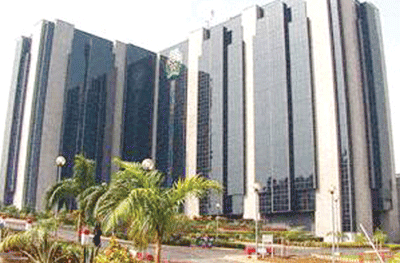
The Central Bank of Nigeria head office in Abuja.
By Omoh Gabriel, Business Editor
Aggrieved shareholders of Spring Bank,one of the nationalised banks, Messrs Dapo Adeyemi-Bajo, Emmanuel Olayinka Sogelola, Mrs Regina Udomesiet, Noah Ekanem, Promise Iwezor, have sued the Central Bank of Nigeria for taking over three of the eight rescued banks in the country.
They are asking the court to award them in particular the sum of N110 billion being damages for the colossal loss suffered by the shareholders of Spring Bank as a result of the poor management and control of the bank by CBN and NDIC when they forcefully intervened in the affairs of the bank.
In a suit filed on their behalf by S. C Ukairo of Ogunsanya and Ogunsanya Chambers at the Lagos High Court (FHC/L/CS/1072) dated 13th September 2011,the aggrieved shareholders are equally seeking a declaration from the court that the purported acts of the CBN whether in the form of selling, nationalising, revoking the bank’s licence, alienating, renaming and or in any manner whatsoever, transferring the bank’s business operations, investment or affairs to the NDIC and AMCON, is unjustified, unconstitutional, illegal, utra vires and therefore null and void.
They are praying the court to set aside, reverse, nullify and or invalidate in its entirety all steps or actions taken by the CBN regarding the affairs and business of the bank on or about 5th day of August, 2011.
They are asking the court to issue an order of perpetual injunction restraining the CBN, its servants, agents, officers and or privies from taking further steps and actions whether by appointing directors, non- executive members of the board of the bank and or inviting or procuring 3rd parties for the purpose of acquiring interest/ownership of the bank or any other acts prejudicial to the interest of the shareholders of the bank among others.
In their fifty-point claims, they are asking the court to compel the CBN and Enterprise Bank to jointly and severally whether by themselves, servants, agents, officers and privies render account of their dealings in the affairs of the bank from June 2007 till the time judgment is delivered in the suit.
They have also asked for an order that a general meeting of the shareholders of the bank be convened for the purpose of considering the account to be rendered by the CBN and Enterprise Bank in their dealings in the affairs and business of Spring Bank and the election of the directors and Board of Spring Bank and that the post-merger adjustment of the federating banks be implemented forthwith.
Joined as defendants in the suit are Central Bank of Nigeria (CBN), Nigerian Deposit Insurance Corporation (NDIC), Asset Management Corporation of Nigeria (AMCON), Enterprise Bank Ltd., the Hon. Minister of Finance, the Attorney- General of the Federation, Deutsche Bank AG and Stanbic/IBTC Bank PLC.
In their statement of claims filed at the Lagos High Court, the shareholders avowed that by virtue of the consolidation exercise in the banking industry in Nigeria in 2005, under the control and supervision of CBN, the six legacy banks that merged to form Spring Bank (Guardian Express Bank Plc, Citizens International Bank Plc, Omega Bank Plc, Fountain Trust Bank Plc, Trans International Bank Plc and African Continental Bank Plc) started the process of merging into an entity called Spring Bank Plc which merger has remained inconclusive till date.
It is on record that during the merger, precisely on the 31st day of December, 2005, CBN approved that the six legacy banks had the following shareholders’ fund positions viz: Guardian Express Bank Plc -N9.58 billion, African Continental Bank Plc – N0.42 billion, Citizens International Bank Plc N7.6 billion, Omega Bank Plc – N9.53 billion, Fountain Trust Bank Plc – N0.81 billion, Trans International Bank Plc – N2.1 billion.
At the end of the consolidation exercise, the federating banks had to agree to a temporary ownership, management and Board structure of the bank subject to the conclusion of the post-merger adjustment, which essentially will be a detailed due diligence on each other’s books, and then a more permanent ownership management and Board of the bank will emerge.
They claimed that “as at the deadline of the consolidation exercise, the total shareholders’ fund of the emerging Spring Bank was N30.77 billioln, as was duly confirmed and or certified by CBN at the all parties meeting held at CBN on 20th December, 2005.
Ironically, CBN in its report of its Maiden Examination of the emerging bank claimed that as at 30th June, 2006 (exactly 6 months after its merger on 31st December, 2005) that the bank’s shareholders’ fund was negative N59.74 billion.
In particular, as part of the Maiden Examination Report, CBN prepared a Post-Merger Adjustment Schedule that showed that the shareholders’ fund of the bank has been negative to the tune of N47 billion as at 1st January, 2006, which was a day after the various federation legacy banks shareholders of the bank sanctioned the merger based on CBN’s representation on 20lh December, 2005.
According to them, “Despite the shocking and bewildering position of CBN, the nascent bank management was committed to making the best out of the bad situation which indeed, reflected in the improved liquidity ratio from 32.5% in January 2006 to 58.10% in June, 2006, which growth continued up till June, 2007 when CBN again intervened by removing the Board of the bank and replacing it with its appointed interim Management Board excluding the participation of the shareholders of the new bank.
“CBN’s intervention was predicated on the perceived disagreement over the post-merger adjustment being undertaken in fulfillment of the requirements of the Merger Heads of Agreement as opposed to the financial condition of the bank which remained strong, a fact which was acknowledged by the Governor of CBN in his issued statement of 12 June, 2007” which said: “Sequel to the developments as stated, the bank’s Board was immediately replaced with a 7-man Interim Management Board by CBN.
The new Board had clear Terms of Reference which included recapitalising the bank and turning it around.” During the process, it became obvious that the implementation of the post- merger adjustment was a major challenge to the recapitalisation of the bank, as the post-merger adjustment was fundamental in determining the “true and substantive owners” and or the standing of the federating banks which could only be ascertained by completing the post-merger adjustment.
The necessity of completing the post-merger adjustment to achieve a credible recapitalisation of the bank was acknowledged by CBN in an all parties meeting at CBN on 13th March, 2007, which led to the sending of a team from CBN and NDIC to finalise the post-merger adjustment by resolving certain aspects of the disagreement between the legacy banks.
“Further, the Interim Board of the bank via its letter of April 21st 2008, made its final report to the management of CBN and amongst other things made its recommendations on the post-merger adjustment and in particular, pointed out that “it was of the firm belief that there can be no effective resolution of the bank’s crisis without putting to rest the issue of post-merger adjustment.
The Interim Management Board further pointed out in its said final report that its effort in making recommendations on the post- merger adjustment was consistent with Item No. 13 of the Terms of Reference, which empowered it to “take any other actions considered necessary to achieve” the turnaround of the Bank”.
They further stated that “The CBN in its letter of August 14, 2008 acknowledged receipt of the Interim Board’s Final Report of 21st April, 2008 and subsequently directed that a revised report be submitted to it within a week ref1ecting some observations it had made, unfortunately, it never followed the post-merger adjustment to logical conclusion.
“Surprisingly, rather than premise the bank’s future on the approval and implementation of the post- merger adjustment submitted and as agreed with CBN, the CBN- imposed Interim Board soon began to talk of getting a new core investor into the bank along with the possibility of causing a takeover by another bank neglecting the implementation of the post-merger adjustment.
Subsequently, in December 2008, the Interim Management Board handed over control of the bank to Bank PHB surprisingly on a Sunday in a purported successful acquisition exercise; therefore, the implementation of the post-merger adjustment was jettisoned.
“As a further show of bias against the shareholders of the bank and flagrant disregard to the order of court restraining it, the CBN on 18th December, 2008, approved the Bank PHB-led Board which comprised only nominees of Bank PHB and two existing members of the Interim Board, to the complete exclusion of representation by other existing shareholders who accounted for at least 45% of the banks.
Thus, Bank PHB accounted for 100% of the Board membership with less than 55% holding while other shareholders had zero representation with over 45% holding, yet CBN approved such proposition without any reservation.
The Bank PHB purported acquisition of the bank has been fought vigorously and decisively by the shareholders of the bank by both petitions and court action wherein the shareholders maintained amongst other things that the acquisition could not be allowed in view of the pending post- merger adjustment which remains unimplemented.
“That the then Honourable Minister of State for Finance in addressing the issues raised in the petitions by its letter of 31st March, 2008 to the then President of the Federal Republic of Nigeria, the late Alhaji Shehu Musa Yar’adua, amongst other things, recommended and emphasised an all parties meeting for the purpose of implementation of the post-merger adjustment.
“The Bank PHB purported acquisition of the bank has been declared illegal and null and void by the Honourable Court in Suit No. FHC/L/CS/5294/08 and the court further granted an order of injunction restraining CBN from changing or taking any steps towards the changing of the name, logo, title, properties, and names of properties to any other name, logo or title other than Spring Bank PLC pending the determination of the suit.
“The combination of the tenor or the Interim Management Board and the Bank PHB -led Board, which took over the management of the bank against the express wish of the shareholders, resulted in further deterioration of the bank’s sharcholders’ fund position to whopping negative sum of N96 billion.
In effect, the CBN directly or indirectly (through Bank PHB and its imposed Interim Management Boards) worsened the bank’s position by as much as negative N73 billion.
That in essence, therefore, when the N37 billion capital shortfall imposed on the bank by the CBN- imposed Interim Management of one of the legacy banks at merger in December, 2005 is added to the N73 billion deterioration that took place when the Management of the bank was handed over to Bank PHB-led CBN-imposed acquisition, the total damage done to the bank on account of the tenor of CBN in the bank (directly and indirectly) amounts to N110 billion in shareholders’ fund.
“It is glaring that in nearly 6 years of the bank’s existence, it was under the control of the shareholders for only about one and half years, that is to say from January 2006 to June 12th 2007 and based on the CBN maiden examination report, the bank recorded a loss of N3.56 billion during the period whereas the rest of the deterioration of’ the shareholders’ funds was caused and or induced by CBN and its agents imposed on the bank.
“The CBN and its imposed Interim Management Boards never allowed the shareholders of the bank to recapitalise and or given a platform for the recapitalisation even as it acknowledged the fact that the post- merger adjustment is crucial to ascertain the true owners of the bank who can then be relied upon to bring forth a credible recapitalisation plan.
“The CBN in disguise as a regulatory body had a field day destroying the bank by imposing its agent with questionable competence and motives inconsistent with those of the owners of the bank, thereby rendering the shareholders incapable of calling for and or convening a general meeting of shareholders of the bank for the purpose of taking to any other name, logo or title other than Spring Bank
“That by their letter of 14th December, 2010, the CBN’s Financial Advisers informed/notified the Group that it has been excluded from further participation in the recapitalisation process. It is evident that the CBN’s Financial Advisers had no reasons and have indeed, offered no reason whatsoever till date for the exclusion of the Group from the recapitalisation exercise.
The exclusion of the Group who had a genuine interest and likelihood of success in the recapitalisation process by the CBN’s Financial Advisers can only be said to be pre-meditated and a clear indication of a pre-determined agenda against the Group, more so, the CBN’s Financial Advisers’ letter of 141h December, 2010 made no reference to Phase Il of the recapitalisation process thereby, creating an impression that the Group never participated in Phase II of the process, which shows that the Financial Advisers had something to hide.
“It is the case of the Claimant that the orchestrated failure of the shareholders to recapitalise the bank by CBN is a smokescreen, figment of imagination of management of CBN and a foul-cry fabricated to paint the shareholders black.
“That on or about the 5th day of August, 2011, even before the 30th September, 2011 recapitalisation deadline, CBN/NDIC announced to the whole world of the nationalisation, acquisition, sale and or transfer of the business and affairs of the bank to NDIC and or Enterprise Bank under the disguise that the shareholders of the bank had made no attempt to recapitalise the bank.
That the acts of the CBN and NDIC with the active support and approval of the other Defendants in nationalising, selling, acquiring and or transfering the affairs and business operations of the bank in all ramifications, are against the due process of law, even as it was done in flagrant disrespect to order of injunction in Suit No. FHC/L/CS/5294/08.
The CBN, NDIC, and or AMCON’s interference in the management, control and or in acquiring, nationalising, selling and or transferring the business operations, investments and affairs of the bank as herein complained of are not for the benefit of the bank nor its shareholders but solely for the private benefit of the CBN, NDIC, AMCON officials and their agents, privies and cronies and in order to dispossess the shareholders of the bank, particularly the plaintiffs of their investments or propriety rights to the bank.”
Disclaimer
Comments expressed here do not reflect the opinions of Vanguard newspapers or any employee thereof.